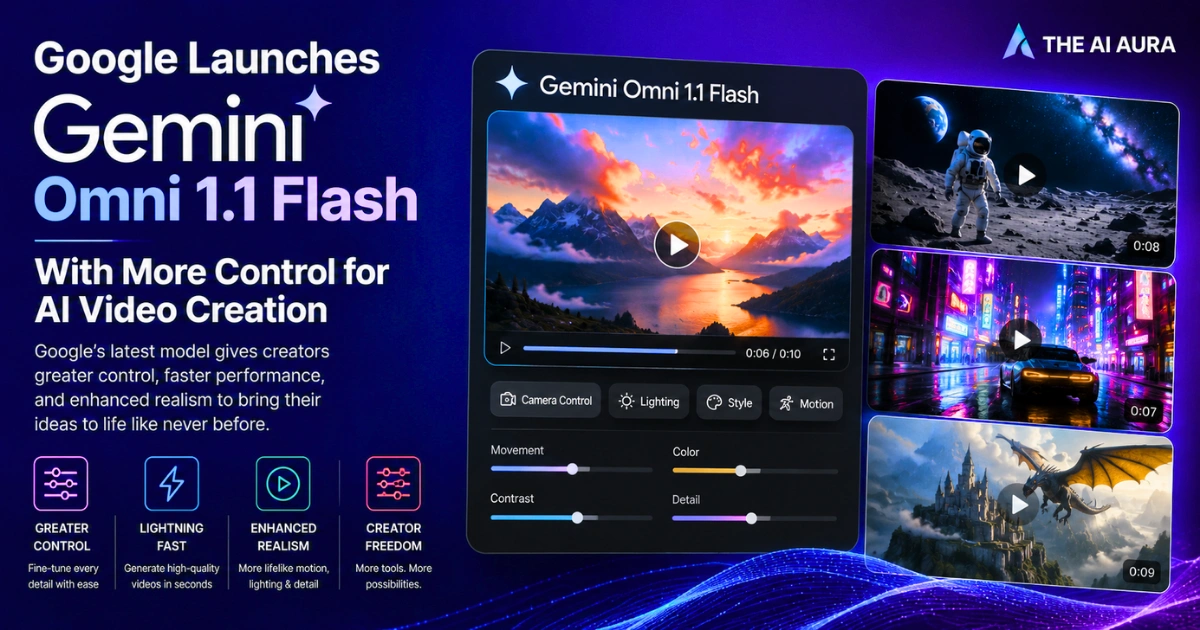

The generative AI video space just shifted gears again. Google has officially dropped Gemini Omni 1.1 Flash, actively pivoting the technology from an experimental novelty into a production-grade asset.
Having spent years dissecting AI frameworks and their practical applications, I can see exactly what Google is targeting here: professional, granular control.
Until recently, generating video via AI felt a bit like pulling the lever on a slot machine. You might hit the jackpot with a breathtaking short clip, but trying to build a cohesive narrative sequence was notoriously frustrating.
With this new release, now accessible via the Gemini API within Google AI Studio, the focus is squarely on giving developers and software architects the creative steering wheel.
We are moving past random visual generation and entering an era of structured, iterative workflows explicitly tailored for high-end media editing software.
The Mechanics Behind the Upgraded Context Window
To understand why this update matters, we have to look at how video generation models actually process sequential data. The fundamental bottleneck in earlier architectures was a severe lack of short-term memory.
If you wanted to extend a generated clip, older models typically only analyzed the final second or sometimes literally just the final frame of your existing footage to calculate what should happen next.
This constraint caused severe hallucination drift. Characters would inexplicably change outfits mid-step, backgrounds would morph into unrecognizable shapes, and the basic physics of the scene would completely fall apart.
Gemini Omni 1.1 Flash actively rewrites this limitation by expanding the model’s analytical context window to a full 10 seconds of prior footage. From a technical engineering standpoint, this means the neural network is ingesting a significantly larger temporal dataset before rendering the next sequence of frames.
By holding a full 10 seconds of motion, lighting continuity, and object permanence in its active memory, the model anchors its next generation to a much firmer reality.
Google refers to this as integrating “real-world reasoning” into generative creation. For developers building the next generation of creative tools, this directly translates to vastly improved visual consistency. You are no longer just generating an isolated cool visual; you are enforcing the narrative adherence that professional production environments strictly demand.
Scene Extension and the 40-Second Narrative Horizon
The most immediate, practical application of this upgraded memory architecture is the refined Scene Extension capability. If you are developing generative video workflows, the ability to iterate on a concept without losing the core visual thread is everything.
Omni 1.1 Flash allows users to take a base video and seamlessly push the story forward in fluid, highly controlled 10-second increments.
Because the model natively understands the physics, momentum, and context of the previous 10 seconds, the splice points between generations become incredibly smooth.
A developer can prompt the API to continue the exact same camera trajectory, or they can intentionally instruct it to branch off into a completely new creative direction, knowing the foundational elements of the scene will remain stable.
Google has currently capped this cumulative extension capability at 40 seconds. While that duration might sound brief to a traditional filmmaker, in the realm of computational video generation, a visually locked, 40-second continuous shot represents a massive engineering leap.
It provides software builders and media editors with a polished, reliable canvas, finally eliminating the need to endlessly stitch together disjointed micro-clips. It is a highly deliberate step toward making AI video fundamentally useful for actual storytellers.
Source: Official Google Blog, "Gemini Omni 1.1 Flash Lets You Build With More Control"