

The initial euphoria surrounding the artificial intelligence boom is meeting a cold, hard economic reality. Across trading floors from Wall Street to Seoul, a profound sell-off in AI-related equities has wiped substantial value from the world’s leading semiconductor manufacturers.
Investors who spent the last eighteen months throwing capital at anything vaguely associated with generative models are suddenly pausing to ask hard questions about return on investment and capital expenditure limits.
The Global Sell-Off and Market Mechanics
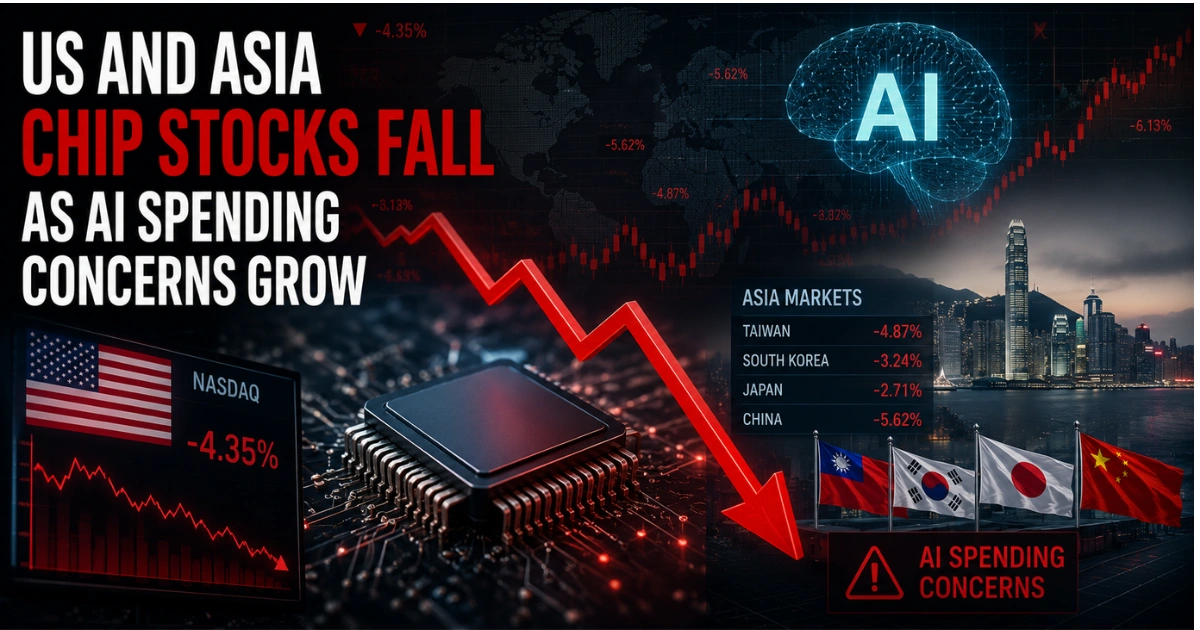
The sheer velocity of the pullback became glaringly obvious in Asian markets this week. South Korea’s benchmark Kospi index suffered a brutal trading session on Tuesday, sliding 8% early in the day and triggering a 20-minute circuit breaker designed to halt panic selling.
When the freeze lifted, the bleeding continued, with the index ultimately closing 10.8% lower. The damage was concentrated heavily in the technology sector, with semiconductor titans Samsung Electronics and SK Hynix leading the downward charge by each plummeting more than 13%.
This volatility is not an isolated event for Seoul. The tech-heavy Kospi has been subjected to multiple circuit-breaker interventions this year, exacerbated by a massive influx of retail investors who have magnified market swings.
While the index more than doubled between January and mid-June, it has since surrendered roughly a third of its value in a dizzying correction. SK Hynix felt the pain on two fronts.
Its US-listed shares tumbled 7.5% on Monday, dropping well below the $149 offer price set during its highly anticipated Nasdaq debut just weeks earlier on July 9.
Japan’s tech-dominated Nikkei 225 mirrored this anxiety, closing almost 4% lower. However, the epicenter of the tremor originated in New York. Nvidia, the undisputed poster child of the AI hardware revolution, dropped 5% on Monday.
The decline cost Nvidia its position as the world’s most valuable listed company and returned the top spot to Apple.
Meanwhile, Apple’s shares have climbed 25% this year. As a result, investors appear to be favoring established consumer technology companies over pure AI infrastructure plays.
Reports that Nvidia is discussing a potential $250 billion investment in OpenAI’s data center project added to the selling pressure.
Although the plan reflects strong confidence in AI, many institutional investors are questioning whether such massive infrastructure spending can deliver sustainable returns.
Rising Competition and the ROI Reality Check
At the core of this market correction is a fundamental shift in investor psychology. The market is transitioning from a growth-at-all-costs phase to one demanding strict capitalization logic.
The sheer volume of money being poured into data centers, specialized silicon, and power grids is raising red flags about monetization bottlenecks.
Jun Bei Liu, founder of the investment firm Ten Cap, noted that investors are increasingly concerned about the astronomical sums required to train and run next-generation models, leading many to take profit off the table while they wait for hardware expenditures to translate into actual software revenue.
Adding fuel to these anxieties is the rapidly shifting geopolitical landscape of semiconductor manufacturing. While Western and allied Asian firms face valuation pressure, China is aggressively advancing its domestic silicon capabilities.
Meanwhile, shares of ChangXin Memory Technologies (CXMT), China’s largest memory chip maker, surged nearly 470% during their Shanghai market debut on Monday.
The company produces DRAM chips for AI data centers and consumer electronics. It plans to use the proceeds from its initial public offering to expand production and accelerate research and development.
The successful debut suggests Chinese chipmakers are closing the technology gap. As they expand domestic production, global competition is expected to increase. Consequently, the semiconductor market could also face a higher risk of oversupply.
Demand for AI hardware remains strong. However, investors are becoming more selective instead of expecting automatic gains from every semiconductor stock.
Analysts expect capital to return to semiconductor stocks after the U.S. holiday season as investors reassess company earnings. However, they are likely to focus more on profitability and long-term growth than on AI hype alone.
Source: BBC News, "US and Asia Chip Stocks Fall as AI Spending Concerns Grow"