
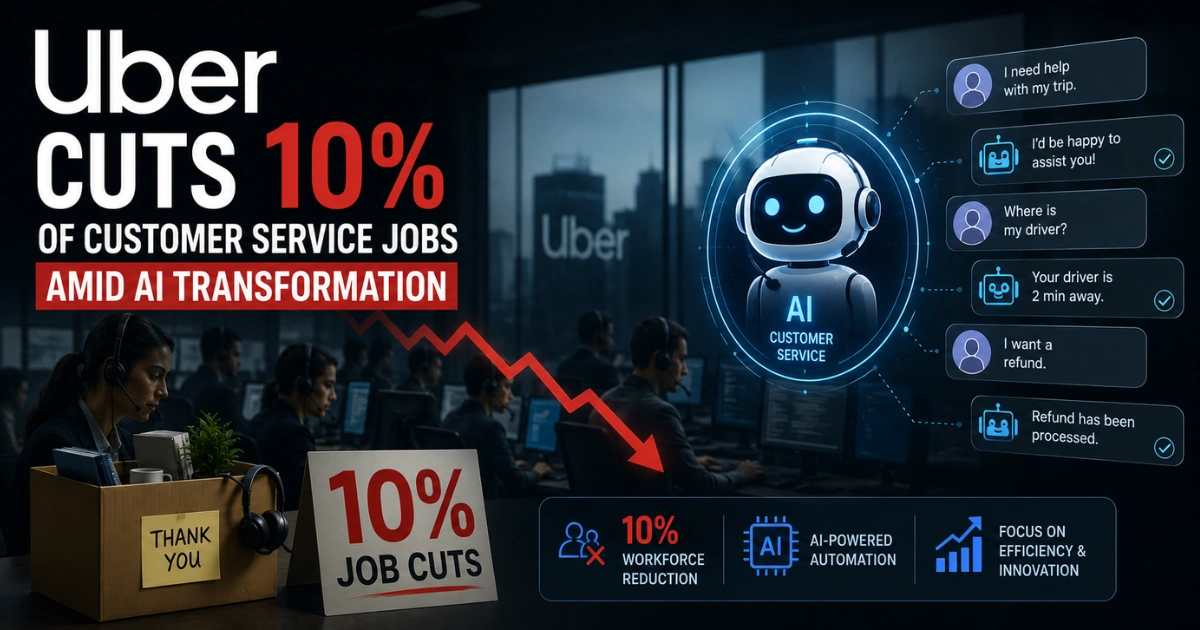

Artificial intelligence is no longer just improving customer support—it is reshaping how support organizations are structured.
Uber’s decision to cut 10% of its Community Operations workforce, the division responsible for global customer service, reflects a broader shift taking place across the technology industry.
Rather than treating AI as an add-on, companies are redesigning their operations to work alongside intelligent automation.
Unlike traditional layoffs driven by slowing revenue or economic conditions, Uber has directly linked these job cuts to its long-term AI strategy. The move highlights an important reality: deploying AI at enterprise scale often requires rebuilding workflows before automation can deliver meaningful results.
Why Uber Is Restructuring Its Customer Support Teams
Over the past decade, Uber expanded rapidly across countries and services, creating separate support teams for riders, drivers, delivery partners, and regional operations.
While this structure worked during periods of hypergrowth, it also created fragmented workflows, inconsistent policies, and isolated management systems.
In an internal memo, Uber Vice President of Global Community Operations Megha Yethadka explained that the organization had become “too complex and siloed” to fully embrace AI.
Her message reflected a common challenge facing large enterprises: AI performs best when it operates on standardized processes and consistent data.
For example, if dispute resolution follows different procedures across regions, AI systems struggle to apply decisions reliably. Before automation can handle customer interactions at scale, businesses first need unified rules, shared knowledge bases, and streamlined operations.
Building the Foundation for AI-Powered Customer Support
Modern AI support agents depend on structured data and consistent workflows. Whether handling refunds, account issues, or delivery disputes, AI systems require a single source of truth rather than multiple disconnected processes.
By reducing organizational complexity and consolidating teams, Uber is creating the operational foundation needed for AI-assisted customer service. The restructuring is less about replacing employees directly and more about simplifying the business so automation can work effectively.
Routine customer requests are increasingly expected to be handled by AI, while human support specialists focus on complex cases that require judgment, negotiation, or empathy.
Why Uber Is Bringing Employees Back to Office Hubs
Alongside the workforce reduction, Uber is also requiring many remote customer support employees to relocate to designated office hubs.
This decision aligns with the company’s AI strategy. As automation handles repetitive tickets, the remaining workforce will increasingly manage difficult customer escalations involving multiple departments. These cases often require faster collaboration between operations, engineering, legal, and trust and safety teams.
Uber believes centralized teams can resolve these high-priority issues more efficiently than distributed remote teams, especially as AI becomes responsible for first-line support.
What This Means for the Future of Customer Service
Uber’s restructuring reflects a broader trend across the technology sector. AI adoption is not simply about deploying new software—it often requires companies to redesign their organizational structures, simplify internal processes, and redefine employee responsibilities.
Rather than eliminating customer service altogether, AI is shifting human workers toward higher-value tasks while automating repetitive interactions.
Companies that successfully standardize their operations are likely to adopt AI more quickly, while organizations with fragmented systems may struggle to realize its full benefits.
Uber’s latest workforce reduction illustrates that AI transformation extends far beyond technology. It is increasingly becoming an organizational redesign, changing how companies operate before automation can scale effectively.
Source: Moneycontrol, "‘Too Complex and Siloed’: Uber Cuts 10% of Customer Service Jobs, Citing ‘Embrace’ of AI"