
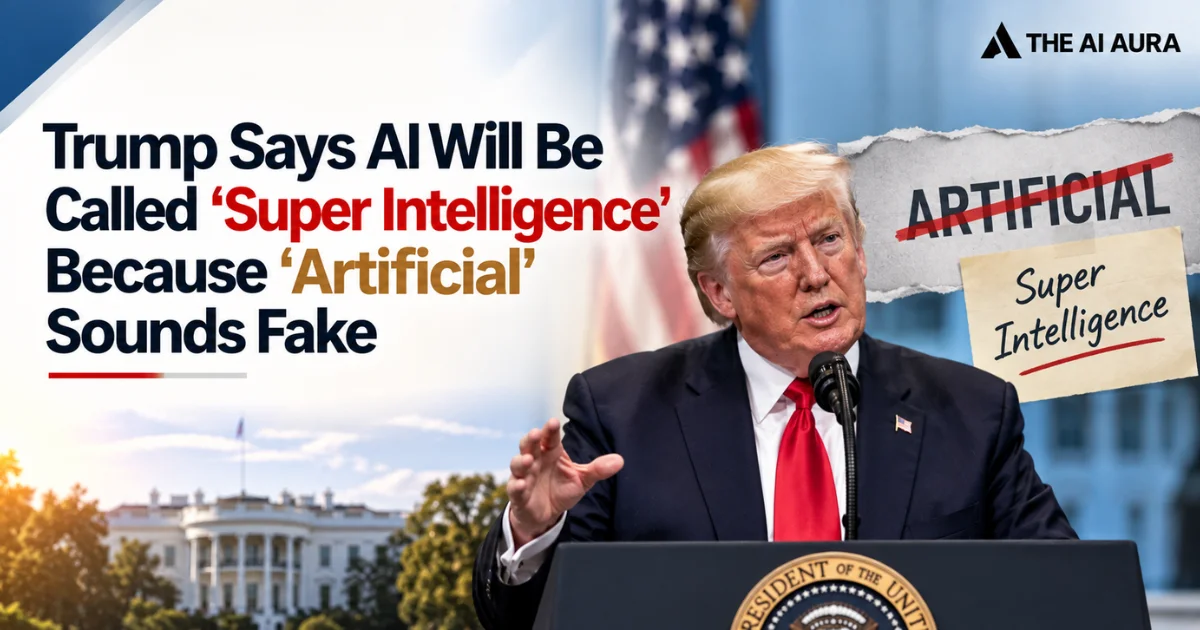

US President Donald Trump announced a major change during a speech at the United Nations General Assembly. The federal government will stop using the term “artificial intelligence.” Instead, all official federal documents will use the term “super intelligence.” This move swaps the popular acronym AI for SI.
The president’s rationale stems from a belief that the current nomenclature undermines the profound reality of the technology.
To him, the word “artificial” incorrectly implies that the resulting machine intellect is somehow fake or contrived.
Instead, he argued that this computational power is not only genuine but “amazing,” prompting a need for a name that reflects its true capability rather than downplaying it a debate that closely mirrors broader discussions surrounding what artificial general intelligence actually is and where the technology stands today.
The Push for an AI Force and Unrestricted Growth
This rebranding matches Trump’s plan to boost the American tech sector. He wants to protect tech firms from heavy regulations. Before his speech, Trump announced plans on Truth Social to launch a new “AI Force.” An appointed AI czar will lead this group. Rather than restricting tech development, the team will expand domestic computing infrastructure.
He strongly pushed back against critics of the massive data centers required to train and run these complex models, framing the opposition as an attempt to destroy a vital American industry.
According to a recent report by NDTV, Trump has dismissed the escalating doomsday warnings surrounding advanced computing capabilities as nothing more than a “globalist scheme.”
He directly compared the chorus of technologists warning about existential threats from intelligent machines to the scientific consensus on climate change, categorizing both as orchestrated hoaxes meant to stifle United States economic and technological growth. The administration’s stance is that the technology should be cherished, guided, and cultivated rather than hindered by panic over theoretical disasters.
Navigating Global Concerns and the Geopolitical Tech Race
Trump’s commitment to unbridled technological advancement stands in stark contrast to the growing international movement toward strict oversight. Ahead of the high-level meetings in New York, leaders from more than two dozen nations issued urgent calls for binding global safety measures.
Their primary concern is that the rapid evolution of autonomous systems could easily outpace humanity’s ability to implement effective fail-safes and control mechanisms a technical challenge directly addressed by researchers studying the AI alignment problem and why even smart models fail.
The international community is increasingly anxious that prioritizing sheer computational power over rigorous safety frameworks could lead to unintended global consequences.
However, the White House views this debate as a race against China. Officials believe that heavy regulations will help foreign rivals.
Currently, Washington and Beijing are negotiating a shared communication channel to manage tech risks. These talks prepare both nations for an upcoming summit with Chinese President Xi Jinping.
For Trump, winning the race in “super intelligence” remains the top goal. He believes deregulation will secure American dominance in the digital age.