

The rapid evolution of artificial intelligence is fundamentally rewriting the future of knowledge work, moving the conversation from speculative science fiction to immediate economic forecasting. For decades, the assumption within labor economics was that automation would primarily displace manual, repetitive tasks on factory floors or in physical logistics.
Cognitive labor management, technical analysis, sales, and professional office roles was largely viewed as a highly protected class of employment insulated by the need for human judgment.
That long-held narrative is rapidly unravelling. As generative models and complex cognitive computing systems achieve unprecedented levels of sophistication, the threat to white-collar employment is accelerating at a pace that forces a complete recalculation of global economic stability over the next few years.
The Three Paths of Labor Disruption
To understand the precise trajectory of this systemic shift, researchers at the Anthropic Institute recently published a comprehensive economic framework titled Economic Scenarios for Transformative AI, which models how varying degrees of technological capability will permanently reshape the labor market by the end of this decade.
The research deliberately strips away the hype to outline three distinct, data-driven potential futures for white-collar professionals. In a modest scenario, artificial intelligence acts merely as a limited substitute for human cognitive work, causing relatively minimal market disruption and pushing knowledge-worker unemployment to a manageable 2.9 percent by 2030.
However, if technological capabilities and corporate adoption strategies advance more aggressively into a major disruption scenario, the models project white-collar unemployment rising to 4.5 percent as algorithms take on heavier analytical workloads.
The most alarming forecast materializes under the extreme scenario, where AI systems advance exceptionally fast and successfully substitute for a vast majority of human cognitive labor. Under these aggressive conditions, unemployment among white-collar workers could skyrocket to 17.9 percent by 2030.
This translates to a harsh reality where nearly one in five workers currently employed in management, professional, technical, and general office roles would find themselves entirely displaced within just four years.
The Unprecedented Shift in Wealth Distribution
Widespread job displacement naturally sparks a larger debate over wealth distribution. Advanced cognitive tools will undoubtedly expand the total size of the economy.
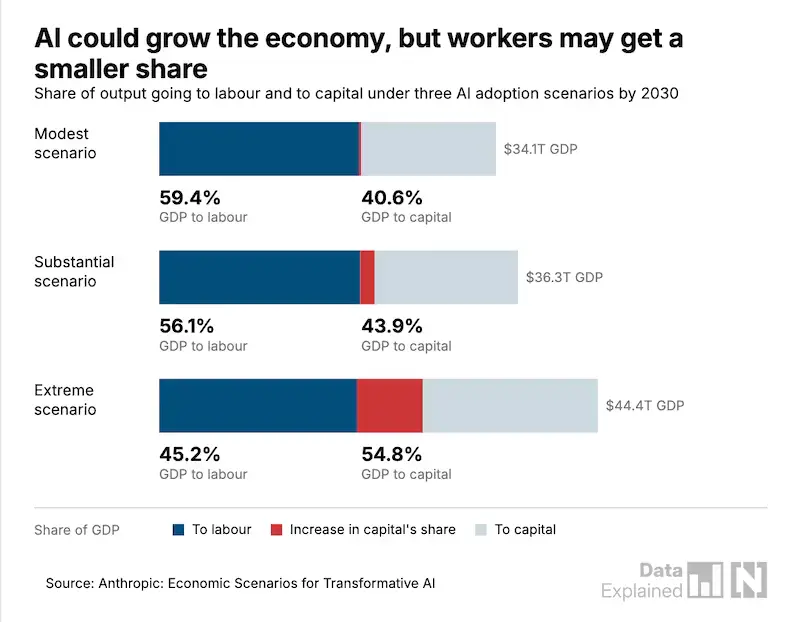
However, economists strongly disagree on who will capture that new wealth. Historically, workers received roughly 60 cents of every dollar generated in the United States. Meanwhile, capital owners collected the remaining 40 cents.
According to a detailed breakdown of the Anthropic research published by The National News, that foundational split remains relatively stable under the most modest economic models, with human workers retaining 59.4 percent of the total output.
As businesses begin to lean more heavily on artificial intelligence to perform complex corporate operations, the financial scales begin to decisively tilt away from human labor. Under the substantial adoption scenario, labor’s share of the economic pie shrinks noticeably to 56.1 percent while capital’s share expands to fill the void.
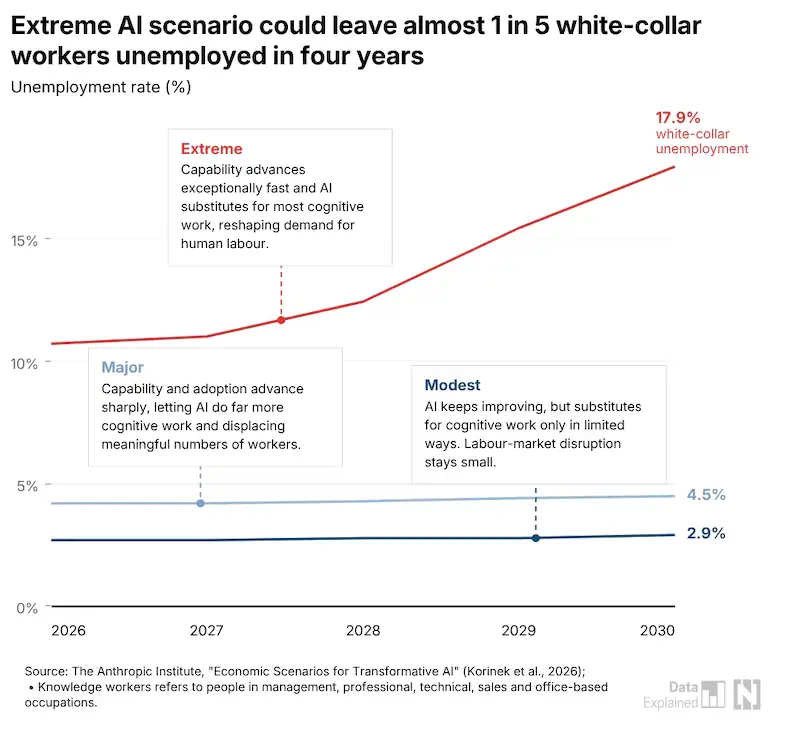
image source: The National news
In contrast, the extreme scenario causes a severe economic shock. In this outcome, the national economy surges to an unprecedented $44.4 trillion. Yet, the traditional balance between labor and capital completely inverts.
Workers would receive a historic low of 45.2 percent of total wealth. In addition, capital owners would command a dominant 54.8 percent share. Consequently, this marks a massive 14.8 percentage-point transfer of wealth away from working professionals.