

When you observe the global IT services sector over the long term, you learn to spot the subtle moments when an industry heavyweight fundamentally changes its operational DNA.
For decades, Tata Consultancy Services (TCS) played a highly predictable, aggressively profitable game: hire recent graduates by the tens of thousands, train them rigorously in-house, and drive growth organically.
The company famously avoided the massive acquisition sprees that its global competitors frequently used to buy market share.
However, the market dynamics of late 2025 forced a strategic recalibration. The Mumbai-based powerhouse is now actively evaluating acquisitions across artificial intelligence, data security, and cybersecurity.
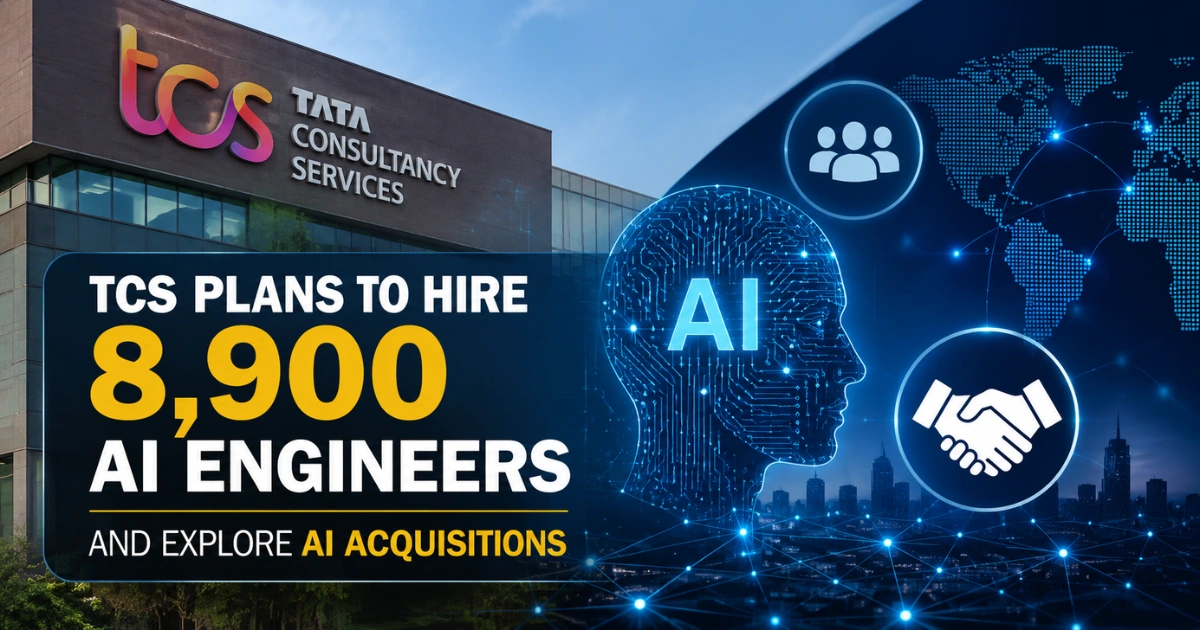
When combined with its acquisition strategy and plan to build a dedicated team of up to 8,900 AI engineers, TCS is making a clear statement. The company is no longer just adapting to the AI wave. It aims to shape how enterprise AI is deployed.
As an analyst watching this deployment cycle, the mechanics of this pivot make perfect sense. We have moved past the initial hype cycle of generative AI. Enterprise clients are no longer asking IT vendors for basic proof-of-concept chat interfaces.
They are demanding production-grade AI systems that can ingest vast amounts of proprietary corporate data securely, automate complex supply chain decisions, and interface seamlessly with legacy software architectures.
Meeting this demand requires highly specialized talent. Internal training alone cannot build those skills quickly enough, even for a company with more than 600,000 employees.
TCS clearly views AI not as a disruptive threat that will cannibalize its billing hours, but as a massive greenfield opportunity that will create entirely new business verticals.
From Organic Strategy to Targeted Buyouts
The decision to abandon a strictly organic growth model in favor of targeted acquisitions highlights the sheer velocity of the AI market. By acquiring niche AI and cybersecurity firms, TCS instantly secures proprietary technologies and the elite engineering teams behind them.
In the enterprise sector, AI deployment is fundamentally a data security issue. You cannot implement generative models without bulletproof cybersecurity frameworks to prevent data leakage.
Targeting acquisitions in both AI and security simultaneously shows TCS is buying the exact capabilities needed to make AI structurally safe for heavily regulated industries.
The 8,900-Strong Deployment Force
Committing to a focused unit of 8,900 AI engineers represents a shift from generalist IT support to highly specialized execution.
While basic AI literacy across a massive workforce is useful, actually deploying enterprise AI requires deep technical expertise—engineers who understand vector databases, model fine-tuning, and algorithmic governance.
This team acts as a specialized deployment engine for global clients who are currently stuck trying to navigate the journey from prompt to production and scale their AI pilot programs.
It reinforces the company’s core bet: AI is going to generate massive new engineering workloads rather than simply automating existing jobs.
This dual approach—buying specialized capabilities while aggressively hiring targeted talent—places TCS in a unique position. They are essentially building a bridge between the rapid innovation of AI startups and the rigid, compliance-heavy realities of Fortune 500 boardrooms.
The companies that win the next decade of IT services won’t necessarily be the ones that invent the best foundational models; they will be the ones that figure out how to deploy them securely at scale.
Source: Moneycontrol, "Tata Consultancy Services Plans up to 8,900 AI Deployment Engineers, Seeks AI Acquisitions"