
India’s IT services sector is currently operating in a highly contradictory climate. Enterprise clients remain intensely defensive regarding discretionary budgets, heavily scrutinizing infrastructure costs and delaying project closures. Simultaneously, the urgency to deploy generative and agentic AI architectures is forcing an immediate reallocation of capital.
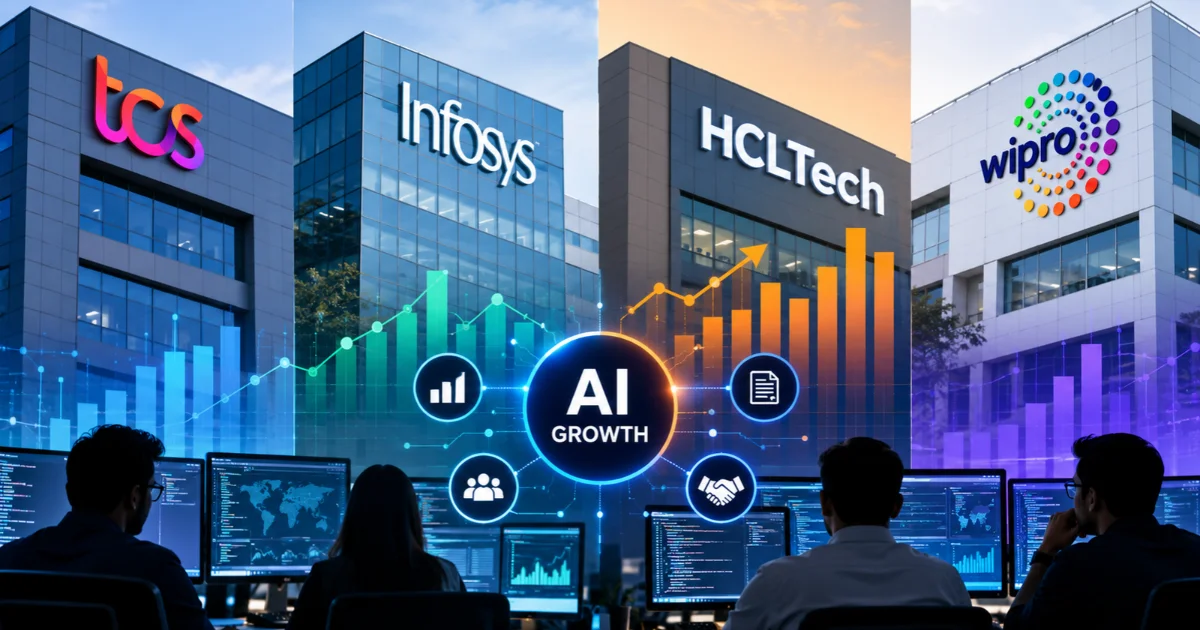
The September quarter results from Tata Consultancy Services, Infosys, HCLTech, and Wipro expose exactly how unevenly these four technology giants are navigating this transitional phase. The reported figures reveal a stark split between traditional operational resilience and the complex reality of integrating artificial intelligence into legacy enterprise workflows.
Revenue Realities and the Talent Pipeline
Looking strictly at sequential constant-currency growth, HCLTech managed to outmaneuver its peers with a solid 2.3% expansion. This was not merely a baseline recovery from a sluggish first quarter; management actively raised the lower end of their full-year guidance, signaling structural confidence in an otherwise volatile demand environment.
They validated this outlook through aggressive talent acquisition, reversing previous workforce contractions by adding over 6,400 net employees. TCS followed a similar volumetric expansion route, leaning heavily on its sheer scale.
While their topline revenue ticked up a modest 0.5%, securing $9.6 billion in total contract value and consistently expanding headcount proves they remain the foundational capacity provider for global enterprises.
The operational friction is far more visible when examining Infosys and Wipro. Infosys posted a stable 1.2% sequential growth and pulled in $5.2 billion in deal wins, with net new contracts driving the bulk of that value. Yet, management abruptly lowered their full-year revenue forecast.
According to market analysis detailed by NDTV Profit, this guidance revision directly reflects severe weakness in discretionary spending across retail and high-tech sectors, effectively neutralizing their immediate deal momentum. Wipro continues to struggle with structural drag.
With total bookings dropping sharply to $2.6 billion and a net headcount reduction approaching 6,700 employees, the company is absorbing the brunt of delayed large-deal closures and sluggish conversion pipelines.
The AI Revenue Mirage vs. Ground Truth
The industry narrative surrounding artificial intelligence requires aggressive filtration to separate actual booked revenue from conceptual pilot projects. Every major player is positioning AI as their definitive growth engine, yet the underlying financial metrics reveal distinctly different maturity curves.
TCS is utilizing its massive global footprint to claim an annualized AI revenue run rate exceeding $3.1 billion. This metric suggests that at the top tier of enterprise adoption, clients recognize that the proof-of-concept era is dead: where 2026 AI budgets are actually going is toward integrated operational models where AI scales alongside human engineering.
Infosys delivered the most aggressive sequential leap in this specific category, accelerating 29% to hit $540 million in quarterly AI revenue.
However, their leadership accurately highlighted a critical operational dynamic that promotional industry narratives often ignore: AI deployment is actively causing revenue compression within traditional legacy services. Artificial intelligence is not exclusively generating net-new capital; it is cannibalizing older, labor-intensive maintenance contracts.
HCLTech echoed this focus on unit economics, growing its advanced AI segment to $219 million and explicitly leveraging those premium margins to offset broader operational costs and fund further reinvestment.
Wipro is attempting to pivot toward agentic AI and legacy modernization to optimize client infrastructure costs but lacks the immediate financial velocity demonstrated by its peers. As firms transition from experimental initiatives, understanding how to move from pilot project to profit engine: making AI pay off in the real world has become essential.
While AI provides a lucrative revenue stream, it demands entirely new delivery architectures and FinOps models that these firms are still actively learning to balance against their shrinking legacy workloads.