

The prevailing narrative around the artificial intelligence boom heavily fixates on silicon—specifically, high-end GPUs and server chips. However, computing power is utterly meaningless if the data cannot move fast enough.
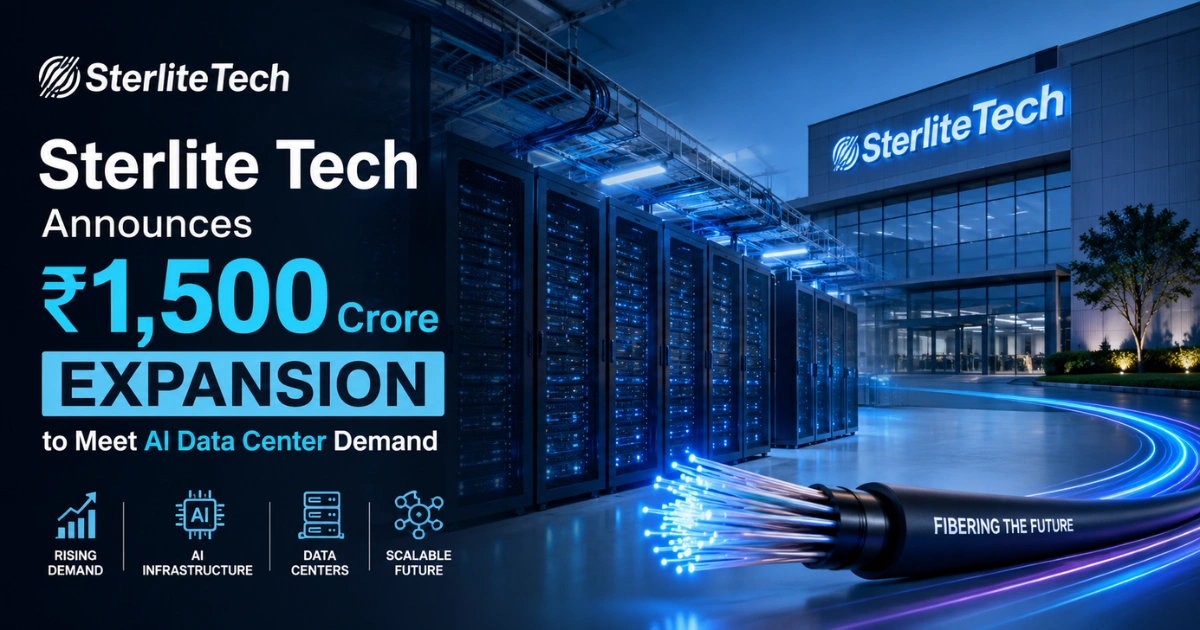
STL will invest ₹1,500 crore over the next three years to expand manufacturing capacity. The move is designed to support rising demand for AI data centres and optical networking infrastructure.
Watching the infrastructure layer of the AI ecosystem evolve, STL’s financial maneuver is a highly calculated necessity.
STL sits at the intersection of three major technology shifts: the explosive growth of AI data centers, global 5G network expansion, and the ongoing push to extend high-speed broadband access.
Backed by an order book worth approximately ₹18,000 crore, STL is expanding capacity to capitalise on what industry analysts expect to be a multi-year demand cycle for optical fibre infrastructure.
The Mechanics of the Fibre Supercycle: Why AI Needs Glass
To understand the core rationale behind STL’s massive capacity expansion, you have to look directly at the physical architecture of a modern AI data center. When training large language models or processing complex generative AI queries, a single server doesn’t do the heavy lifting.
AI workloads are distributed across compute clusters containing thousands of GPUs that must exchange data in fractions of a microsecond.
This is where conventional network infrastructure reaches its limits. Traditional copper cabling struggles to support the bandwidth required by modern AI clusters. At higher speeds, it generates more heat, consumes more power, and introduces greater latency than optical fibre.
Optical fibre transmits data as pulses of light through ultra-pure glass fibres. This enables the high bandwidth, low latency, and energy efficiency that modern AI infrastructure demands.
Inside an AI-focused facility, the sheer volume of fibre connections is exponentially higher than in a traditional cloud server farm. We are looking at massive requirements for high-density optical cables linking every single switch, router, and server rack.
The global expansion of telecom networks is also driving demand. The external “pipes” connecting hyperscale data centers to businesses and consumers must be upgraded to handle rising traffic.
STL is addressing this need with high-strand-count fibre cables. These cables fit into existing underground conduits while increasing network capacity, creating sustained demand for advanced optical solutions.
Decoding STL’s ₹1,500 Crore Playbook and ₹18,000 Crore Order Book
Capital allocation patterns reveal exactly what a company’s leadership anticipates from the market.
STL will invest ₹1,500 crore over the next 36 months to capture high-margin global infrastructure contracts. The strategy aims to expand capacity before shortages push buyers toward competing manufacturers.
Crucially, this is not a speculative “build it and they will come” expansion. The foundation of this investment rests entirely on an active, confirmed order book exceeding ₹18,000 crore.
In industrial manufacturing, a large order book reduces the risks linked to new capital investments. The demand is already locked in and contracted; the immediate challenge for STL is scaling fulfillment.
This investment will funnel heavily into two primary operational channels: scaling up raw manufacturing capacity and fortifying dedicated R&D divisions.
By expanding its manufacturing footprint, STL can reduce costs through scale. This will help the company compete better in North American and European markets, where AI infrastructure spending is growing rapidly.
Simultaneously, the R&D funding ensures they are engineering the specialized, ultra-low-loss optical products demanded by tier-one hyperscalers.
STL is actively transitioning its operational identity from a traditional cable manufacturer into a core, foundational infrastructure provider for the AI economy, aligning its output with the rigid physics of modern data transmission.
Source: Official Moneycontrol, "Sterlite Tech Plans Rs 1,500 Crore Expansion as AI Data Centres Drive Global Fibre Demand"z