
Right now, the robotics industry is stuck in a hardware-first echo chamber. Companies are spending billions to train foundation models. They rely on endless web videos or expensive motion-capture sessions with human operators.
The goal is always the same: force the robot to understand a physical task it wasn’t explicitly programmed to do.
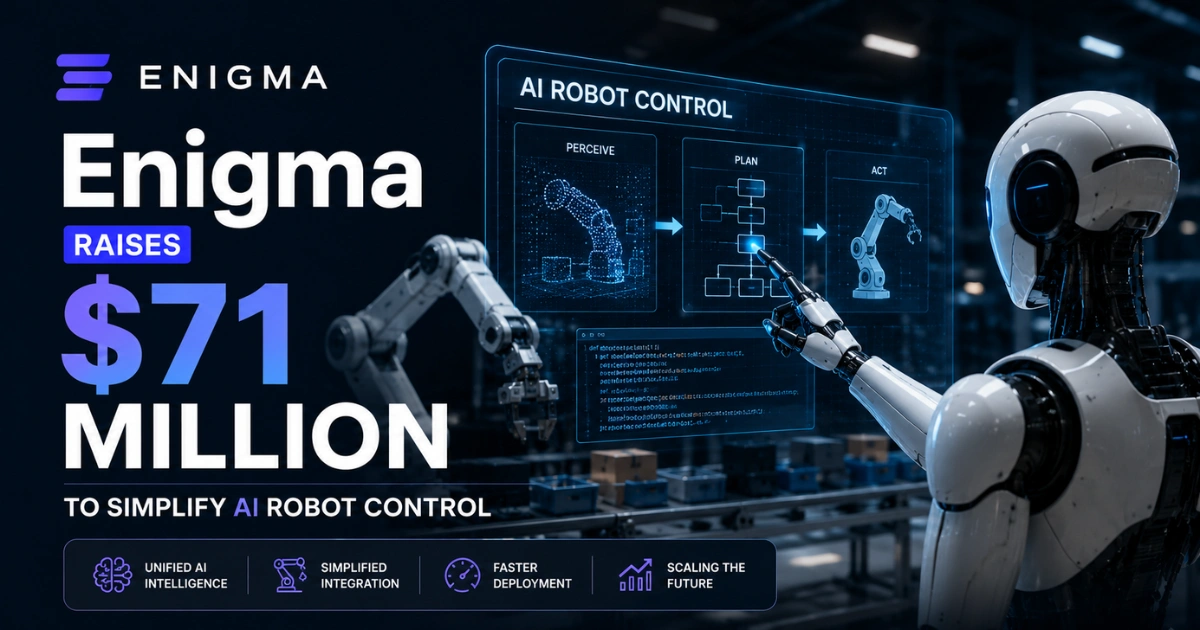
Enigma, a newly uncloaked research lab, just pulled in a massive $71 million seed round by betting against that grain. Backed by heavyweights like Index Ventures and Ribbit Capital, this less-than-a-year-old startup isn’t starting with the robot’s brain. They are starting with us.
Instead of brute-forcing capability, Enigma is stripping away the friction of human-machine communication. If it takes you fifteen frustrating minutes of prompt engineering to get an AI arm to load a dishwasher, you’re just going to wash the plates yourself. The underlying technology is useless if the interface is broken.
Flipping the Script on Embodied AI
The architects behind this pivot aren’t roboticists, which is likely their biggest advantage.
Co-founder Jonathan Jacobi was Microsoft’s youngest-ever hire. He and Gal Niv built their expertise through cybersecurity competitions and service in Israel’s elite Unit 8200.
They skipped traditional robotics veterans when building the team. Instead, they recruited Math Olympiad champions and AI researchers from leading labs.
This outsider perspective fundamentally changes how Enigma operates. While traditional players obsess over mechanical dexterity and teleoperation, Enigma’s team is obsessed with the user experience.
Jacobi’s philosophy hinges on what he calls the “volume knob” problem. When you get in a car, you don’t type in a specific percentage to turn up the radio. You just turn a physical dial until it sounds right.
It’s instant, intuitive, and frictionless. Today, controlling an AI robot is like guessing the exact volume level in a silent room. It is slow, awkward, and far from intuitive.
Enigma believes the right interface will unlock better robotics. It could rely on natural language, drag-and-drop controls, or visual cues. The goal is a faster and more efficient robotic foundation model.
The team built its robotic arms from scratch. It also developed the underlying AI architecture to prevent hardware from slowing software experiments.
A Global Sandbox in Real Time
To actually find this elusive intuitive interface, Enigma is skipping closed-door beta testing and launching a live, crowdsourced experiment.
Enigma has deployed more than 100 proprietary robots in hangars across California and Israel. Now, it is opening remote access to users over the internet.
Anyone will be able to log on and command these machines to execute complex tasks. We aren’t just talking about moving blocks on a table. These robots are set up to paint canvases, conduct simple chemistry experiments with liquid flasks, and even swordfight.
The sheer chaos of a public sandbox is exactly what Enigma wants. The company will study how thousands of users interact with its robots. That data will reveal which control methods feel most natural.
Do users prefer text commands?
Do they prefer speaking to the robots?
Or do they naturally drag and drop waypoints on a screen?
This open-ended approach is a massive gamble, but it’s a calculated one. Enigma is mapping how people naturally communicate with machines. It will use those insights to build a training model that reflects real human behavior.
While the consumer endgame is still taking shape, the enterprise applications are already moving forward. The startup has locked in early partnerships across logistics, healthcare, and entertainment.
Enigma sees AI robot control as an interface problem, not just a mechanical one. That shift challenges a long-held assumption across the robotics industry.
Source: Official TechCrunch "Enigma Raises $71 Million to Make Controlling a Robot as Easy as Adjusting the Volume"