
The geographic distribution of artificial intelligence adoption is revealing a sharp contrast in how different global economies absorb foundational technologies. While the United States remains the undisputed center of gravity for AI research, housing the compute infrastructure and engineering talent that built models like GPT-4, the actual deployment momentum is shifting eastward.
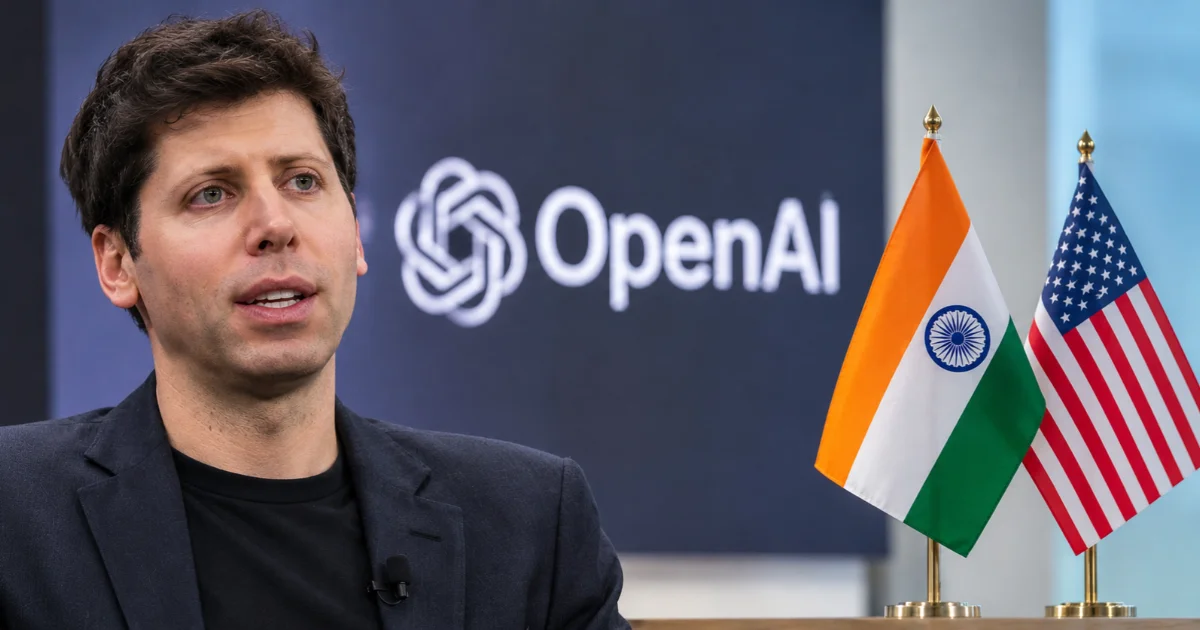
OpenAI co-founder Sam Altman recently highlighted this divergence, noting that India is embracing generative AI with a baseline enthusiasm that is noticeably absent in American markets.
During a recent appearance on the Figuring Out podcast, Altman categorized the United States as unusually negative on AI relative to the rest of the world. This negativity often manifests in domestic regulatory anxiety, union disputes over job displacement, and sustained friction regarding monopolistic consolidation among a few hyperscalers.
India, however, has rapidly scaled to become ChatGPT’s largest market by user volume, treating large language models less as an existential threat to legacy industries and more as an immediate, high-leverage utility for scaling new ventures.
Economic Velocity and the Supply Deficit
The psychological divide between the two nations is rooted in hard macroeconomic realities rather than arbitrary cultural preferences.
Mature, developed markets often view disruptive automation as a direct risk to established workflows and entrenched institutional structures. In rapidly developing economies, the calculus flips entirely.
According to a detailed breakdown of the podcast conversation published at NDTV, Altman pointed directly to the pace of economic development and the immense demand for baseline products and services as the primary driver of this regional optimism.
Markets experiencing aggressive GDP growth combined with a structural undersupply of legacy services inherently welcome scalable technology. AI in the Indian context acts as a critical bridging mechanism to bypass traditional developmental bottlenecks.
Where a mature western economy might view an AI agent as a direct replacement for a junior software engineer or a legal clerk, emerging markets view the exact same agent as a mechanism to stand up operations where human capital was previously inaccessible or financially unviable for a bootstrapped enterprise.
The technology fundamentally fills a vacuum rather than displacing an incumbent.
The Builder Energy Driving Adoption
This structural market deficit has cultivated what Altman described as incredible builder energy across the Indian subcontinent.
A massive, overwhelmingly young workforce operating within a hyper-competitive startup ecosystem is treating generative AI as a foundational infrastructure layer for new commercial applications.
The deployment cases happening on the ground are intensely pragmatic. Altman cited a recent instance of a local Indian student leveraging a full stack of OpenAI tools to autonomously execute a comprehensive fundraising campaign for his school, handling everything from strategic outreach to operational execution without any prior domain expertise.
This anecdote represents a much broader systemic shift happening across the country’s tech hubs.
Local developers and founders are utilizing AI APIs to write production code, generate localized marketing assets, and build automated multilingual customer service pipelines designed to serve a massive, linguistically fragmented domestic population.
The regional focus remains aggressively tied to building, iterating, and solving infrastructural problems at scale. Instead of debating the theoretical long-term risks of artificial general intelligence, the Indian market is extracting immediate commercial value from current-generation models.