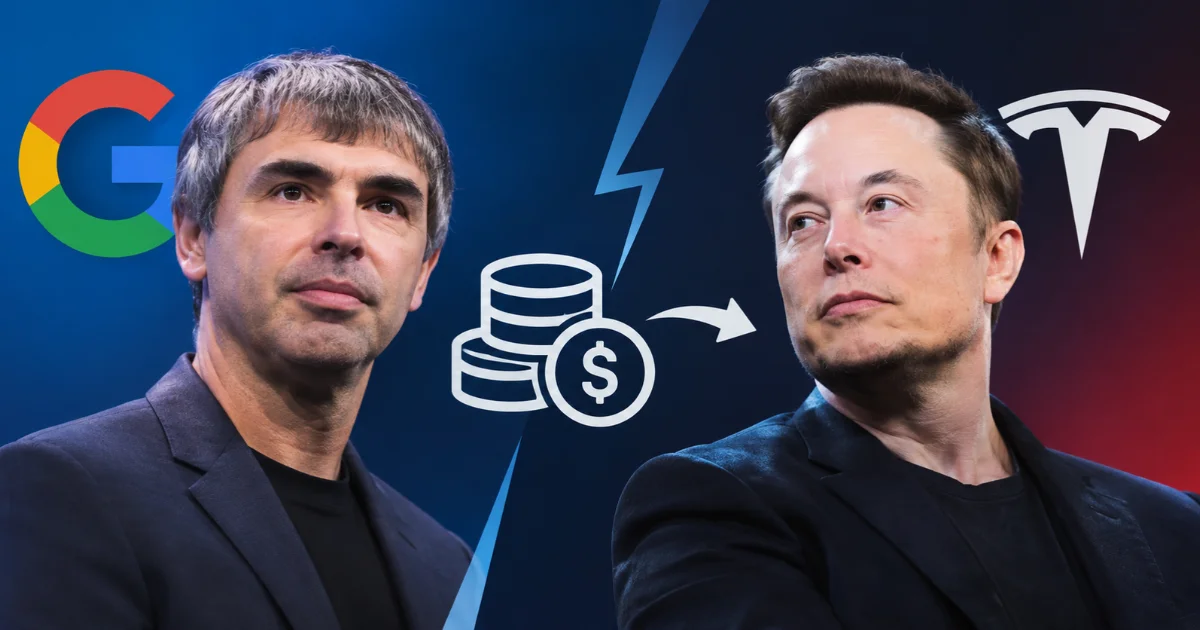

The technology industry is built on unusual alliances, but few were as fascinating as the deep, early friendship between Google co-founder Larry Page and Tesla CEO Elon Musk.
Long before they were recognized as two of the wealthiest operators on the planet, they spent hours debating the trajectory of human civilization and the role silicon would play in it.
Their bond was so strong that Page once publicly stated he would rather leave his massive fortune to Musk than to a traditional philanthropic foundation.
It was a stunning endorsement of Musk’s engineering vision, yet this high-profile friendship eventually fractured over the very technology they both helped pioneer: artificial intelligence.
Redefining Capital Allocation and Billionaire Philanthropy
The concept of transferring billions to a single fellow entrepreneur sounds absurd on the surface, but Page viewed the allocation of capital through a highly specific, systemic lens.
The idea first caught public attention during a 2014 TED interview with Charlie Rose, though its roots go back to a Stanford University event a year prior. During a Google lunch, Page reportedly mentioned that if he were to suddenly pass away, he would want all his assets handed over to Musk.
According to a retrospective report published at Times of India, venture capitalist Steve Jurvetson recalled the audience laughing at the remark, though Page was entirely serious.
For Page, traditional charity lacked the operational scale necessary to alter the course of human history. He viewed Musk’s overarching ambition to make humanity a multiplanetary species through SpaceX as a fundamentally philanthropic endeavor.
Backing up the human race on Mars wasn’t just a business venture in Page’s eyes; it was the ultimate infrastructure insurance policy for civilization.
He believed that consolidating wealth behind a visionary executing world-changing engineering feats would yield a drastically higher return on investment for humanity than distributing it across conventional non-profit causes.
The Safety Friction That Fractured a Tech Alliance
Despite their mutual desire to push the boundaries of technology, the ideological divide that eventually separated them centered entirely on the development and deployment of artificial intelligence.
In the early days of their friendship, Page and Musk regularly discussed the potential of machine learning. However, as the compute power and capabilities of neural networks rapidly accelerated, a sharp philosophical contrast emerged.
Page maintained a deeply optimistic outlook, believing that advanced AI was the natural next step in digital evolution and a crucial tool for solving complex global challenges. He viewed the rapid scaling of intelligent systems as a net positive that would unlock unprecedented economic and scientific growth.
Musk looked at the exact same technological trajectory and saw an existential threat. He became increasingly vocal about the lack of regulatory safeguards, warning that unconstrained AI could easily outpace human control and pose a severe danger to society.
This wasn’t a minor disagreement over corporate strategy; it was a fundamental clash of worldviews regarding the survival of the human species.
Musk felt Page wasn’t taking the safety implications and alignment problems seriously enough, while Page reportedly viewed Musk’s alarms as unnecessary friction that hindered progress.
As their respective companies began heavily investing in competing AI research laboratories, the once-tight alliance cooled completely, fundamentally altering the competitive landscape of modern artificial intelligence development.