
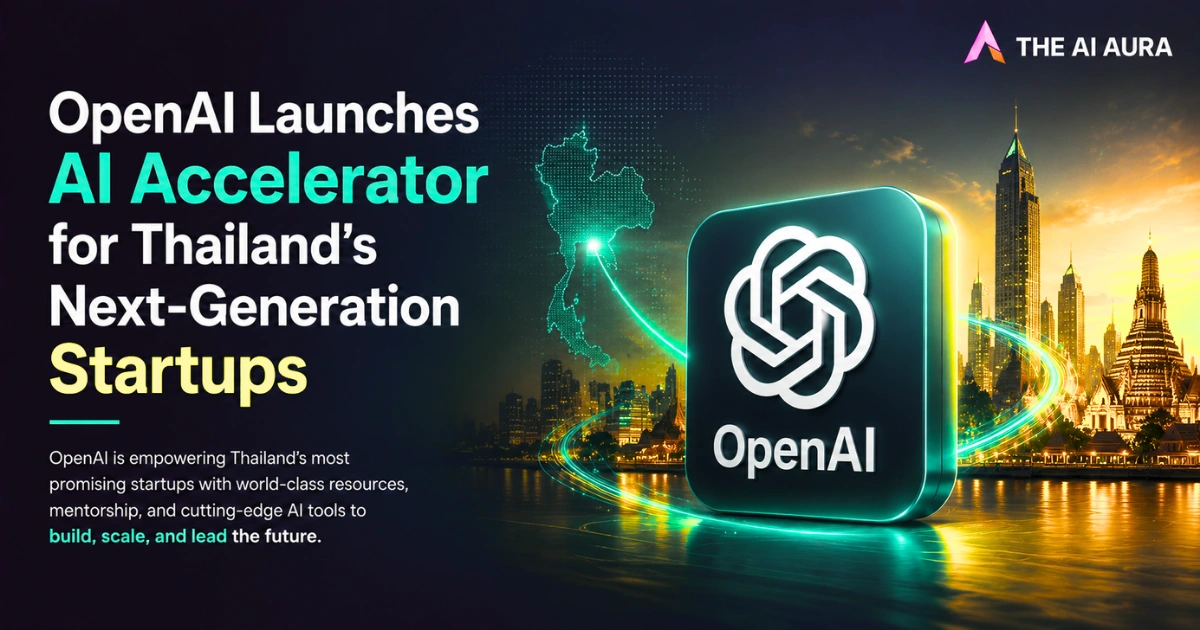

OpenAI has officially launched its first public-private partnership with the Thai government, aiming to bridge the notoriously difficult gap between an impressive AI prototype and a reliable, market-ready product.
Operating in collaboration with Thailand’s Ministry of Higher Education, Science, Research and Innovation (MHESI), the National Innovation Agency (NIA), and Mahidol University, this new accelerator provides critical infrastructure to ten carefully vetted startups.
In fact, Thailand ranks in the top 20 countries worldwide for ChatGPT and Codex usage. Therefore, this initiative directly capitalizes on that local adoption. The eight-week program does not teach basic coding.
Instead, it pushes high-potential projects straight into real-world deployment. Consequently, strict safeguards, automated testing, and sustainable business models become mandatory for survival.
Targeting High-Stakes Sectors: Healthcare and Education
The accelerator intentionally focuses on healthcare and education. In these critical sectors, reliability is non-negotiable and error margins are razor-thin. For instance, Thailand is currently managing a rapidly aging population.
This demographic shift creates urgent demand for preventative care, remote diagnostics, and independent living tools.
Simultaneously, the nation is modernizing its educational infrastructure. As a result, its future workforce can remain competitive in a digital economy.
Startups like Wello Food, Dietz, Precisionize, and FitSloth joined the inaugural cohort. To support them, OpenAI provides $2,000 in API credits and technical guidance. However, the technical stack is only half the battle.
Weekly mentorship sessions focus heavily on the unglamorous but essential aspects of enterprise AI: responsible deployment, privacy, security protocols, and cost management.
The objective is to ensure these startups build robust platforms capable of handling sensitive medical records and childhood development tracking without compromising user privacy or generating unreliable outputs.
Moving from Concept to Commercial Deployment
The accelerator sets aggressive commercial and technical milestones for its participants, culminating in a highly anticipated Demo Day in Bangkok this November.
The expectation is that by week eight, founders will present concrete user data, rigorous evaluation metrics, and a functional path to mass implementation.
We can already see practical applications taking shape. For example, CARIVA is building a multilingual voice agent for hospital networks. Unlike standard bots, it uses real-time speech models to assist patients in their preferred language.
In addition, the agent actively listens for urgent medical emergencies that require immediate human escalation. Direct guidance from OpenAI engineers helps refine safety guardrails under high pressure.
Meanwhile, Curico is building AI tools tailored for childcare centers. Their platform generates interactive stories, physical activities, and personalized feedback.
As a result, it relieves the daily burden on overwhelmed educators. Curico will soon launch live pilots across Bangkok childcare centers and test AI grading at Chulalongkorn University.
Ultimately, this partnership creates a strong blueprint for localized AI development. It successfully pairs Silicon Valley frontier models with deep local domain expertise. Therefore, teams in Bangkok can build secure, vetted solutions and export them globally.
Source: Official OpenAI, "Supporting Thailand’s Next Generation of AI Startups"