
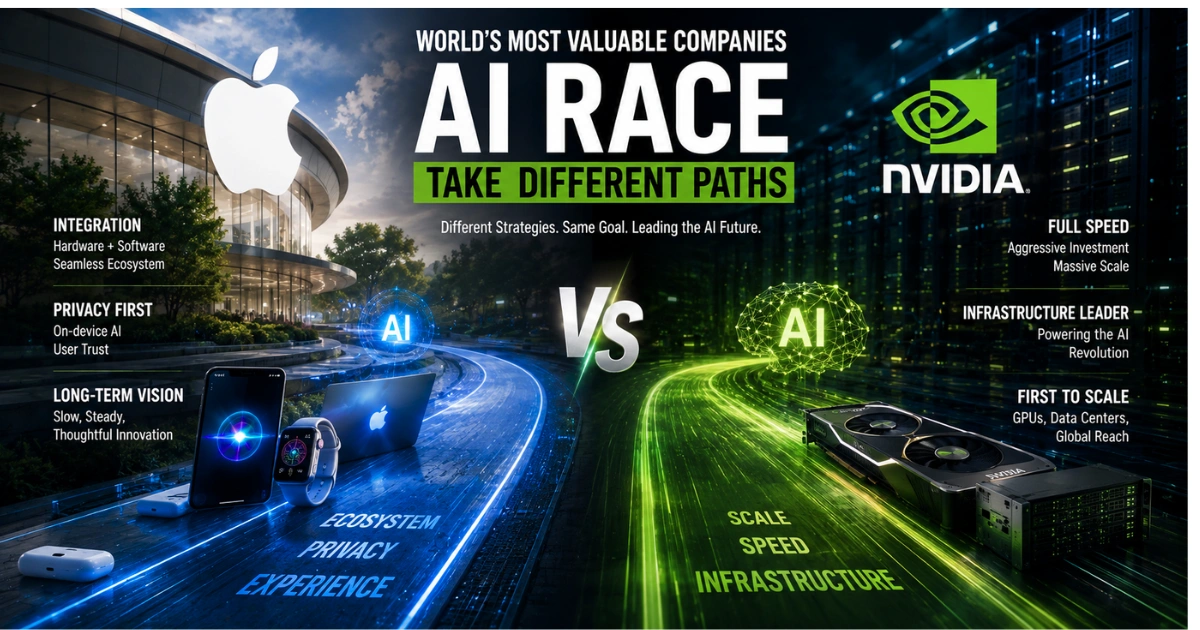

The global market battle is increasingly being shaped by AI strategy. In late July 2026, Apple reclaimed the market-value crown from Nvidia. Its market capitalization moved close to the historic $5 trillion mark.
For more than a year, Wall Street rewarded the companies building the infrastructure behind AI.
Semiconductor giants reached record valuations as demand for AI chips surged. The latest reshuffling, however, points to a broader change in the market.
The race is no longer just about building bigger data centers. Companies are now following very different AI strategies.
Some are investing heavily in the infrastructure needed to train and run advanced models. Others are focusing on bringing AI directly to consumers through existing products and services. This shift could determine where the biggest financial gains from AI emerge over the next decade.
Nvidia’s Capital-Intensive Infrastructure Play
Nvidia has spent the last three years executing a highly aggressive, infrastructure-first blueprint. As the undisputed titan of graphics processing units and accelerated computing, the company’s core strategy hinges on fueling the massive data centers that train and operate foundational models.
By controlling a dominant share of the AI data center GPU market, Nvidia essentially dictates the pace of the entire industry’s technological advancement.
Yet, maintaining this absolute dominance requires staggering financial commitments. The recent market volatility surrounding semiconductor stocks stems directly from growing anxiety over these mounting infrastructure costs.
Reports of Nvidia negotiating immense financial guarantees including discussions around a massive $250 billion financing pipeline for external data centers have highlighted the sheer capital required to sustain this growth trajectory.
The company is betting heavily that the global enterprise appetite for raw compute will only accelerate as intelligent agents and spatial computing become more complex.
This distinct path relies on continuous, heavy capital expenditure, assuming that the foundational infrastructure layer will permanently remain the most lucrative chokepoint in the global tech supply chain, regardless of short-term cost concerns.
Apple’s Lean Ecosystem and Consumer Deployment
In stark contrast to the heavy lifting of silicon fabrication and hyper-scale server farms, Apple has adopted a highly restrained, consumer-centric deployment strategy.
Earlier in the generative AI boom, the iPhone maker was frequently dismissed as a laggard for refusing to engage in a reckless spending war.
Instead of deploying hundreds of billions into proprietary data centers, Apple quietly positioned itself to leverage its single greatest structural asset: unmatched ecosystem lock-in.
By rolling out localized features like Apple Intelligence and a deeply overhauled Siri directly onto mobile devices, the company cleverly shifted the computation burden to the edge.
They opted to rent cloud capacity and partner with established model developers rather than attempting to outspend them on server architecture. This lean strategy successfully insulates Apple from the severe capital expenditure cycles currently weighing down major chipmakers.
Furthermore, by processing personal data strictly on-device, Apple bypasses massive privacy bottlenecks while simultaneously triggering a highly profitable hardware upgrade cycle among its loyal user base.
Financial markets have fiercely validated this pragmatic approach. Investors are increasingly rotating toward tech behemoths that can efficiently monetize artificial intelligence through existing services and premium hardware margins, proving that winning the modern tech race does not require building the expensive infrastructure, as long as you control the consumer’s primary access point.
Source: Official CNN, "Apple and Nvidia AI Race"