
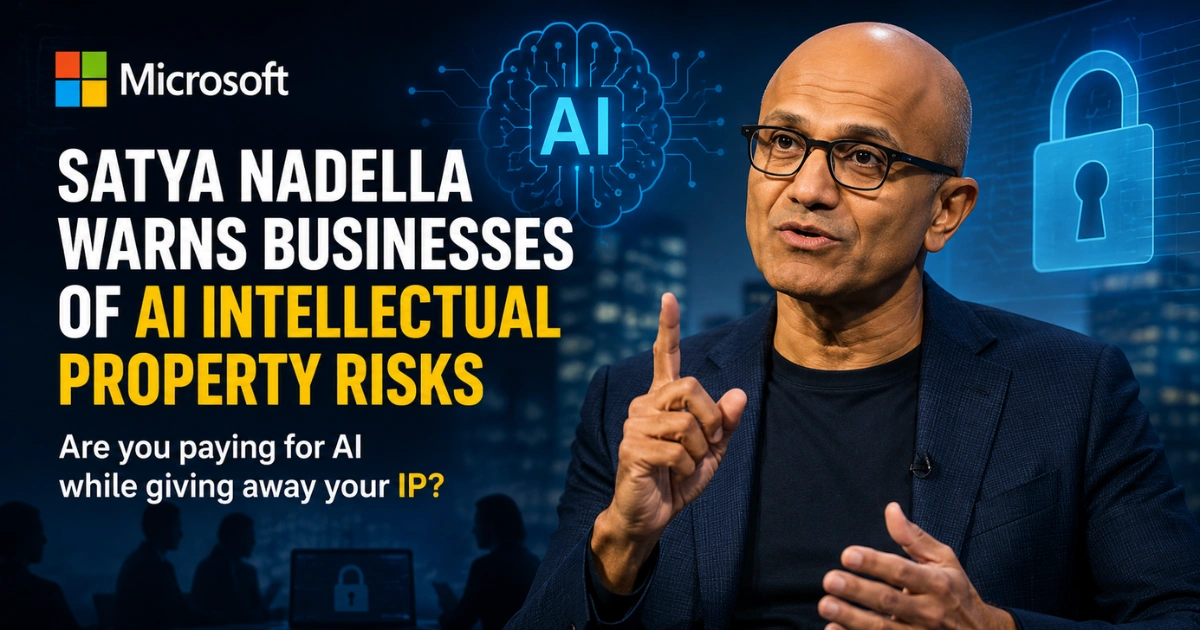

Microsoft CEO Satya Nadella sparked widespread discussion after publishing a lengthy essay on X instead of announcing a new product.
The post, which attracted nearly 10 million views, argued that businesses using AI may be giving away valuable intellectual property alongside their subscription fees.
According to Nadella, companies pay not only for AI services but also with the proprietary knowledge they provide to make those systems more effective, exposing a deeply hidden cost of AI in business.
Nadella’s “Reverse Information Paradox” and His Proposed Solution
Nadella describes the issue as the “Reverse Information Paradox,” a concept inspired by economist Kenneth Arrow’s theory about the value of information. While Arrow argued that information loses value once a seller reveals it, Nadella says AI reverses the equation.
Companies create value by sharing prompts, workflows, corrections, and evaluations with AI systems, gradually exposing the operational knowledge that differentiates their business.
He refers to this accumulated knowledge as “intelligence exhaust,” arguing that it represents proprietary expertise that competitors cannot easily replicate. Drawing on economist Friedrich Hayek’s work on dispersed knowledge, Nadella maintains that this intelligence belongs to the enterprise that generated it rather than the AI provider processing it.
Nadella also highlights what he sees as an inconsistency in today’s AI ecosystem. He argues that many AI companies defend training models on publicly available internet data while restricting model distillation, the practice of using AI-generated outputs to train smaller models.
As an example, he referenced Anthropic’s complaint that Chinese open-source labs had submitted millions of prompts in an attempt to reproduce Claude’s capabilities.
To address these risks, Nadella proposes building a “trust boundary” around enterprise knowledge. His framework focuses on five principles: Control, Capability, Choice, Cost, and Compound.
Together, these practices encourage private evaluation systems, internal model customization, and multi-model strategies that reduce dependence on any single AI provider.
Why the Debate Extends Beyond Microsoft
Critics point out that Microsoft’s position creates an obvious contradiction. The company owns roughly 27% of OpenAI and has built products such as Azure AI, Microsoft 365 Copilot, and GitHub Copilot around proprietary AI models.
As a result, some observers argue that Microsoft benefits from the same ecosystem Nadella now warns businesses to approach cautiously.
The Register also noted that Microsoft Copilot has faced concerns over enterprise data exposure.
It cited a 2024 Securiti survey showing that about half of the chief data officers surveyed had limited or suspended Copilot deployments because of concerns about broad SharePoint and Microsoft 365 permissions exposing sensitive information.
Nadella is not alone in raising these concerns. TechCrunch noted that investors such as Jason Calacanis and Palantir CEO Alex Karp have previously encouraged businesses to retain greater control over their AI infrastructure. Industry leaders also report growing interest in open-source AI models.
Solo.io CEO Idit Levine says many enterprise customers now ask whether open-source models running on their own infrastructure can deliver about 90% of the performance of proprietary models while providing lower costs and stronger data control.
Vercel has also reported that open-source models now account for 29% of traffic through its AI gateway.
Regardless of Microsoft’s own role in the AI ecosystem, Nadella’s central recommendation reflects a broader enterprise trend.
Companies increasingly want to protect proprietary data, maintain ownership of internal knowledge, and avoid building long-term AI strategies around a single technology vendor.
Source: The Times of India, "Microsoft CEO Satya Nadella to Every Company Across the World Using AI: You Are Paying for Your Own IP, Suggests 5 Ways to Solve the Problem"