
Global financial markets face a massive capital concentration. The relentless artificial intelligence boom drives this trend entirely.
Trillions of dollars in institutional wealth now sit in a few tech giants. This rush pushes valuations to unprecedented, unsustainable levels. However, financial markets remain inherently cyclical.
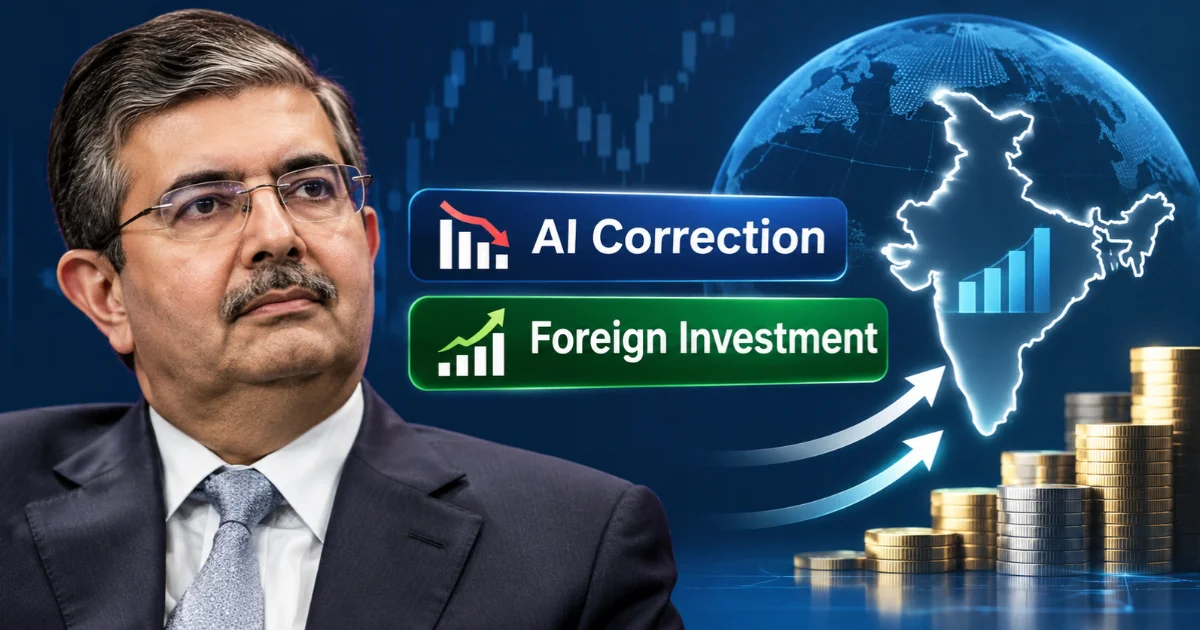
Speculative euphoria always collides with economic reality. Veteran financier Uday Kotak recently offered a pragmatic view on this dynamic. He suggests a cooling AI frenzy could structurally boost Indian equity markets.
A tech correction might not cause a global bear market. Instead, it could trigger a massive geographic wealth rotation. This shift would position India to capture significant displaced foreign investment.
The Mechanics of Global Capital Rotation
To understand how a technology sell-off in the West directly benefits domestic Indian equities, one must examine the plumbing of global asset management. Currently, international fund managers are severely overweight on AI-related equities to avoid missing out on benchmark-beating returns.
Because these specific stocks are priced for absolute perfection, any minor delay in corporate AI monetization, regulatory hurdles, or slight earnings misses will trigger rapid profit-taking.
When institutional capital exits a crowded, high-valuation trade, it does not simply retreat into low-yielding cash reserves. Instead, it aggressively hunts for new equity environments that offer sustainable, compounding growth at justifiable multiples.
According to the economic outlook detailed at Money control, Uday Kotak anticipates that this specific unwinding process will force global allocators to abandon speculative tech narratives in favor of strong macroeconomic fundamentals.
The underlying mechanism relies on relative valuation. As the risk-reward ratio in high-flying tech equities deteriorates, the comparative appeal of emerging markets immediately sharpens, prompting foreign portfolio investors to systematically rebalance their holdings toward more grounded economies.
Why India Stands as the Primary Safe Haven
Inevitable capital flight from the AI sector will eventually begin. Displaced liquidity naturally gravitates toward regions showing structural resilience. This dynamic gives India a distinct advantage over emerging market peers.
Many traditional developing investment destinations face major struggles right now. Heavily leveraged property sectors deter long-term foreign capital.
Deflationary pressures and shifting regulatory environments also cause serious concern. In stark contrast, India offers a predictable, expanding macroeconomic runway. Aggressive government infrastructure spending actively supports the economy.
A rapidly formalizing digital economy also fuels this domestic growth. Furthermore, a clean, well-regulated banking sector easily funds corporate expansion.
Global investors occasionally express reservations about India’s premium valuations. However, a severe tech sector correction changes this calculus entirely.
Compared to a tech bubble where future revenues are largely hypothetical, India’s corporate earnings growth is deeply anchored in tangible domestic consumption and physical industrial output.
Additionally, as multinational corporations continue to diversify their global supply chains, India is steadily capturing a larger share of global manufacturing operations.
When trillion-dollar asset managers eventually reduce their exposure to an overheating AI narrative, they will require a destination market that is deep, liquid, and fundamentally sound enough to absorb massive capital inflows.
India is uniquely equipped to receive this liquidity, ensuring that a sharp overseas market correction translates directly into sustained domestic financial growth.