
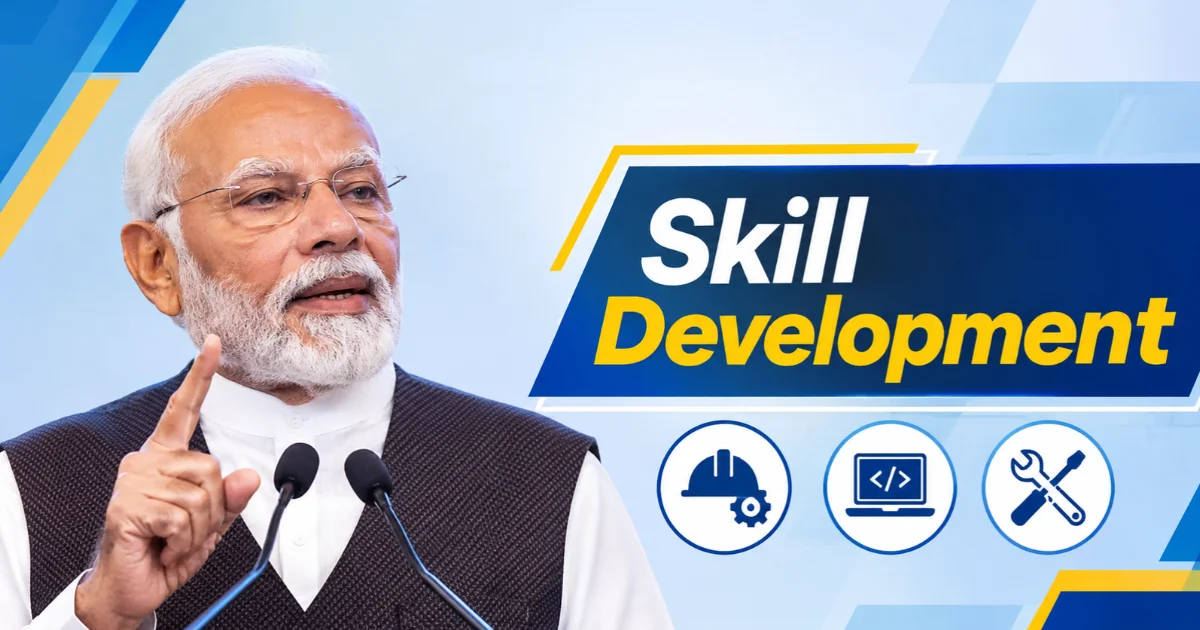
On November 21, 2026, Prime Minister Narendra Modi addressed graduating Industrial Training Institute (ITI) students at the 5th Kaushal Deekshant Samaroh in Lucknow, marking the first time the national skill convocation was hosted outside Delhi.
Speaking as both Prime Minister and a Member of Parliament from Uttar Pradesh, Modi framed vocational training as the primary driver of a developed India rather than a secondary alternative to university degrees.
He traced this perspective back to India’s own economic history, pointing to Lucknow’s Chikankari, Banaras and Kanjeevaram silk, Kashmir Pashmina, and traditional metallurgy as proof that craftsmanship once anchored the country’s global identity.
According to Modi, colonial education broke that model by rewarding clerical paperwork and attaching a stigma to blue-collar work a mindset that still holds back young talent today.
Modernizing ITIs Through PM-SETU and New-Age Trades
Changing social attitudes toward vocational work requires more than speeches; it demands institutions that match modern factory floors. Over the past decade, the government has built nearly 5,000 new ITIs, expanding enrollment by more than five lakh students while increasing female participation by over two and a half times.
To fix outdated curricula and aging workshop equipment, the Centre is rolling out the ₹60,000 crore PM-SETU scheme.
The program operates on a hub-and-spoke model, upgrading 1,000 government ITIs by linking 200 well-equipped hub centers complete with modern labs and incubation units to 800 spoke institutes, all co-managed alongside industry partners.
According to the Press Information Bureau (PIB), Government of India, this overhaul has already introduced more than 30 new-age trades tailored for both domestic industry and international trade agreements, including Artificial Intelligence Assistant, Cyber Security Assistant, Semiconductor Technician, Drone Technician, Green Hydrogen Technician, Industrial Robotics, and Electric Vehicles.
Modi also addressed widespread anxiety over Artificial Intelligence replacing human jobs. Drawing a parallel to the COVID-19 pandemic, he reminded graduates that when white-collar offices froze, skilled technicians kept power grids, supply lines, and essential services alive. While software can automate routine desk work, practical technical capability remains difficult to displace.
Real-World Demand and Uttar Pradesh’s Industrial Shift
The economic case for vocational training becomes obvious when looking at everyday infrastructure bottlenecks.
Modi shared a telling example from recent review meetings: during gas supply disruptions linked to the West Asia conflict, the government set a target of installing at least one lakh piped natural gas (PNG) connections per day, only to face repeated delays caused by a shortage of trained plumbers. Similar labor gaps are widening across solar power installation, rural housing, water pipelines, and India’s expanding sports manufacturing sector.
With 50 crore people moving out of poverty over the last 12 to 13 years, domestic consumption and infrastructure projects are creating steady demand for electricians, carpenters, and specialized technicians.
Uttar Pradesh sits right in the middle of this industrial push. Crediting Chief Minister Yogi Adityanath’s administration, Modi pointed to the state’s network of expressways, international airports, mobile manufacturing plants, an upcoming semiconductor factory, and BrahMos missile production as direct engines of local job creation.
He also tied industrial growth to workplace safety, recalling a young woman at a recent factory inauguration in Varanasi who told him she now commutes home comfortably even at 11 PM.
Looking ahead, Modi announced that India will host the WorldSkills Asia competition in Greater Noida in 2027, giving Indian trainees a direct stage to compete with peers from across the continent. By aligning formal ITI training directly with factory requirements and global standards, the country is steadily turning its demographic scale into a practical manufacturing advantage.