

Washington’s aggressive export controls on high-end semiconductors were supposed to choke Beijing’s artificial intelligence ambitions.
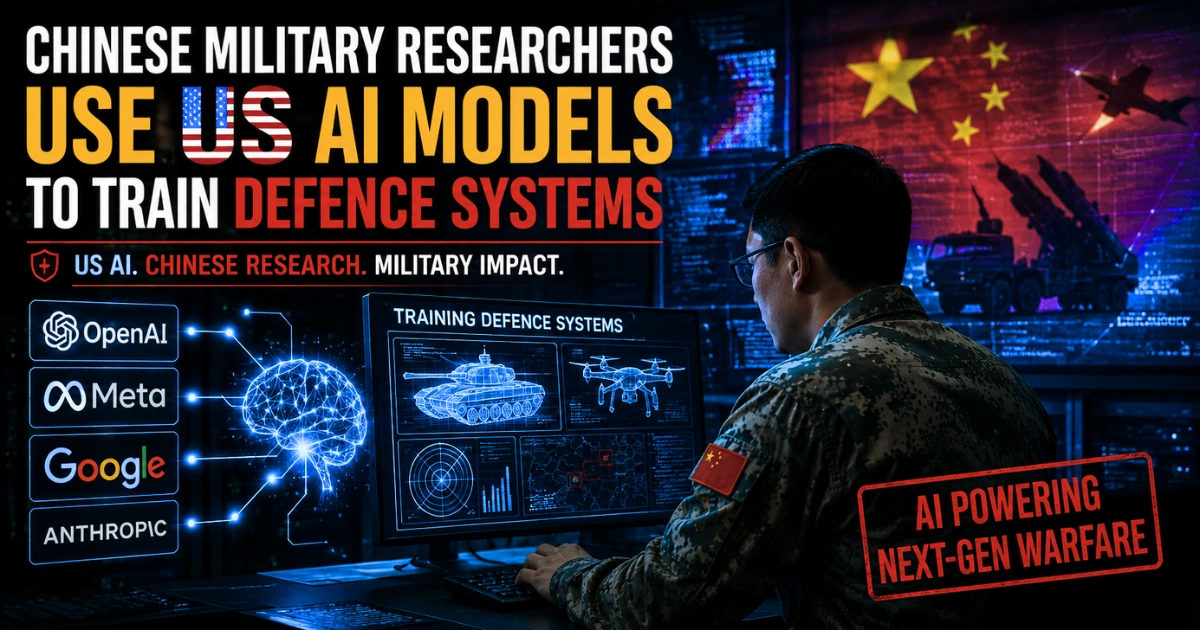
Instead, they forced a tactical pivot. Recent reviews of dozens of Chinese academic papers reveal a striking reality: the People’s Liberation Army (PLA) and affiliated defense institutions are not waiting to build frontier AI from scratch.
They are quietly leveraging the exact American systems they are competing against specifically those from OpenAI and Anthropic to accelerate their own military capabilities.
As someone who tracks both neural network architecture and defense technology, the methodology here is pragmatic and highly effective.
The strategy relies on a well-established industry practice called model distillation.
While the geopolitical friction centers on unauthorized extraction, the technical reality is that China has found a highly efficient shortcut to bypass the massive compute bottlenecks required for foundational AI training.
The Mechanics of Model Distillation in Warfare
To understand how this works, you have to look at the massive resource gap between training an AI and running one.
Frontier models require vast data centers and thousands of advanced GPUs to develop their reasoning capabilities.
The Chinese military doesn’t necessarily need a multi-modal giant that can write poetry and code simultaneously. They need hyper-specialized, localized intelligence that can operate securely in disconnected environments.
Model distillation solves this. In practice, researchers feed complex, domain-specific prompts into a powerful Western model.
They extract not just the correct answers, but the step-by-step reasoning the model used to get there. They then use this rich output to train a much smaller, domestic neural network.
We are seeing this deployed across highly sensitive military units. PLA cyber-warfare units, for instance, are using models like GPT-3.5 to process and summarize classified source code.
Because they cannot upload state secrets to a server in California, they use the American model’s outputs to train a lightweight domestic system that lives entirely on secure, air-gapped Chinese servers.
This practice is directly subsidized by the Chinese government to promote edge computing. It allows powerful target-recognition systems to run on limited hardware.
Current academic papers detail how these distilled models are compressed to fit onto unmanned aerial vehicles and autonomous submarines.
If a drone loses its satellite uplink during a maritime operation, it still retains the distilled tactical decision-making capabilities of a much larger system, allowing it to navigate and identify targets autonomously in real time.
Strategic Reality vs. Technological Limits
It is easy to view this dynamic as a massive security failure for the United States, but looking at the raw engineering, distillation is a targeted tool with hard limitations.
Systematically capturing the reasoning steps of Western models works brilliantly for specific use cases like surveillance, content moderation, or tactical targeting. However, a distilled model only inherits what you explicitly teach it.
It cannot fully replicate the broad, emergent intelligence of its teacher model. It is a derivative product.
You are transferring selected capabilities into a cheaper, locally controlled system, but you are not achieving independent frontier intelligence.
Furthermore, Chinese military engineers are keenly aware of the vulnerabilities inherent in this approach.
Relying on Western models introduces the risk of inheriting unseen security flaws.
Researchers at the Army Engineering University are already publishing defense mechanisms against “data-free distillation,” indicating they know their own closed systems could theoretically be reverse-engineered by adversaries using similar techniques.
The current landscape shows a highly pragmatic Chinese defense apparatus. They are using American innovation as a scaffolding to build out their edge-computing combat networks.
While distillation will not hand Beijing the keys to artificial general intelligence, it successfully bridges the immediate tactical gap, proving that in the AI arms race, software workarounds can temporarily neutralize hardware blockades.
Source: Reuters, "Chinese Military Researchers Tap US AI Models to Train Defence Systems"