
Rand Fishkin recently struck a nerve on LinkedIn, pointing out that Similarweb’s “2026 Generative AI Landscape” report is built to frustrate everyone.
It hands hard data to both the zealots who think chatbots killed the search bar and the skeptics who think AI is just a temporary fever.
I spend my time ground-truthing these shifts, testing how retrieval systems actually interact with live web environments.
When you read past the executive summary of this 38-page report, the narrative isn’t about replacement. It is about layering.
The search ecosystem isn’t collapsing; it is becoming more complex, demanding a complete rethinking of how we approach visibility, authority, and generative engine optimization.
The Habit Stacking of Generative Search
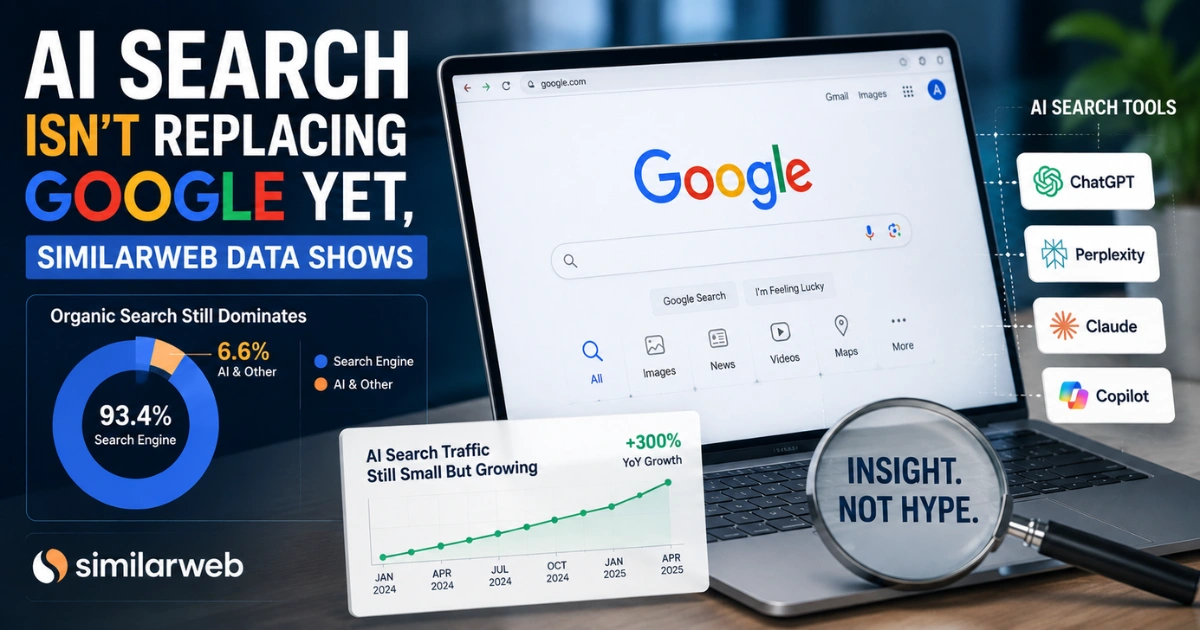
The most disruptive metric in the Similarweb data isn’t a growth chart. It’s an overlap stat. Between March and May 2026, 95% of ChatGPT’s 494 million users also used Google.
Nobody is abandoning their traditional search habits. Instead, they are stacking chatbots on top of them. Search still commands a staggering 3.3 billion average monthly unique visitors globally.
The entire AI chatbot category, even with its blistering 57% year-over-year growth, sits at 655 million. We are looking at a market where traditional search is still roughly five times larger than its supposed replacement.
What is actually changing is how people format their intent. Users are taking the conversational prompting habits they learned from ChatGPT and bringing them straight into Google. The average search query length is climbing.
People aren’t necessarily looking for different things; they are just feeding longer, more conversational sentences into the exact same search boxes.
This is where the skeptics get it wrong. They see Google’s dominance and assume the AI wave is overblown. But the underlying demographic shift tells a different story.
Half of all generative AI users are now 35 or older. That is a massive jump from just two years ago when 61% were under 34.
When new technology adoption ages up, it transitions from a fleeting trend into durable, mainstream behavior. AI isn’t replacing Google, but it is fundamentally altering the syntax of discovery.
The Disconnect Between AI Citations and Human Clicks
If you are building an Answer Engine Optimization (AEO) strategy, the Similarweb data reveals a massive tracking flaw you need to fix immediately. Aleyda Solis highlighted a chart in the report that should completely reorganize how marketing teams measure ROI.
Currently, 65% of the URLs that ChatGPT cites as sources live deep within a website’s architecture usually two or three folders down.
These are the heavy, research-backed pages doing the actual evidentiary work to answer the user’s prompt. Yet nearly 60% of the referral traffic that AI actually sends back to websites lands right on the homepage.
The page the AI cites and the page the human clicks are two completely different URLs.
If your dashboard only tracks whether your deep-dive technical content gets cited by a language model, you are flying blind.
You are missing the reality that the actual human who decides to click through is landing on your front door and needs an entirely separate conversion path.
This requires splitting your performance metrics. Citation rate and folder depth measure algorithmic trust does the AI view your content as an authoritative source? Referral landing pages and downstream actions measure human intent what happens after the user verifies that authority? Conflating the two guarantees you will misunderstand both.
The practitioners winning this transition aren’t picking sides between traditional SEO and AI visibility. They are analyzing the affinity data.
Claude users skew heavily toward deep research and university sites; Gemini users index high on hardware and security; ChatGPT leans toward consumer health and lifestyle. A blanket “AI-optimized” piece of content will fail across all three.
The smartest play right now is figuring out exactly which layer of the stack your specific audience is clicking, and optimizing for the reality of the metrics, not the noise on the timeline.
Source: Search Engine Journal, "AI Search Isn’t Replacing Google, It’s Layering On Top – Similarweb Data"