
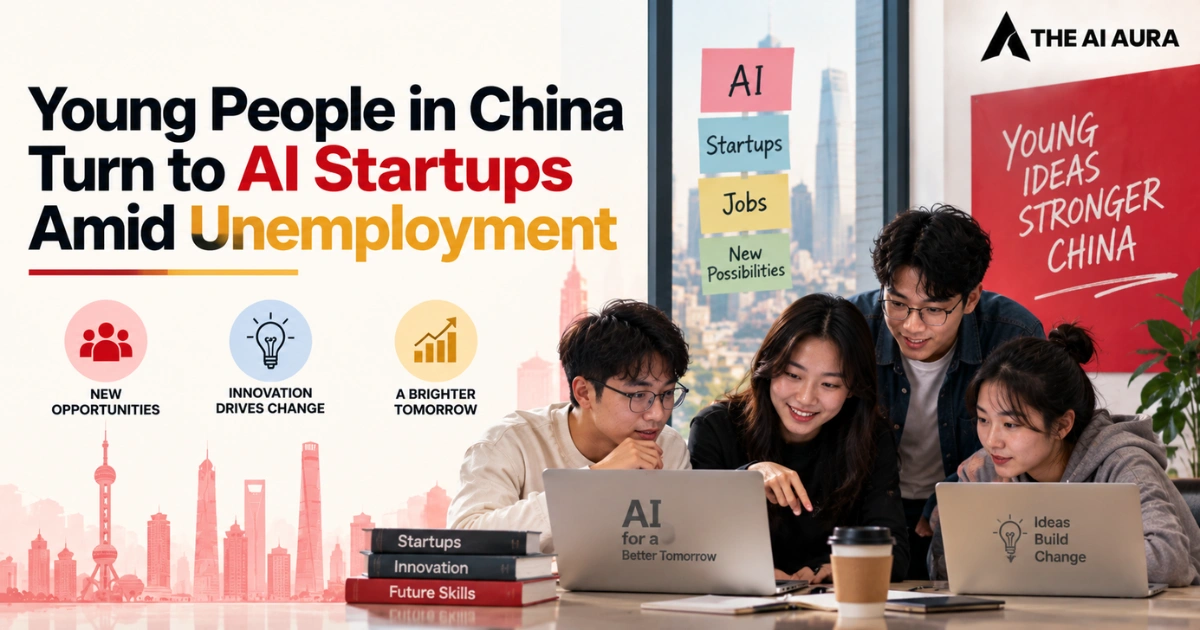

China’s grueling corporate culture has reached a tipping point. Today, graduates face the most challenging job market in decades. For years, the unspoken social contract was simple.
Students graduated from good universities and joined major tech firms or trading companies. Then, they endured the infamous “996” schedule: working 9 a.m. to 9 p.m., six days a week.
However, that traditional path is rapidly dissolving. Youth unemployment rates hover at historic highs, while economic headwinds slow corporate hiring. Many young professionals refuse to surrender to the bare-minimum “lying flat” movement. Instead, exhausted workers are carving an alternative route.
They use generative artificial intelligence to build micro-startups. By doing so, they transform personal burnout and unemployment into entrepreneurial fuel.
Escaping the Corporate Pressure Cooker
The transition from a stable corporate employee to an independent AI founder is rarely driven by dreams of becoming the next Silicon Valley billionaire. More often, it is a desperate bid for mental and physical survival. The relentless demands of traditional roles leave many young workers chronically stressed, battling severe insomnia, and entirely devoid of a functional work-life balance.
According to a recent report by The Wall Street Journal, this exact high-pressure scenario pushed 35-year-old Wu Songyun to leave her demanding international trade job in the city of Chengdu. Tormented by long hours and an unforgiving boss, her mental health and sleep suffered severely.
In 2024, she walked away from the traditional workforce to launch TideFlow, an AI-powered application designed to track sleep patterns, provide guided meditation exercises, and recommend better rest strategies. Her pivot perfectly encapsulates the current mood of Chinese youth.
They are no longer willing to sacrifice their physiological health for a paycheck, especially when job security is largely a relic of the past. Building a small AI enterprise offers them a chance to reclaim their autonomy, dictate their own hours, and solve the very real lifestyle anxieties that corporate life created.
Lowering the Barrier to Entry
What makes this current wave of independent entrepreneurship unique is the specific technology facilitating it. In previous eras, launching a digital startup required significant upfront capital, a team of specialized software engineers, and months of complex product development.
Today, artificial intelligence has drastically lowered that barrier to entry. Large language models and AI coding assistants for developers allow solo founders or incredibly small teams to prototype, build, and deploy functional applications in a fraction of the time and at near-zero cost.
Young founders are utilizing these tools to build an AI app from scratch that delivers hyper-focused solutions aimed at wellness, productivity, and personal management areas they intimately understand because of their own recent struggles in the workforce.
This structural shift also reflects a profound change in how success is measured among China’s young professionals. The dominant ambition is no longer to build a massive, sprawling conglomerate that requires endless rounds of venture capital.
Instead, the goal is to establish a sustainable, low-overhead digital business that generates enough revenue to live comfortably and independently. AI acts as the great equalizer in this pursuit, serving as a co-founder, lead developer, and marketing assistant all rolled into one.
As the traditional job market continues to stagnate, these micro-startups serve as both a financial lifeline and a psychological sanctuary. By turning to artificial intelligence, this disillusioned generation is quietly rewriting the rules of the Chinese labor market, proving that when the established economic system stops working, the most viable survival strategy is to simply code a new one.