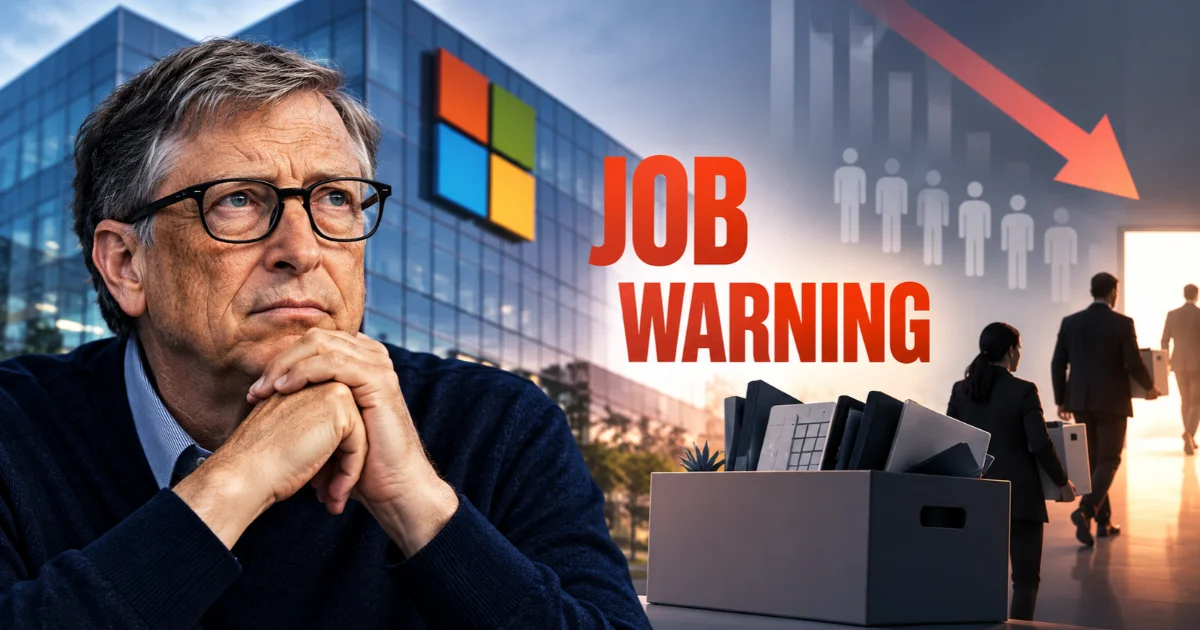

Corporate announcements rarely offer such cinematic irony. Just yesterday, Bill Gates warned the public about the rapid trajectory of artificial intelligence. Today, Microsoft rolled out a massive voluntary buyout program targeting a quarter of its global workforce.
Gates no longer steers Microsoft directly. However, his recent words landed with heavy significance.
He described a corporate incentive structure designed to “hire the robot, fire the human and don’t look back.” Meanwhile, tens of thousands of tech employees actively weighed their futures.
The Economics of an Evolutionary Event
Gates views the rapid advancement of artificial intelligence not just as a technological leap, but as an evolutionary event where human intelligence is suddenly facing unprecedented competition.
His primary concern extends beyond immediate job displacement to the structural foundation of modern economies. If AI systematically takes over white-collar roles before eventually moving into physical labor, the traditional worker-based tax pool will inevitably shrink.
This creates a dangerous paradox where overall societal prosperity might increase due to AI-driven productivity, but the safety nets protecting vulnerable populations deteriorate from a severe lack of funding.
According to a recent report at NDTV, detailing the timeline of these events, Gates has advocated for radical shifts in tax policy to counter this disruption.
He suggests implementing a token tax on AI usage and significantly raising taxes on billionaires, noting his own willingness to pay vastly more than his historical tax bill to help stabilize a system threatened by automation.
The fundamental issue he highlights is that current economic incentives heavily reward companies for substituting human capital with digital alternatives, without requiring them to bear the long-term societal costs of that displacement.
Corporate Restructuring in the Automation Era
Microsoft’s latest workforce reduction strategy contrasts sharply with this economic theory. The tech giant recently initiated a highly targeted “Voluntary Exit Offer.” This offer reaches approximately 60,000 employees up to the vice president level.
It affects staff across the US, Canada, the UK, and India. The company offers accepting staff a sliding scale of severance pay based on tenure. Employees also receive continued healthcare benefits and stock vesting extensions.
Officially, Microsoft executives maintain that this restructuring is a standard business maneuver rather than a direct result of AI integration.
However, the financial mechanics of the modern tech industry tell a remarkably different story. Conglomerates are currently locked in a wildly expensive arms race to build and train next-generation AI models.
Funding these massive capital expenditures requires aggressive cost containment elsewhere in the business. This buyout program, which follows a string of earlier layoffs and a previous retirement package, highlights a clear pivot in resource allocation.
Institutions like the International Monetary Fund have echoed the underlying anxiety driving this shift, warning that while AI will boost overall productivity, it risks severely widening the wealth gap by disproportionately rewarding capital owners over wage earners.
The IMF stresses that economies must urgently prioritize policies that help displaced workers transition into new roles. For nations like India, which houses one of the world’s most crucial technology workforces and is heavily exposed to Microsoft’s current exit offer, the stakes are exceptionally high.
As companies redirect billions of dollars from human payrolls into neural networks, the global workforce is left navigating an environment where human skills are rapidly being benchmarked against the relentless efficiency of machines.