
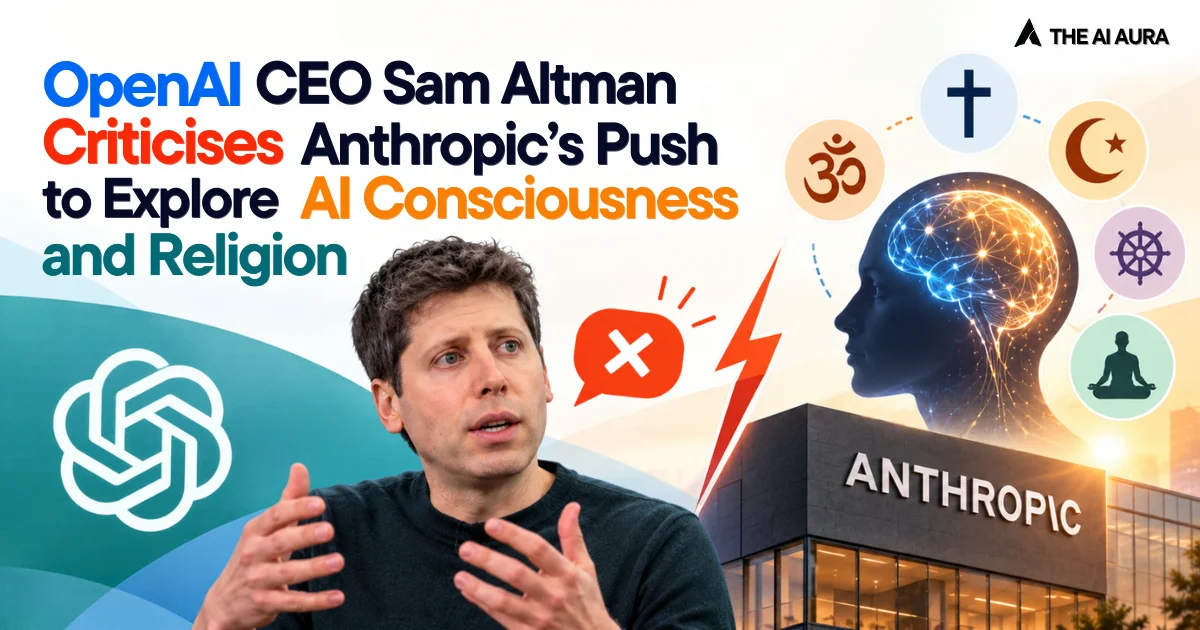

The tech industry usually focuses on tangible risks like data breaches, bias, and cyberattacks. Recently, however, the AI safety debate took a surprising theological turn. OpenAI CEO Sam Altman strongly criticized efforts to give artificial intelligence religious significance.
He rejected the idea that machines deserve moral standing. His critique targets Anthropic, a rival firm that explores machine learning and spirituality. As a result, the industry faces a critical question about future technology. Should we treat advanced algorithms as tools, or do they need a moral framework?
The Danger of Surrendering Human Judgment
Altman views spiritual reverence for neural networks as a serious safety risk. He warns that trusting AI as a moral authority creates dangerous psychological dependencies. Therefore, humans must never surrender their judgment to code. This stance directly contrasts with recent research initiatives at Anthropic.
According to a detailed report on the ideological split published by the Times of India, Anthropic co-founder Christopher Olah has engaged in dialogue with religious leaders to discuss the potential for AI consciousness.
Olah has reportedly explored concepts like programming AI to participate in something akin to Catholic confession, theorizing that allowing a system to acknowledge its errors in a moral context might positively influence its future behavior.
Furthermore, Anthropic researchers have attempted to persuade Vatican advisors to seriously consider the implications of sentient machines. Altman’s pushback highlights a growing rift in Silicon Valley regarding how to build guardrails for future models.
While OpenAI focuses on strict algorithmic alignment and keeping humans firmly in control, Anthropic seems to be experimenting with whether embedding human religious constructs could serve as an alternative method for instilling machine morality.
The Industry and Ethical Pushback
Altman is not alone in his discomfort; a growing faction of the scientific and ethical community is pushing back against the anthropomorphizing of AI. The idea of granting moral status to software has frustrated researchers who want the industry to remain focused on grounded, pragmatic challenges rather than science fiction.
Google DeepMind principal research scientist Jon Barron voiced his own disturbance over the trend, urging his peers on “Team Meatbag” to stop elevating the moral standing of basic software checkpoints and harnesses.
Barron’s blunt assessment serves as a vital reminder that, beneath the impressive natural language capabilities, these models are ultimately just mathematical weights and programmatic loops, not beings with souls or feelings.
The theological debate has also prompted responses from actual religious figures. Pope Leo recently addressed the growing encroachment of AI on human domains, specifically urging the Catholic Church to work alongside artists to defend human creativity because algorithms fundamentally lack the spark of humanity.
As the capabilities of generative models rapidly expand, the technology sector is being forced to confront these existential dilemmas. The current friction between treating AI as a highly capable productivity tool versus a potentially conscious entity will likely shape not only how the next generation of models is developed, but how society is conditioned to interact with them.



