

India’s forests are filled with sound. In the Western Ghats, monsoon rain mixes with bird calls, insects and animal movements. The dry forests of the East Deccan have their own distinct acoustic patterns.
Birdsong cuts through the humid air. Insects create a constant background hum, while frogs call from nearby vegetation. Even the movement of animals can add subtle sounds to the mix.
For decades, ecologists tasked with measuring the health of these complex ecosystems relied heavily on their eyes.
A field researcher might stand quietly in a clearing for 15 minutes. During that time, they would record every bird or mammal they could spot. The method can produce useful data, but it also has clear limits.
Yet, in a dense tropical canopy, relying strictly on visual point counts means missing the vast majority of the wildlife hiding just out of sight.
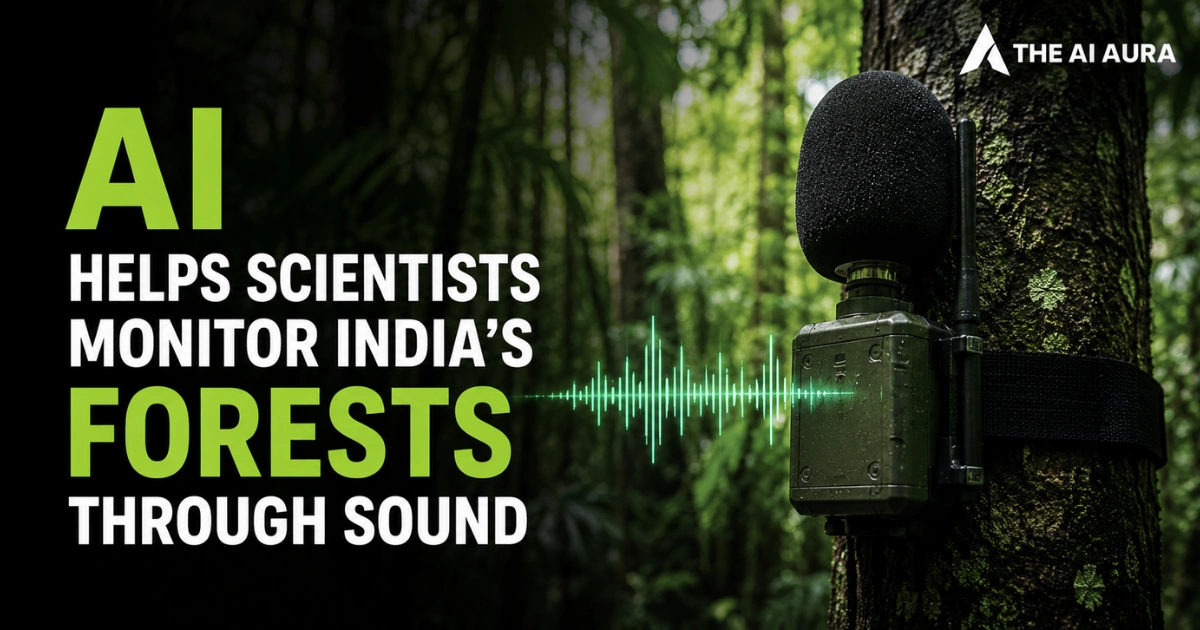
That massive blind spot is rapidly closing thanks to the field of ecoacoustics. By strapping unassuming, weather-proof audio recorders to tree trunks, scientists can capture unbroken soundscapes spanning months. These recordings act as flawless ecological time capsules.
They pick up frequencies human ears entirely miss, document the unique vocal fingerprints of individual animals like the distinct chuffing of a tiger and track how animal vocalizations shift over long periods.
Today, artificial intelligence has fundamentally simplified the grueling, manual process of listening back to these endless audio files.
Deep learning models can now sift through weeks of tape in minutes to automatically identify specific species.
However, when researchers attempted to apply these cutting-edge AI tools to Indian forests, they hit a massive geographical roadblock.
The Trouble with Global Algorithms
Machine learning models are ultimately only as capable as the data fed into them.
Popular acoustic recognition systems, such as BirdNET and Perch, were largely developed and trained using audio data sourced heavily from the Global North.
When deployed in the incredibly complex, noisy environment of a tropical Indian forest, these global algorithms routinely struggled
An Indian Forest does not sound like a typical temperate woodland. The background noise is heavier, while monsoon rain creates its own distinct sounds. The many species living close together also produce a unique acoustic environment.
For years, researchers collected recordings separately and stored them on different hard drives. There was no large, unified database that could teach AI how Indian wildlife sounds in the real world.
To build accurate AI systems, scientists needed something more important than better software. They needed thousands of hours of real jungle recordings.
Crowdsourcing a Wild Acoustic Library
To bridge this critical data gap, the Indian Ecoacoustics Network initiated a massive grassroots effort to build the country’s first open-access, crowdsourced audio dataset.
They asked researchers, citizen scientists, and wildlife enthusiasts to submit their raw field recordings. The mandate was specific: they wanted the noise.
They needed audio complete with wind interference, crunching leaves, background human activity, and competing species calls, because that is exactly the chaotic environment AI models must navigate in the real world.
The resulting collection represents 5,815 minutes of audio painstakingly annotated by trained ears.
Experts combed through the submissions, mapping the exact frequency and timestamp of 518 distinct species across 25 states onto visual spectrograms.
Before being published, independent experts spot-checked the data, finding a 98 percent accuracy rate among the crowdsourced labels.
This manually verified, globally accessible library now gives field researchers a plug-and-play resource to instantly fine-tune global AI models for local Indian habitats.
As this open-source acoustic library continues to grow, its applications will stretch far beyond basic species identification.
These digital audio fingerprints will eventually allow conservationists to track shifting migration routes, measure the immediate fallout of tree felling, and even hear how a prolonged drought alters the desperate mating calls of species fighting to survive.
Source: Official The Indian Express, "Global AI Models Struggle With Indian Wildlife Sounds; 59 Volunteers Built a Fix"