
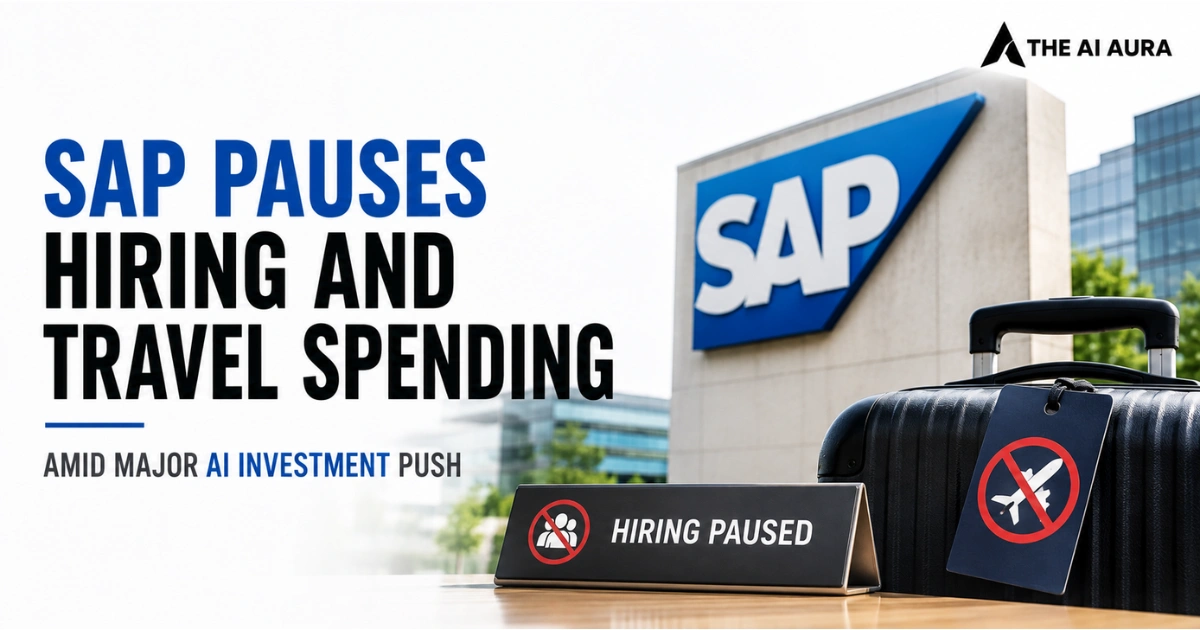

Europe’s largest technology firm is making a calculated, aggressive pivot. A recently leaked internal memo revealed that SAP has slammed the brakes on nearly all internal travel and general hiring.
The reason isn’t a downturn in revenue or a sudden macroeconomic shock. Instead, it’s a massive, capital-intensive shift toward artificial intelligence.
For a company of SAP’s sheer scale, halting standard operational spend to funnel cash into AI development signals a critical change in how enterprise software giants are financing the next technological era.
Employees were bluntly told the company needs to be highly disciplined in its spending, leaving only customer-facing trips, mission-critical AI training, and core AI engineering roles exempt from the freeze.
The Hidden Economics of Enterprise AI Deployment
To understand why a highly profitable entity like SAP is suddenly scrutinizing expense reports and freezing general headcount, you have to look at the underlying mechanics of AI infrastructure.
Scaling artificial intelligence across a global software portfolio isn’t just about paying top-tier developer salaries; it involves a continuous, compounding burn rate tied directly to compute power and token consumption.
Every time an AI-driven scenario goes live whether it’s an intelligent copilot helping a client optimize their supply chain or an internal tool summarizing corporate data it consumes tokens.
SAP’s leadership explicitly cited this surging token usage and the associated infrastructural costs as a primary driver for the financial reshuffle.
The software industry is moving away from a traditional model with mostly fixed post-development costs. It is entering a consumption-based model instead. In this setup, every user interaction can trigger a small server-side cost.
SAP is investing heavily in AI across its enterprise resource planning (ERP) products. The company is also pursuing strategic data acquisitions and accelerating internal AI adoption.
Running AI at global enterprise scale requires significant computing power. Managing large language model queries also adds to the cost.
SAP is also cutting non-essential internal travel, which can be a major expense for a global technology company.
At the same time, it is limiting hiring to specialized AI roles. These moves allow SAP to redirect part of its operating budget toward its “All in on AI” strategy.
A Broader Industry Correction on Generative AI Spending
SAP is hardly an outlier in this financial rebalancing. What we are witnessing across the tech sector is the end of the honeymoon phase for generative AI.
For the past year, companies rushed to deploy these tools unconditionally to avoid falling behind. Now, the infrastructure bill has arrived, and the financial reality of sustained AI deployment is forcing a quiet, industry-wide tightening of belts.
Take a look across the enterprise landscape: multinational banks like Citi have heavily restricted access to specific AI models to manage costs, while major players like Atlassian recently killed off unlimited AI usage perks, replacing them with strict employee consumption dashboards.
Even the companies building the foundational technology are feeling the pinch. Microsoft has reportedly implemented internal AI budget limits, pushing its workforce to optimize how they use computing resources.
Adobe decided not to renew unlimited access to some AI models. Internal discussions at Accenture have also highlighted concerns about rising token costs. This has sparked debate over whether companies should limit AI access for employees who use it for routine tasks.
Some tech companies are quietly adjusting their internal AI assistants. In some cases, these tools now produce shorter and less detailed responses. The goal is simple: reduce operating costs. SAP’s decision to pause travel and standard recruitment is one of the clearest signs of this shift.
These companies are not simply cutting back. They are making a deliberate trade-off. Traditional corporate spending is being reduced to free up money for AI infrastructure and future technology.
This internal restructuring shows how deeply AI is changing the tech industry. It is affecting more than the software companies build. It is also changing how major technology firms manage their budgets and resources.
Source: The Times of India, "Europe's Largest Technology Company SAP Stops All Travel and Hiring; Tells Employees: We Need to Be Disciplined in How We Spend"