
We are building digital systems that make decisions at a scale and speed no human workforce could ever match.
Yet, the aggressive push to integrate generative AI, large language models, and automated workflows into everyday business operations has exposed a massive vulnerability: the assumption that algorithms are neutral.
They aren’t. They inherit the blind spots, historical prejudices, and skewed training data of their environment.
This is why establishing an AI Code of Ethics is no longer just an academic debate for massive tech conglomerates. It is an urgent, operational necessity for any business deploying machine learning tools.
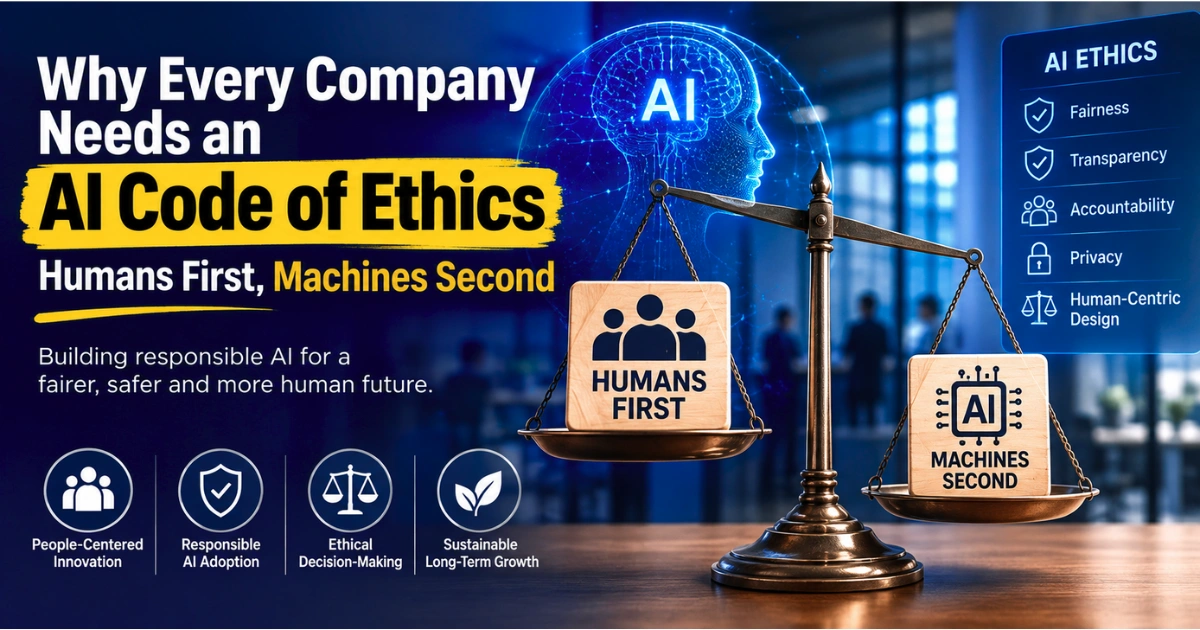
Prioritizing a “humans first, machines second” approach is the only way to maintain corporate ethical integrity in the age of automation. When companies treat artificial intelligence as a hands-off, autonomous black box, they inevitably crash into algorithmic bias.
We have already seen this play out with automated recruitment tools filtering out female candidates and credit-scoring algorithms redlining specific demographic zones.
A structured ethics code acts as the foundational blueprint that forces organizations to audit their digital deployments and align them strictly with human-centric values.
It dictates that technology must serve human flourishing, not merely optimize corporate margins at the expense of fairness.
Operationalizing Integrity Against Algorithmic Bias
How does this philosophy actually work on the engineering floor? A highly functional AI code of ethics acts as a set of hard operational guardrails rather than a forgotten compliance document sitting on a server.
It starts at the very bottom of the tech stack: the data ingestion layer. Before a model is ever trained or fine-tuned, data engineering teams are required to run rigorous audits to identify underrepresented cohorts or skewed variables.
If the raw data reflects historical inequalities, the resulting machine will simply automate and scale those exact inequalities.
Furthermore, this framework demands a “human-in-the-loop” (HITL) architecture for any high-stakes business decision.
Under this model, the AI functions as a high-powered advisory engine, not the final authority.
Whether applied to healthcare diagnostics, legal contract review, or financial lending, the algorithmic output must be routed to an experienced human professional who possesses the nuanced context that a machine fundamentally lacks.
The ethics code structurally mandates this specific workflow, ensuring that speed and efficiency never bypass human accountability.
It also institutionalizes routine red-teaming a practice where security researchers and engineers actively try to break the model to expose harmful biases or logical hallucinations long before the system ever faces the public.
The Architecture of Human-Centric Governance
Executing a human-first AI strategy requires completely rewriting the standard software development lifecycle.
It shifts the engineering focus away from purely optimizing for processing speed to optimizing for fairness, explainability, and user privacy. This introduces the requirement for an AI impact assessment.
Much like an environmental impact study for physical construction, companies must deeply evaluate the potential societal and individual friction of a new algorithmic tool before the project is even greenlit for production.
This governance architecture dictates that models cannot be opaque. If an enterprise algorithm denies a customer a service or flags an account, the company must possess the architecture to trace that specific decision back to its root variables and explain it to the user in plain language.
A robust code of ethics also enforces mandatory, continuous post-deployment monitoring. AI models naturally drift over time as they ingest and interact with new, real-world data.
An ethical and highly accurate system on launch day can easily degrade into a heavily biased engine a few months later.
By mandating regular stress tests, strict version control, and active feedback loops, companies guarantee that their machines remain strictly tethered to the human priorities they were originally built to serve.
Source: Official LiveMint, “‘Humans First, Machines Second’: Why Every Firm Must Have an AI Code of Ethics”