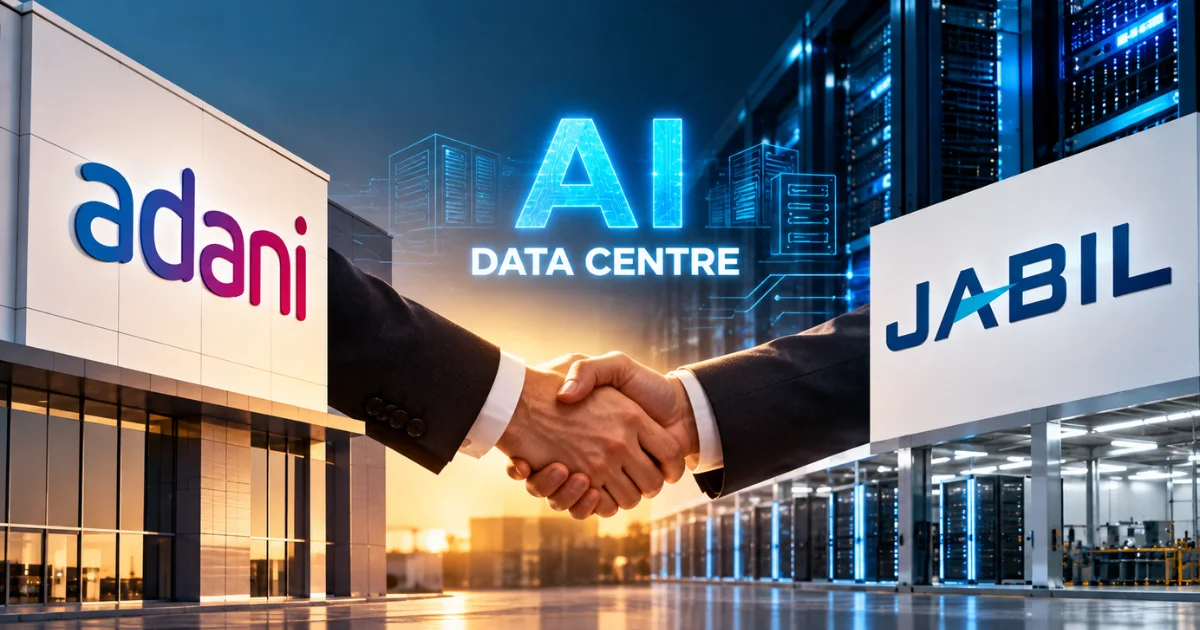

Many people view the artificial intelligence boom strictly as a software revolution. However, anyone working close to the metal understands that AI presents a massive infrastructure challenge. Training large language models and running complex inference workloads demand immense physical hardware, precision engineering, and raw power.
Because of these demands, Adani Enterprises and American manufacturing heavyweight Jabil formed a 50:50 joint venture. They do not plan to just pack standard servers into cold rooms.
Instead, they are building an entirely new industrial architecture in India to fuel the intelligence economy. Therefore, to understand this market shift, we must look at how modern hyperscale facilities operate and why legacy setups can no longer keep up.
The Mechanics of High-Density AI Hardware
Standard cloud computing data centers are completely unequipped for the thermal and power demands of modern artificial intelligence. A traditional server rack might draw somewhere between five to ten kilowatts of power on a busy day.
An AI-specific rack packed with high-performance hardware can easily push past forty or fifty kilowatts. You simply cannot cool that kind of density with standard raised-floor air conditioning. It requires a fundamental redesign of the facility’s physical footprint.
This is where Jabil’s manufacturing pedigree converges with Adani’s massive real estate and energy scale. The framework of their agreement targets the actual lifeblood of these facilities.
They are setting up local manufacturing for AI racks, specialized networking equipment, and high-capacity storage arrays. But more importantly, the venture is deeply focused on the life-support systems of these servers. That means building out massive power distribution units, advanced liquid-cooling systems, and heavy-duty transformers.
Liquid cooling is no longer an exotic luxury in this space; it is a hard physical requirement to keep the silicon from melting down under continuous multi-modal AI workloads. Understanding these physical demands is essential when evaluating the broader AI stack and its underlying infrastructure.
By localizing the assembly of these critical cooling and power delivery systems, the joint venture drastically reduces supply chain friction for hyperscalers trying to deploy immediate capacity in South Asia.
Scaling to Multi-Gigawatt Capacity
The sheer scale of this ambition is difficult to fully grasp without looking at the underlying power metrics. We are talking about building out manufacturing lines capable of supporting several gigawatts of combined computing power. For context, a single gigawatt is roughly the power output of a commercial nuclear reactor.
According to a recent report detailing the joint venture on the Economic Times, the flagship entity of the Adani Group confirmed that this venture will also provide comprehensive installation and commissioning services alongside the hardware manufacturing.
This strategy brilliantly bypasses the traditional, fragmented approach to data center construction. Jabil brings the global engineering precision required to build the intricate rack-level solutions that the world’s largest tech companies demand. Meanwhile, the Adani Group has independently committed a massive hundred billion dollars to develop five gigawatts of strictly green-energy-powered data centers by the year 2035.
You can see the strategic synergy clearly here. Adani provides the renewable energy generation and the concrete facility infrastructure, while this new manufacturing alliance fills those massive facilities with state-of-the-art computing racks. Jabil’s CEO Mike Dastoor noted that establishing a scaled manufacturing platform in India is a critical step for meeting surging demand.
The global supply chain for AI hardware has been notoriously constrained, mostly bottlenecked by specialized component manufacturing and assembly limitations. Solving these hardware bottlenecks is vital for teams focused on how to build scalable AI systems that don’t fail in production
By spinning up a massive, localized production engine in India, the alliance creates a critical relief valve for the entire global market. They are essentially building a vertically integrated pipeline where renewable energy goes in one end, and highly optimized artificial intelligence compute capacity comes out the other.