
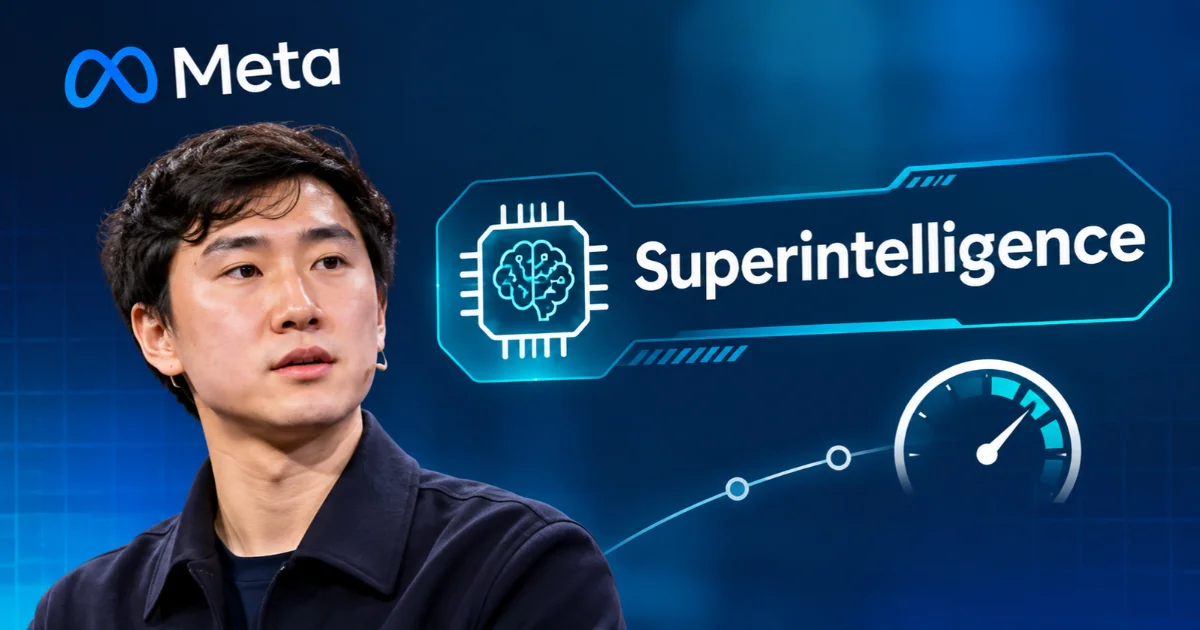
Silicon Valley has spent years treating artificial superintelligence as a distant theoretical milestone, but Meta’s top AI executive thinks the timeline just collapsed. On November 22, 2026, Meta Chief AI Officer Alexandr Wang published a blunt warning on X declaring that “superintelligence is arriving” and arguing that the decisions humanity makes over the next year will carry lasting consequences.
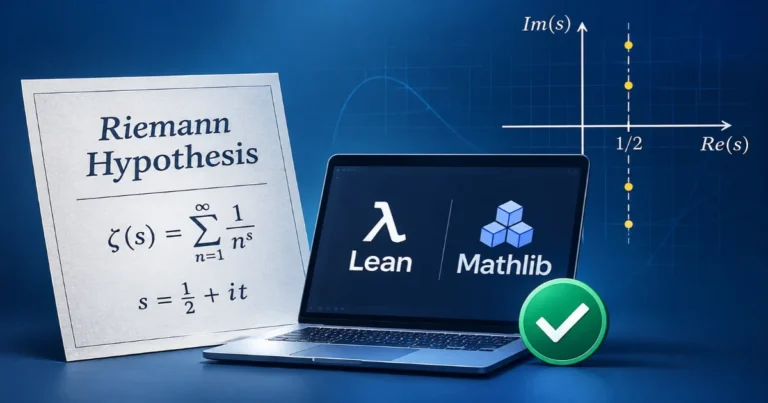
His post came immediately after Anthropic mathematician Levent Alpöge announced a Claude-assisted proof of the Riemann Hypothesis a 167-year-old puzzle about prime numbers that received formal verification from the Lean and Mathlib communities.
Growing up in Los Alamos, New Mexico, Wang noted that many physicists would treat the discovery of the atomic bomb as a “homework problem” next to cracking the Riemann Hypothesis, describing the feat as work completed alongside an “alien mind” humans still do not understand.
Why Raw Intelligence Is No Longer the Bottleneck
To explain why a math proof matters to everyday industries, Wang pointed back to December 2024, when OpenAI’s o3 model began acing the American Invitational Mathematics Examination (AIME). For anyone who competed in math contests, that was the moment everything shifted.
The hardest AIME questions demand more raw intellectual firepower than most day-to-day software engineering, cybersecurity, or corporate strategy work.
Over the two years that followed, AI labs did not need a miracle in reasoning to make models useful; they simply had to supply domain context, tooling, and agentic workflows. Once those tactical gaps closed, coding was nearly solved and autonomous cyber capabilities surged.
According to Alexandr Wang’s post on X, Wang views the Riemann Hypothesis milestone as that exact same pattern playing out on a vastly larger scale. AIME is an extracurricular contest for teenagers, whereas the Riemann Hypothesis has stumped the world’s sharpest mathematicians for more than 150 years.
As Wang’s former professors at MIT often remarked, the toughest intellectual problems in almost every other discipline are easier by comparison. In his view, raw intelligence is no longer the limiting factor keeping machines from outperforming top human experts everywhere. The only remaining hurdles are domain-specific know-how, engineering plumbing, data, and real-world experimentation.
The Risk of Recursive Self-Improvement
That shift carries immediate consequences for how AI itself gets built. Because AI research is far less intellectually demanding than solving the Riemann Hypothesis, Wang warned that frontier models will soon be capable of automating the entire field and improving themselves at a clearly superhuman pace.
At the same time, those systems could accelerate biological research, weapons development, and economics faster than human institutions can monitor or even comprehend. Just as the mathematics community is still struggling to digest a 17-million-line computer-checked proof, governments and labs could find themselves watching critical fields advance beyond human oversight.
Wang made it clear that he finds it hard to imagine humanity keeping control over unconstrained recursive self-improvement or a system 1,000 times smarter than people across every domain. With the core technical barriers to capability progress largely solved, he argued that the industry’s urgent priority must shift to safety, alignment, and security.
He also pushed back hard against what he called “lazy thinking” inside tech circles the fatalistic assumption that a handover of society to AI is inevitable.
In a follow-up clarification, Wang noted that Meta CEO Mark Zuckerberg has directed the company’s AI unit to focus compute on serving people and customers rather than chasing recursive self-improvement. Whether rival labs follow suit, or continue sprinting down the default path, will likely define the next twelve months of the AI race.