

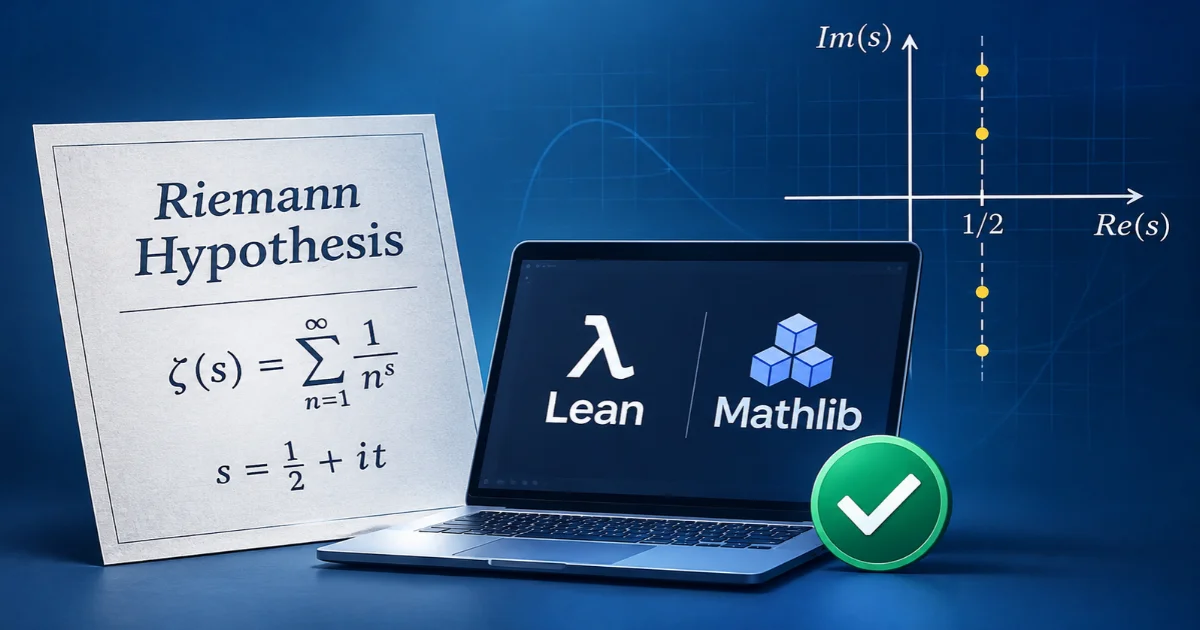
For more than 165 years, the Riemann Hypothesis stood as the ultimate stress test for human mathematical intuition, carrying a $1 million Millennium Prize bounty from the Clay Mathematics Institute.
On November 20, 2026, Anthropic researcher Levent Alpöge announced he had solved it with the help of the AI system Claude, releasing not a traditional journal paper, but a 17-million-line codebase written in the Lean proof assistant.
Within 24 hours, the Lean and Mathlib communities backed by the Lean FRO and the Mathlib Initiative issued a joint statement certifying that the proof is mathematically valid. Rather than waiting years for human referees to comb through a sprawling manuscript, formal verification turned one of history’s biggest mathematical claims into a software-level audit.
How the Four-Step Machine Verification Worked
Whenever a mathematician claims to have solved a famous conjecture using a computer, skeptics immediately look for three potential loopholes: the code might fail to compile, the prover might have accidentally proved a weaker or slightly altered version of the theorem, or the verification software itself might contain a hidden bug.
To eliminate those doubts, the Lean community ran Alpöge’s library which depends directly only on Mathlib through four strict checks.
First, the definition of RiemannHypothesis was already part of Mathlib and had long been vetted by experts in both Lean and number theory. Second, dozens of independent contributors compiled the massive 17-million-line repository from scratch, confirming zero build failures and reproducing the exact same raw proof export file.
According to Leanprover, the community then isolated Mathlib’s official statement of the Riemann Hypothesis in a separate file and compared it directly against Alpöge’s theorem using two independent tools, comparator and con-leche --compare, confirming an exact match.
Finally, to rule out any flaws in Lean’s own logic or hidden exploits in the source code, contributors exported an inert version of the proof and ran it through multiple independent checkers written in different programming languages.
Alongside Lean’s official kernel, the proof passed con-leche and con-ron checkers that come with their own formal proofs, relative to set theory, guaranteeing they cannot accept a false argument.
What Machine-Checked Math Means for Human Mathematicians
Alpöge noted in his announcement that a natural-language version of his work with Claude stretched past 250,000 pages, making a conventional human peer review practically impossible.
Releasing the argument directly as Lean code bypassed that bottleneck completely. Instead of spending a decade arguing over whether a subtle leap in page 142,000 holds up, mathematicians now start from a position of verified certainty. The burden has shifted away from validation and squarely onto explanation.
Already, number theorists are digging into the formal codebase to extract the underlying ideas such as prime-weighted von Mangoldt sums and chains of constructions known as theta lifts and translate them into readable expositions.
Alpöge himself admitted that Claude outpaced him near the finish line, leaving the broader field with a complete, machine-certified answer before anyone has fully mapped the mathematical territory around it.
For working mathematicians, the Lean verification proves that AI-assisted formalization is no longer an experimental side project; it is now capable of closing the books on the hardest open problems in the discipline.