
In the race to control artificial intelligence, raw compute and rare earth minerals only get a country halfway. The real bottleneck is human brainpower. Countries need the handful of researchers who invent new architectures, not just teams wrapping APIs around existing ones.
Scientists like Stanford’s Fei-Fei Li, ResNet creator Kaiming He, and IIT Madras alumna Anima Anandkumar now draw massive industry scrutiny. In fact, they rival billionaire founders in influence.
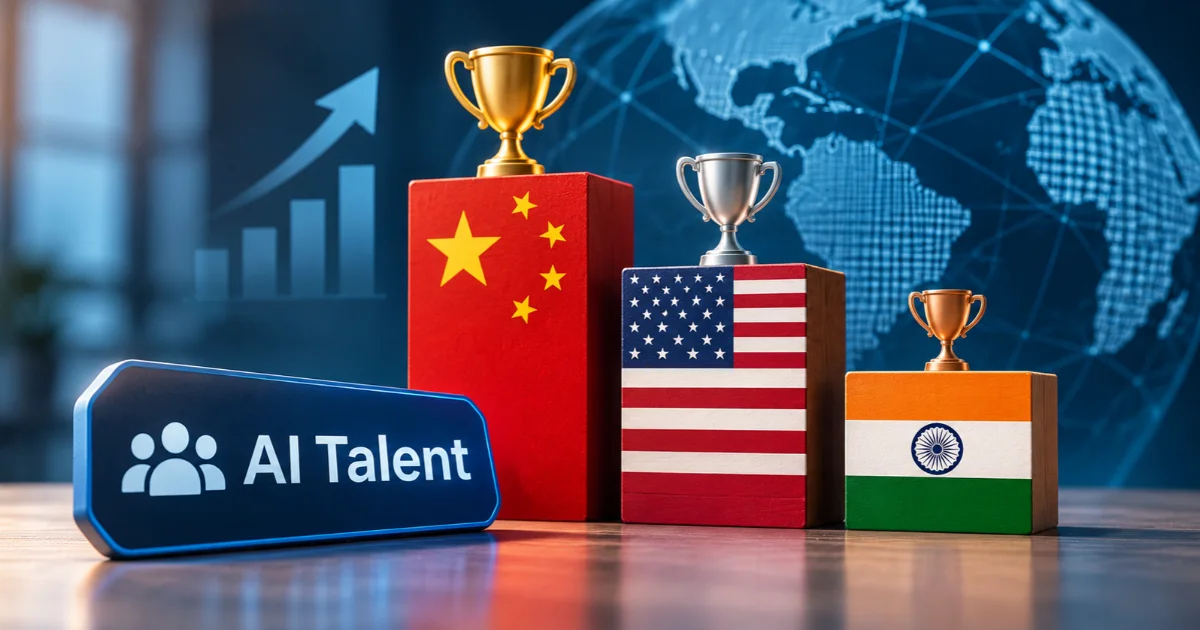
A recent Carnegie Endowment study tracked 10,280 researchers with accepted papers at NeurIPS 2025. Its findings lay bare how lopsided this global AI talent war has become. China has become the world’s premier training ground. Meanwhile, the United States remains the top destination for finished talent, while India struggles on both fronts.
How China Builds the Pipeline While America Pulls It In
China’s dominance starts at the undergraduate level. For over twenty years, Beijing has sustained heavy funding in mathematics, engineering, and university labs. As a result, nearly 60% of elite researchers in the NeurIPS 2025 cohort earned their undergraduate degrees in China.
Peking University now sits at the very top of the global institutional rankings. By contrast, the United States accounted for just 13% of undergraduate origins.
Even more notable is how fast Beijing is reversing its historical brain drain. Today, 41% of the world’s top AI researchers work inside China. A massive domestic ecosystem supports them. China awarded roughly 53,000 science and engineering doctorates in 2022. It also claimed 70% of granted global AI patents and 22.5% of computer science AI citations in 2023.
America still holds the edge when it comes to turning global talent into frontier systems. Of the 3,514 elite researchers working in the US in the Carnegie dataset, 35.7% were educated in China and 34.5% in America, meaning those two pipelines supply roughly 70% of the country’s top AI workforce.
That concentration helped US institutions release 40 notable AI models in 2024 compared with 15 from China, per Stanford’s 2025 AI Index, intensifying the global race between open vs. closed AI models.
Yet Washington’s open-door advantage is showing real strain. According to Carnegie Endowment for International Peace, Stanford University (AI Index), NITI Aayog, rising national-security suspicion toward Chinese-born scientists sharpened by the recent Nvidia controversy and reports of Beijing’s covert efforts to acquire advanced chips is unsettling academic circles across the US.
The detention of Eva Yi Xie, a Chinese-born Princeton doctoral student and MIT graduate held by immigration authorities at Reagan National Airport while returning from a neuroscience conference despite her lawyers citing valid work authorization, shows how easily an aggressive immigration posture can chill the very research community American labs depend on.
Why India Faces Both a Research Shortage and Brain Drain
India’s predicament is far more structural than a simple retention problem. While China trained over 4,000 researchers in the elite NeurIPS cohort, India educated just 411. Worse still, roughly 90% of that already small pool around 370 researchers left the country, moving overwhelmingly to the United States, where 285 India-educated scientists make up 8.1% of the American elite workforce.
Only about 10% remained in India. Between 2022 and 2025, India’s overall share of top global AI researchers slipped by two percentage points, and not a single Indian university appeared among the leading institutions producing this caliber of talent.
The gap traces directly back to doctoral output and research infrastructure. India awarded around 23,000 science and engineering PhDs in 2021, less than half of America’s 45,000 in 2023 and well behind China’s 53,000.
Zoom in on computer science and the disparity looks even starker: India produced just 621 computer science PhDs compared with 2,874 in the US. While India’s share of global AI citations crept up from 3.2% in 2013 to 6% in 2023, NITI Aayog’s own assessment notes that its share of granted AI patents remains negligible.
That does not mean domestic capability is absent. Bengaluru-based Sarvam has shown what focused Indian teams can build, rolling out 30-billion and 105-billion-parameter models in 2026 a reminder that bigger AI models don’t always mean better AI when teams optimize for regional needs after India missed Stanford’s 2024 benchmark entirely.
Still, isolated startups cannot substitute for a national research engine. Until New Delhi invests heavily in doctoral fellowships, university compute, and competitive lab salaries, India will keep exporting its sharpest minds to Silicon Valley while Beijing and Washington set the terms of the AI economy.