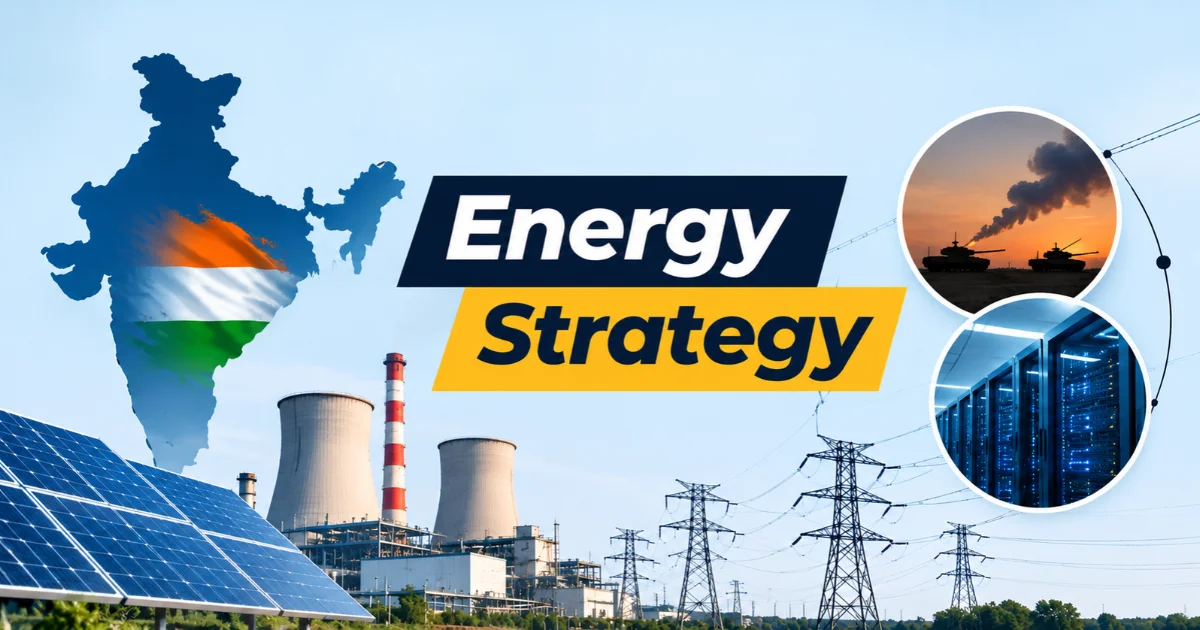

The global energy landscape is currently caught in a relentless squeeze between traditional geopolitical volatility and the sudden, massive power requirements of the modern digital economy.
As international conflicts disrupt critical refineries and redraw supply chains, the artificial intelligence boom is simultaneously pulling unprecedented amounts of electricity from the grid.
For a rapidly growing economy like India, which has historically relied heavily on imported fossil fuels, this convergence of pressures creates a serious security challenge.
However, instead of remaining entirely exposed to international supply shocks and elevated transportation costs, India is aggressively rewriting its power generation playbook.
By accelerating a shift toward domestic renewable resources, the country is proving that clean energy is no longer just a climate commitment, but a foundational economic shield.
Navigating Geopolitical Shocks and the AI Squeeze
Recent escalations in the Middle East and Eastern Europe have exposed the fragile nature of global energy networks. Disruptions now go beyond delayed crude oil shipments in strategic waterways.
Attackers increasingly target entire refineries and infrastructure hubs. Targeted attacks drop global crude throughput significantly. Import-dependent countries then face immediate spikes in freight, insurance, and fuel prices.
Geopolitical uncertainty alone makes procuring energy significantly more expensive, even without severed physical supplies.
While these supply-side anxieties grow, the rapid scaling of artificial intelligence presents an entirely different demand-side problem.
Data centers, which house the servers and intense cooling systems required for AI processing, demand massive, uninterrupted electricity. Unlike traditional manufacturing facilities, these digital hubs cannot easily power down during grid fluctuations.
India is quickly emerging as a primary destination for this infrastructure, with domestic projections indicating an additional electrical load of over 26 gigawatts from AI data centers alone by the early 2030s.
Meeting this surging demand entirely through imported coal and natural gas would severely compromise the nation’s economic stability and expose domestic power costs to unpredictable global commodity markets.
Building an Economic Buffer Through Renewables
To counter these overlapping threats, India is scaling its solar and wind infrastructure at an unprecedented pace.
The country has already achieved its initial target of sourcing half its installed power capacity from non-fossil fuels well ahead of schedule, pushing its total renewable capacity past 300 gigawatts in 2026. This aggressive domestic expansion is generating massive financial returns.
According to a detailed market analysis published at The Economic Times, shifting to renewable generation has helped India avoid over $100 billion in cumulative coal and natural gas import expenditures over the past decade and a half.
If the current trajectory holds, cumulative savings on fossil fuel imports could reach a staggering $240 billion by the end of the decade.
The physical implementation still faces hurdles, particularly regarding the need to store power for peak evening hours when daylight fades and solar generation drops off.
Recognizing this bottleneck, massive government investments are now being directed toward grid modernization and battery storage to ensure that the clean electricity generated during the day can reliably power nighttime consumption.
New state utility requirements are mandating battery storage integration for future projects.
Ultimately, building a self-reliant power grid backed by robust storage is the most effective way to insulate national economic growth from unpredictable foreign conflicts and the ravenous energy appetite of the next technological revolution.