
The rapid acceleration of artificial intelligence has blurred the lines between technological innovation and national security. For years, Silicon Valley operated with relative autonomy, building the infrastructure of the future while Washington struggled to keep pace with the underlying science.
That dynamic is shifting violently as AI becomes the most critical asset in global geopolitical dominance.
The stakes are no longer just market share or consumer data; they now involve deep-state espionage, sovereign capabilities, and the very real threat of federal imprisonment for executives who cross invisible red lines.
A direct threat from the Oval Office
The escalating tension between the government and tech elites recently spilled into public view following explosive claims involving one of the industry’s most valuable players.
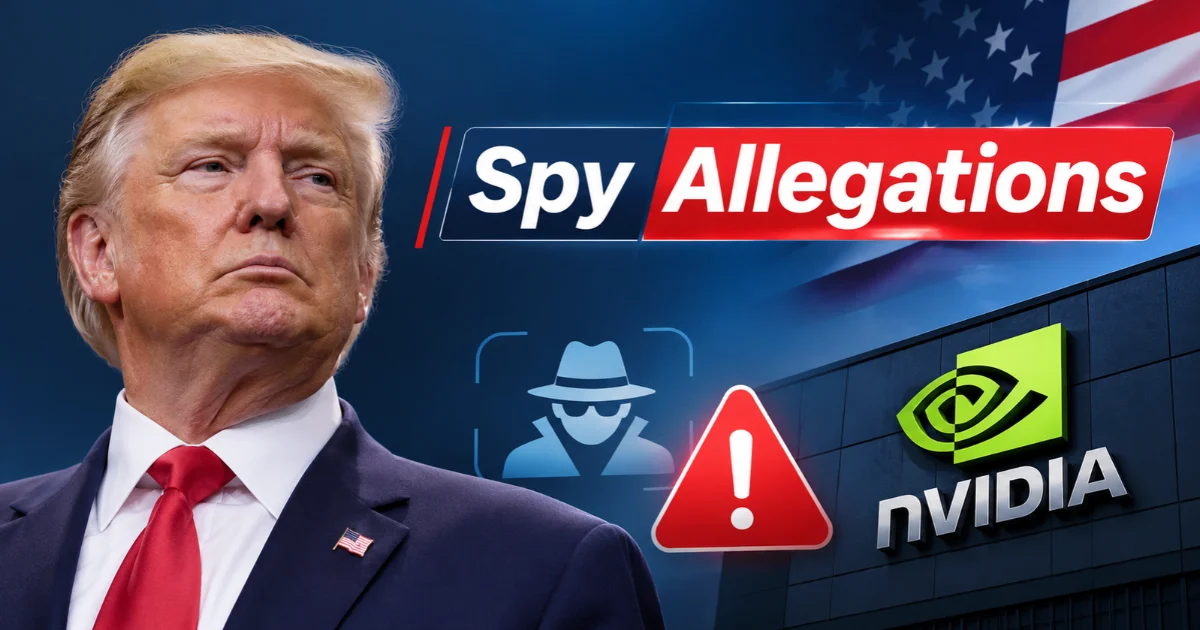
As controversy continues to swirl around Nvidia CEO Jensen Huang and the allegations of Chinese espionage tied to former Megaspeed executive Alice Huang, former US President Donald Trump added fuel to the fire.
During a recent interview with 60 Minutes correspondent Ross Douthat, Trump claimed that his administration once directly threatened the leader of a major AI firm with severe legal consequences.
According to a detailed report covering the geopolitical fallout at Money control, Trump explicitly told the unnamed executive to get ready to go to jail for doing something bad with AI.
He intentionally withheld the identity of both the individual and the corporation, leaving the tech industry to wildly speculate about who was on the receiving end of the ultimatum.
This revelation exposes a harsh reality about how the government views artificial intelligence. It is no longer just software; it is being treated as a highly sensitive weapons system.
The mechanics of shadow regulation
Understanding how these backroom warnings work requires looking past standard regulatory frameworks.
Congress has notoriously lagged in passing comprehensive legislation regarding machine learning and generative models, leaving a vacuum that the executive branch has historically filled through direct pressure.
When a major tech entity engages in behavior deemed a national security risk whether that involves careless data sharing with foreign adversaries or developing models with dangerous autonomous capabilities the initial response is rarely a public fine.
Instead, intelligence agencies brief the administration, leading to closed-door confrontations where the ultimate leverage is federal prosecution.
The government relies on broad statutes related to national security, export controls, and corporate espionage to force immediate compliance from tech billionaires.
The Nvidia spy allegations currently dominating headlines serve as a perfect backdrop for Trump’s anecdote, highlighting how deeply intertwined foreign intelligence operations have become with cutting-edge chip manufacturing and neural network training.
For the leaders of these massive AI companies, the message is unmistakably clear. Operating at the absolute frontier of technology now means navigating a minefield of international rivalries, where a misstep does not just result in a loss of stock value, but the very real possibility of losing their freedom.