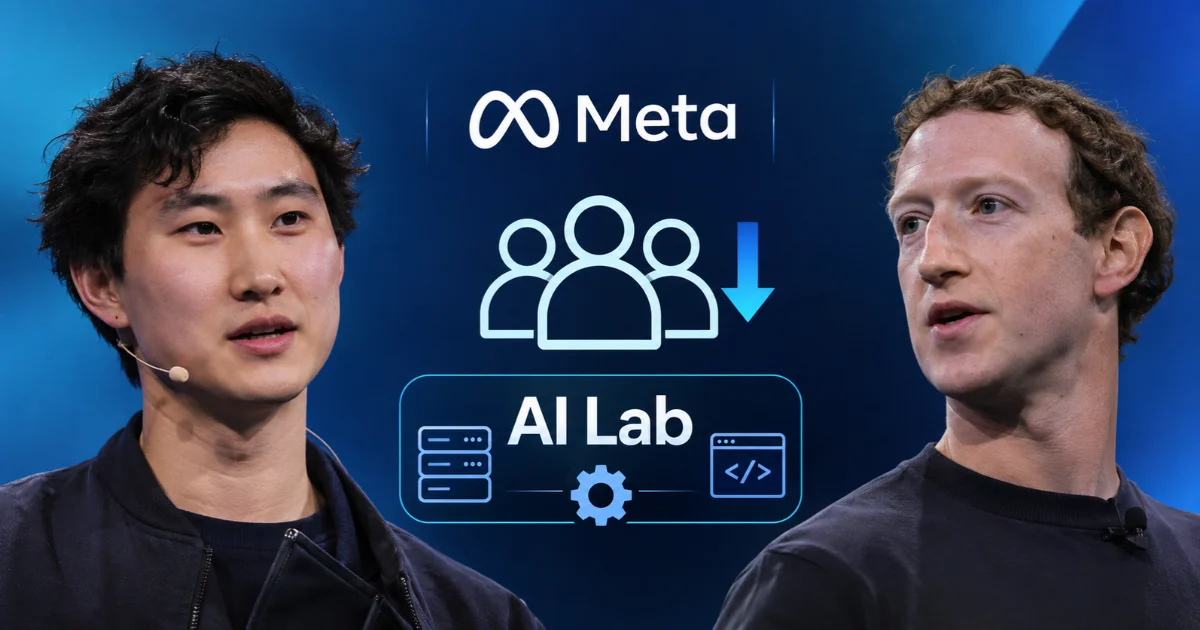

In the rapidly expanding universe of artificial intelligence development, the prevailing strategy for major tech conglomerates has traditionally been brute force: hire as many engineers as possible and build massive, sprawling divisions. However, the architecture of Meta’s latest artificial intelligence ambitions was built on a radically different premise.
When Meta faced a critical juncture in its developmental roadmap following the somewhat underwhelming reception of its earlier Llama 4 models, CEO Mark Zuckerberg sought a fresh perspective. He found it in Alexandr Wang, the 29-year-old co-founder of Scale AI.
The partnership between the two tech leaders began organically, but it fundamentally altered how Meta approaches its workforce and research strategies.
Rather than aggressively expanding the employee roster to match the headcount of competing labs, Wang presented a counterintuitive vision that prioritized an extreme concentration of expertise over a sprawling corporate hierarchy.
Prioritizing Talent Density Over Headcount
Wang drafted his strategy before officially accepting the leadership role. He currently leads the new Meta Superintelligence Labs. Zuckerberg initiated a 44-minute WhatsApp call in April 2025. Afterward, Wang wrote a comprehensive memo detailing his restructuring plans.
His core philosophy was remarkably straightforward. The frontier model race does not require thousands of engineers. Instead, the focus must remain entirely on talent density. A tight-knit group of exceptional researchers can easily outpace a massive team.
According to a detailed report published at Times of India, Zuckerberg fully embraced this first principle alongside a willingness to scrap previous architectures and rebuild from scratch.
The recruitment drive that followed was intense and highly targeted, described by Zuckerberg as a supernova effort.
Meta acquired a massive 49 percent stake in Scale AI for 14.3 billion dollars to secure Wang’s leadership and reportedly utilized extraordinary compensation packages to poach top researchers directly from rivals like OpenAI.
As a result, the core research group under Wang operates with fewer than two hundred individuals and perhaps closer to one hundred which is a remarkably lean operation nested within a broader corporate structure of 75,000 employees.
High-Stakes Development and Shifting Corporate Culture
Industry observers saw this move as a bold gamble. Wang is known primarily for data labeling, not training frontier models. However, Zuckerberg possessed deep conviction in Wang’s capabilities. He formed this belief after consulting various industry research heads.
This lean lab environment relies on a high-pressure culture. Wang notes that insecure overachievers drive this intense workplace. Staggering financial realities certainly warrant this immense pressure. Experts project Meta’s capital spending will nearly double.
It could reach up to 145 billion dollars in 2026. Executives issued a clear warning at recent company gatherings. The new generative models simply cannot fail. Failure would cause severe financial repercussions for the company. Fortunately, this hyper-focused approach shows highly encouraging immediate results.
The lab rapidly shipped Muse Spark, followed closely by the frontier-class Muse Wonder, which currently ranks as a state-of-the-art model for professional agent tasks and competes closely with leading models from OpenAI and Anthropic.
Furthermore, the consumer-facing Muse application became an instant success, topping app store charts with millions of downloads within weeks of its US release. This rapid turnaround highlights how a smaller, elite workforce operating under clear directives and immense financial backing can efficiently pivot a tech giant’s trajectory.