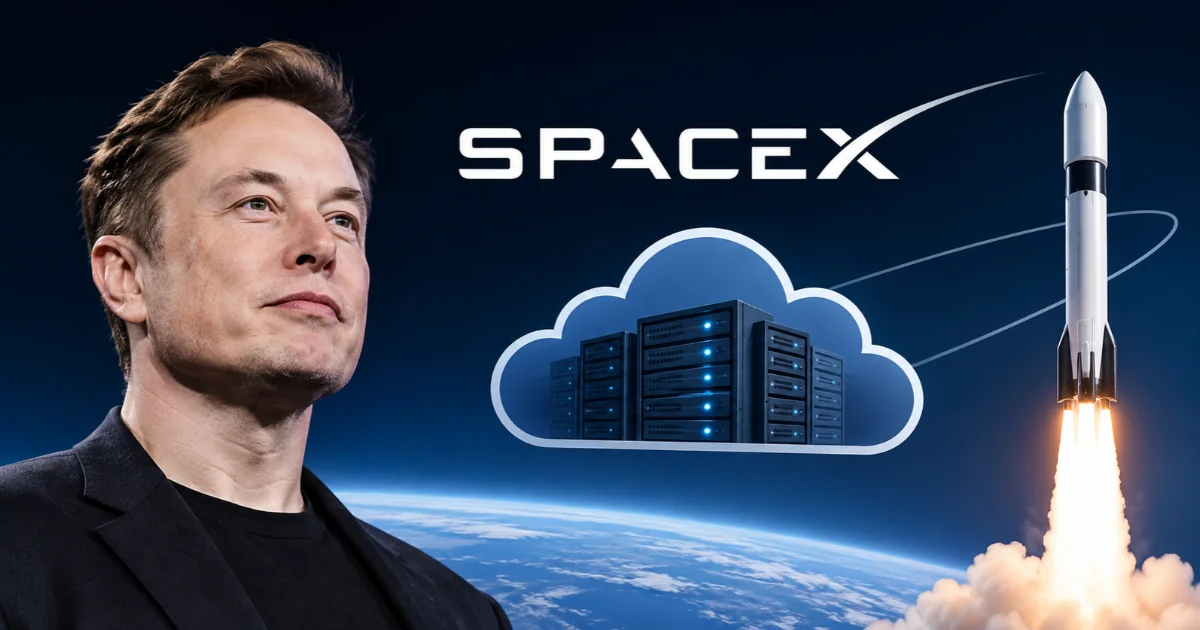

The narrative around SpaceX is aggressively pivoting from orbital logistics to sheer planetary compute density. Elon Musk is rearchitecting his aerospace pipeline into a brute-force artificial intelligence infrastructure play, leveraging vast real estate and localized grid solutions to outpace traditional hyperscalers.
The market initially dismissed this idea as a chaotic distraction. Reality proves them wrong. Amazon and Microsoft face long municipal zoning delays. They also struggle with slow grid interconnection queues. Meanwhile, SpaceX is forcing gigawatt-scale data centers into existence.
The physics of scaling AI models requires massive power and fast physical deployment. SpaceX has mastered these exact friction points over the last decade. They do not wait for utilities to upgrade transmission lines. Instead, they deploy behind-the-meter turbines and giant battery systems.
This guarantees absolute uptime. The team is repurposing hardware expertise originally meant for Starship. They stack massive liquid-cooled server clusters incredibly fast. Silicon Valley cannot pour concrete this quickly.
Repurposing Aerospace Campuses for Gigawatt Compute
SpaceX is weaponizing its existing rocket campuses to construct compute infrastructure at unprecedented speeds.
Transforming heavy industrial zones into server farms allows them to bypass the traditional real estate acquisition bottlenecks that paralyze Amazon Web Services and Google Cloud.
According to a recent at Semi analysis, technical deep-dive the company is on track to complete a staggering 13 gigawatts of power capacity by late 2027. The math behind this expansion is brutal and undeniable.
There is already 3.6 gigawatts actively under construction right now, with analysts identifying an additional 9 gigawatts of potential sites across the broader SpaceX portfolio.
This relentless pace makes them the fastest data center builder globally, easily eclipsing the rapid deployment metrics historically dominated by massive Chinese infrastructure firms.
The forthcoming “Colossus 2” expansion alone is projected to add roughly two gigawatts of capacity in just under twelve months. This is not standard modular data center construction. It is a militarized supply chain operation.
SpaceX is physically slotting compute blocks into heavy manufacturing footprints, relying on localized power generation to light up server racks the moment they are bolted to the floor. The latency between hardware delivery and live training runs is collapsing entirely.
The Economics of a Vertically Integrated Hyper-Cloud
Building the iron is useless without the tenant demand to absorb the capital expenditure. The market validation for this pivot is materializing through staggering enterprise compute agreements that instantly legitimize SpaceX as a top-tier cloud vendor.
Recent industry channel checks indicate massive capital inflows securing this capacity, including a reported $6.3 billion deal with Reflection AI that anchors the Colossus architecture as the premier AI cloud on the planet.
Broader ecosystem rumors point to even larger structural compute deals with frontier model builders like Anthropic, theoretically scaling up to $120.5 billion over the lifetime of the contract.
Musk understands that artificial intelligence is currently constrained by energy availability and physical cooling limits rather than algorithmic theory.
By owning the land, generating the power off-grid, and bypassing bureaucratic zoning delays, SpaceX drastically undercuts the standard timeline for standing up frontier training clusters.
Hyperscalers are fundamentally software businesses attempting to learn heavy construction. SpaceX is a heavy construction and physics company that happens to be plugging in GPUs.
The capital efficiency of this model redefines the AI infrastructure baseline, shifting the core industry bottleneck away from semiconductor yields directly to energy deployment and physical thermal management.