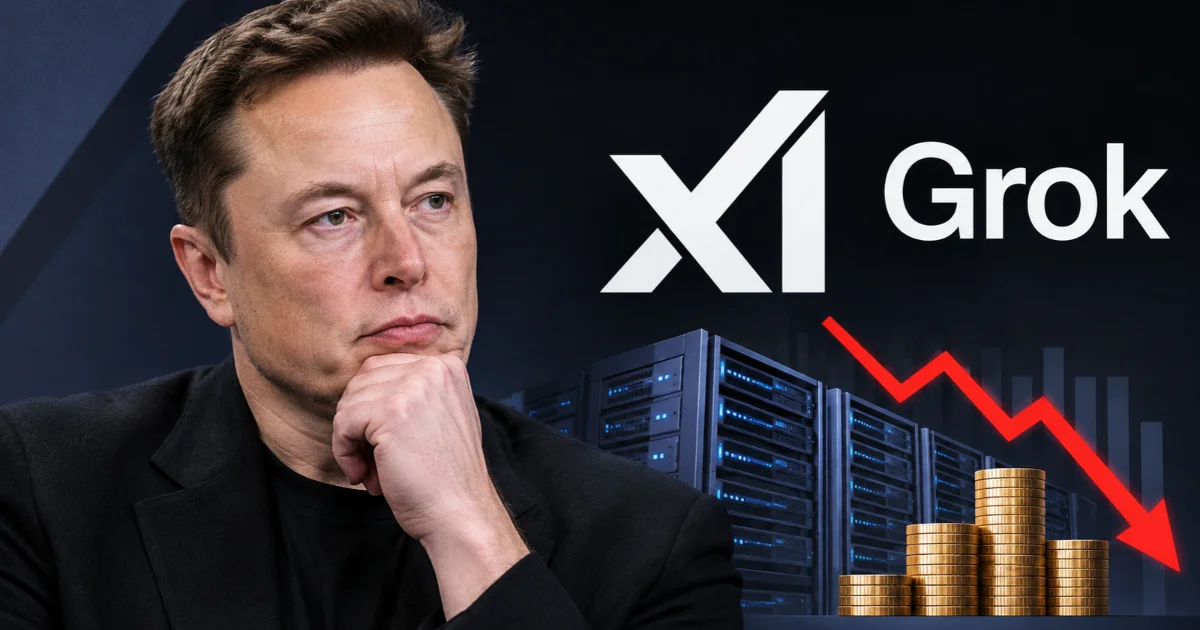

The AI industry currently faces a massive reality check. Keeping sophisticated machine learning systems online is incredibly expensive. Consumers love the expanding capabilities of digital agents. However, the required underlying infrastructure is quietly bleeding companies dry.
Elon Musk recently revealed this crisis at his own venture, xAI. Paid subscribers recently complained about exhausting their weekly Grok Bot usage allowances. Musk offered a highly transparent and sobering explanation in response.
He stated the cost of serving the autonomous agent is unsustainably high. It costs far more than the subscription revenue generates. This admission highlights a growing tech sector friction point. Demand for continuous computing heavily outpaces current monetization models.
Operating advanced models requires massive data centers, cooling infrastructure, and immense power consumption, turning what seems like a purely software-based product into a heavy industrial expense.
The Infrastructure Demands of Background Agents
To understand why operating expenses are spiraling, it helps to look at the mechanical differences between early-generation chatbots and xAI’s current offerings.
Grok Bot does not simply wait for a single prompt, generate a short text response, and then power down. Instead, it functions as an autonomous background agent that actively navigates the web, synthesizes deep research, and executes multi-step workflows within isolated virtual environments.
Because the system iterates through continuous reasoning loops rather than producing a one-off answer, every active session consumes an astonishing volume of graphics processing unit cycles.
When a user questioned if usage caps could be reset after running out of quota prematurely, Musk firmly declined, citing the immediate financial realities of the hardware strain.
According to detailed industry coverage at Times of India, the fundamental problem plaguing xAI and its competitors is that operating these highly capable multi-turn reasoning models drains cash much faster than flat-rate subscription fees can replenish it.
The massive hardware required to process these extended context windows means every background task is actively burning server time, requiring companies to rethink how much freedom they can actually afford to give their users.
Scaling Up the Financial Deficit
Traditional software models rely on scaling to acquire massive user bases. This amortizes fixed overhead costs and eventually leads to profitability. In the generative compute space, this logic runs entirely in reverse. xAI bundled its advanced agent directly into existing paid tiers.
They did not establish dedicated, usage-based pricing. The bot rapidly scaled to hundreds of thousands of active users. This massive volume of processing demands magnified the company’s underlying compute deficit.
Every user executing complex background tasks increases variable costs. This includes server electricity, GPU wear, and network bandwidth. Financial trackers noted xAI burning through billions in cash. Reports indicate they spent around eight billion in just nine months.
Building and maintaining competitive infrastructure requires massive capital. Securing lucrative deployment contracts and courting private capital keeps servers running. However, the core mathematical problem remains unsolved.
The computational cost of generating automated actions heavily outweighs the revenue they generate. The broader market already sees the consequences of this imbalance. Smaller platforms throttle features behind rigid paywalls or fold entirely.
Musk made a rare public acknowledgment of these high serving expenses. This signals a definitive shift for the next era of technological advancement. Success depends entirely on drastically lowering compute costs before hardware bills outpace investor patience.