
The Indian telecommunications sector faces another massive technological shift. A few years ago, Reliance Jio completely overhauled data consumption for a billion people.
They turned high-speed internet access from an expensive luxury into an everyday utility. Now, the conglomerate looks well beyond mobile broadband and standard network connections.
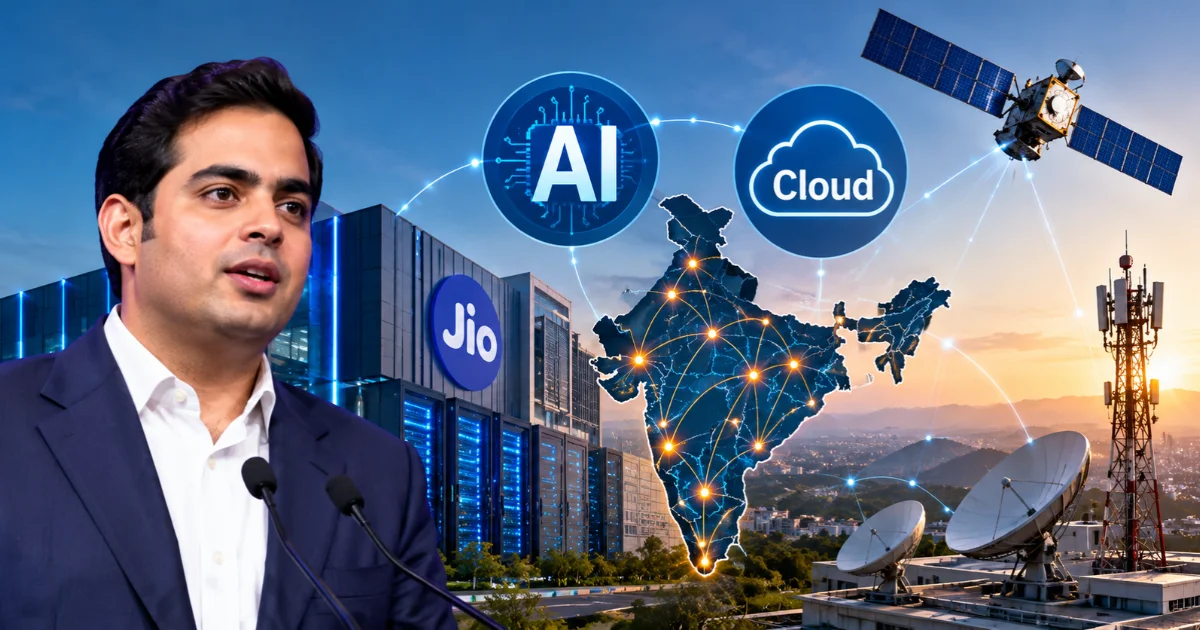
Managing Director Akash Ambani outlined a bold new vision during Jio Platforms’ highly anticipated stock market debut. He made it clear that the initial data revolution only laid the foundation for a larger ecosystem.
Over the next decade, Jio will put advanced technologies directly into the hands of the masses. The ambition goes beyond getting citizens online. Jio wants to provide the computing power and intelligence necessary for a globally competitive digital economy.
Democratizing Artificial Intelligence and Cloud Infrastructure
The idea of democratizing tech is popular in corporate presentations, but executing it on an Indian scale requires an entirely different approach to digital infrastructure.
Ambani’s roadmap specifically targets artificial intelligence and cloud computing, two critical sectors traditionally dominated by global heavyweights like Amazon, Google, and Microsoft.
Jio’s strategy involves building vast, proprietary data centers equipped with massive GPU clusters to offer scalable cloud resources and localized AI services.
This marks a deliberate pivot toward both the enterprise and consumer markets. Small and medium businesses across India often find international cloud and AI services prohibitively expensive or too complex to integrate.
By localizing these data nodes and pushing edge computing capabilities across the country, Jio intends to drastically lower the barrier to entry.
According to a detailed report on the historic stock listing at The Economic Times, Ambani emphasized that the company’s next phase will focus heavily on democratizing every technology capable of transforming lives.
The core objective is to ensure that machine learning models, intelligent automation, and advanced data analytics are not restricted to top-tier tech firms but are readily accessible to a local logistics company or a regional healthcare provider.
Bridging the Gap with Space-Based Connectivity
While artificial intelligence and affordable cloud services address the computing deficit, the physical reach of the internet remains a persistent hurdle in geographically challenging regions. To solve this, the second major pillar of Akash Ambani’s strategy relies heavily on space connectivity.
Urban centers in India currently enjoy robust broadband penetration, but laying fiber-optic cables through difficult terrains like dense forests or high-altitude mountain ranges has always been economically unviable. This is exactly where satellite internet enters the picture.
By partnering with low Earth orbit satellite networks and establishing hybrid ground stations, Jio plans to beam high-speed digital access directly to the most remote corners of the subcontinent.
This ambitious move positions the company in direct competition with global satellite broadband players who are also eyeing the lucrative Indian market.
However, Jio brings a massive inherent advantage to this race: an existing, sticky subscriber base of over 400 million users and a deep, battle-tested understanding of local pricing dynamics.
When satellite connectivity is directly integrated with accessible cloud infrastructure and localized AI tools, the real-world applications become incredibly powerful.
For example, a farmer in a deeply remote village could access real-time, AI-driven agricultural analytics, processed on a domestic cloud server and delivered instantly via a space-based network.
Ambani noted during the listing ceremony that India has spent years being a consumer of global technology, but this integrated approach is designed to turn the country into an active creator.
The sheer scale of combining AI, cloud, and space networks under one affordable umbrella could fundamentally alter how digital economies operate across emerging markets over the next ten years.