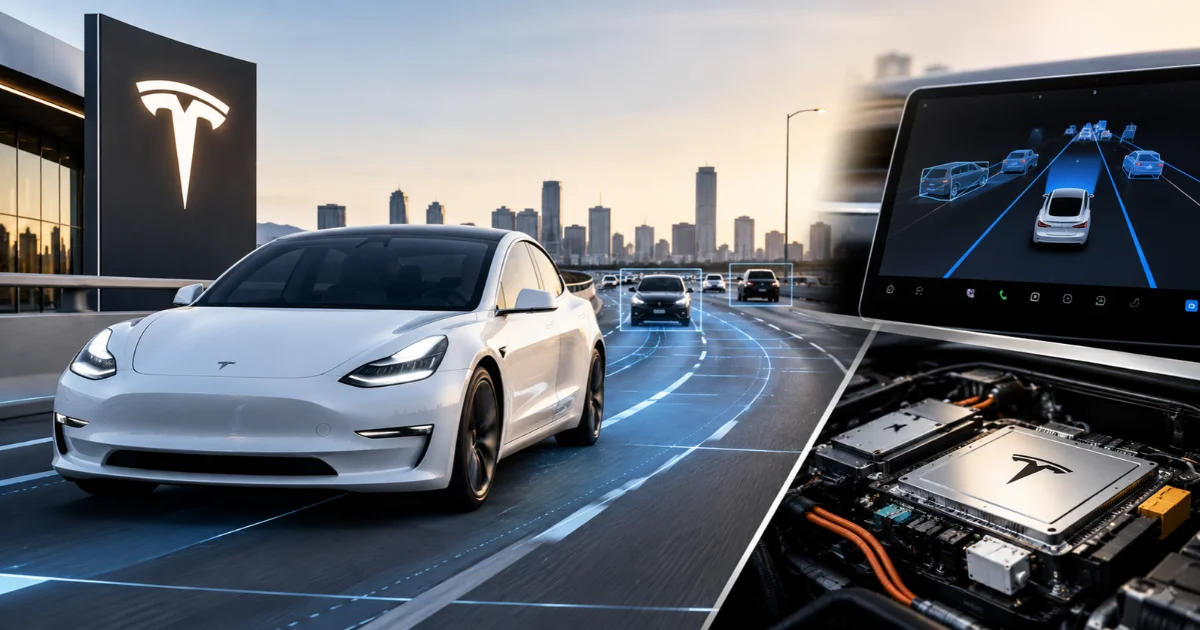

The automotive industry is undergoing a fundamental economic shift, moving away from traditional hardware margins and pivoting aggressively toward software.
For years, the narrative surrounding electric vehicle manufacturers focused heavily on factory output, battery efficiency, and delivery targets. That conversation is changing.
The core value of a modern vehicle is increasingly defined by the code running in its onboard computers rather than the steel of its chassis.
Tesla is actively engineering a transition to capitalize on this reality, positioning artificial intelligence and autonomous driving software as the primary engines for future profitability.
By treating the vehicle as a rolling hardware platform, the company is preparing for a future where digital subscriptions generate more consistent, high-margin revenue than the one-time sale of physical cars.
The Economics of Artificial Intelligence on Wheels
At the center of this strategic realignment is the Full Self-Driving platform, a system designed to incrementally take over the operational burden from human drivers.
Despite the ambitious branding, the current iteration remains a supervised technology that requires constant human oversight. Yet, consumer appetite for these advanced features is surging.
Over three-quarters of new vehicles rolling off Tesla lots in North America are now equipped with the supervised version of the software.
To understand the financial mechanics behind this, one must look at the transition to a recurring revenue model. Unlike traditional car sales that yield a single profit event, software subscriptions provide a continuous cash flow stream.
According to a recent industry analysis at Mezha, the number of active subscriptions worldwide has swelled to 1.7 million, representing a massive 67 percent increase from the previous year.
Analysts note that driving the subscription adoption rate from its historical base of roughly ten to fifteen percent up to fifty percent would entirely rewrite the financial architecture of the automaker.
It transforms a capital-intensive manufacturing business into a high-margin technology enterprise, where every new vehicle on the road serves as a permanent node for monthly software monetization.
Global Rivals and the Regulatory Roadblocks
This pivot toward artificial intelligence is not happening in a vacuum. The global electric vehicle market is fiercely competitive, forcing legacy and emerging brands alike to accelerate their own autonomous programs.
Chinese manufacturers are rapidly closing the technological gap. BYD has already demonstrated immense manufacturing scale. Meanwhile, companies like Xpeng aggressively develop proprietary autonomous systems for foreign traction.
Giants like Mercedes-Benz, BMW, and General Motors also pour capital into sophisticated driver assistance suites. They want to avoid product obsolescence.
However, the real battleground extends beyond software capabilities into the complex realm of government regulation. Deploying these systems globally requires navigating a patchwork of strict safety frameworks. Supervised driving has operational approval in places like the Netherlands. Yet, fully autonomous systems still face strict EU regulatory scrutiny.
Discussions of deeper corporate integrations also complicate this strategy. Leadership explores synergies between the automotive business and aerospace ventures like SpaceX.
Sharing AI architecture and material science could accelerate neural network training. However, it also compounds the operational risks. The true challenge lies in balancing this bleeding-edge machine learning with the rigid limitations of international transport laws.