
The enterprise software ecosystem is currently choking on its own technical debt, while executive boards mistakenly believe deploying a few AI coding assistants will magically untangle decades of legacy architecture.
Individual developers have already integrated tools into their daily routines, often turning to the 7 Best AI Coding Assistants for Developers to boost personal productivity.
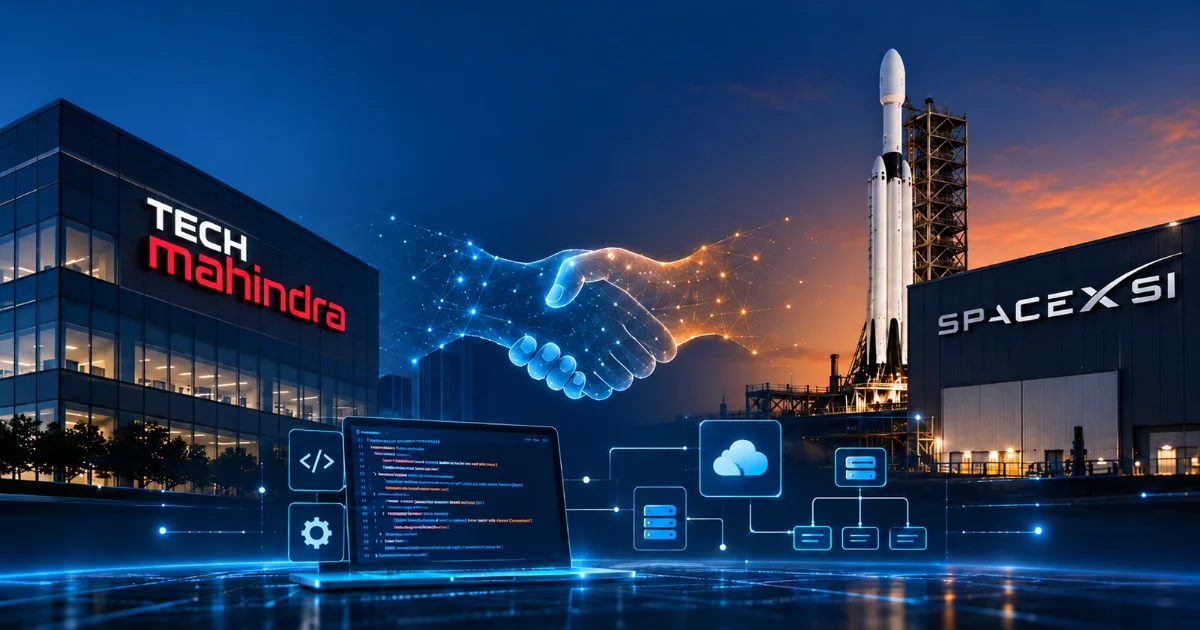
However, scaling these isolated tools across large, distributed engineering teams creates friction. Organizations struggle to maintain compliance rules and protect production pipelines. Tech Mahindra’s partnership with SpaceXSI tackles this exact bottleneck.
Instead of launching another generic AI wrapper, this collaboration embeds SpaceXSI’s Grok Build directly into enterprise workflows. Generating raw code is relatively inexpensive. In contrast, maintaining security, governance, and architecture across thousands of repositories quickly drains enterprise budgets.
The End of Isolated Sandbox Experiments
Most organizations are stuck in a holding pattern of localized AI pilots that generate impressive demos but fail to deliver measurable business outcomes.
Enterprise IT departments are discovering that handing engineers a sophisticated AI agent does not automatically modernize monolithic applications or cleanly rewrite millions of lines of undocumented Java.
Moving past The $45,000 Sandbox Illusion: Why Enterprise AI is Bleeding Cash, the integration between Tech Mahindra and SpaceXSI pivots away from these isolated test environments. By tying Grok Build into Tech Mahindra’s existing application modernization services, the focus moves entirely to deployment architecture and cost control.
Enterprises operating in heavily regulated sectors like banking, telecommunications, and healthcare cannot afford unpredictable hallucinations infiltrating their mission-critical transaction engines. They require deterministic outputs and rigid guardrails.
This partnership targets the orchestration layer, ensuring that when an AI agent refactors a legacy module, the resulting codebase adheres to strict corporate governance protocols rather than just optimizing for speed.
According to the coverage from Reuters detailing the announcement, the immediate mandate is accelerating the agonizing process of legacy software migration.
Toni Adams, Head of Global Partnerships at SpaceXSI, accurately diagnosed the current enterprise paralysis, noting that companies no longer need convincing about AI’s potential.
They need robust mechanical processes for rolling these systems out across diverse engineering teams without shattering what already works. This requires aggressive infrastructure management, stringent access controls, and a complete overhaul of continuous integration and deployment pipelines to accommodate AI-generated pull requests safely.
Orchestrating Architecture Over Hype
Setting up an AI coding assistant in a local environment takes only minutes. Conversely, rolling out that tool across a multinational bank requires months of security audits, pipeline redesigns, and risk assessments. Tech Mahindra bridges this divide by wrapping core AI models in operational governance.
Furthermore, the joint initiative provides dedicated enablement and certification programs. These programs establish clear rules for how AI tools interact with proprietary data.
For example, when Grok Build maps dependencies in a legacy banking system, it runs inside a secure boundary. This prevents data leaks while allowing the model to grasp the broader software architecture.
Ultimately, this alliance marks a major shift in software engineering. The industry is moving past generative novelty and confronting the realities of system architecture. Enterprises with aging codebases face two choices.
They can rewrite decaying infrastructure manually at great cost, or they can use governed AI agents to accelerate migration.
The Tech Mahindra and SpaceXSI partnership delivers a pragmatic path forward. It prioritizes predictable orchestration, risk mitigation, and verifiable ROI over raw code output. In the end, surviving organizations will treat AI as a core architectural asset that requires disciplined engineering at scale.