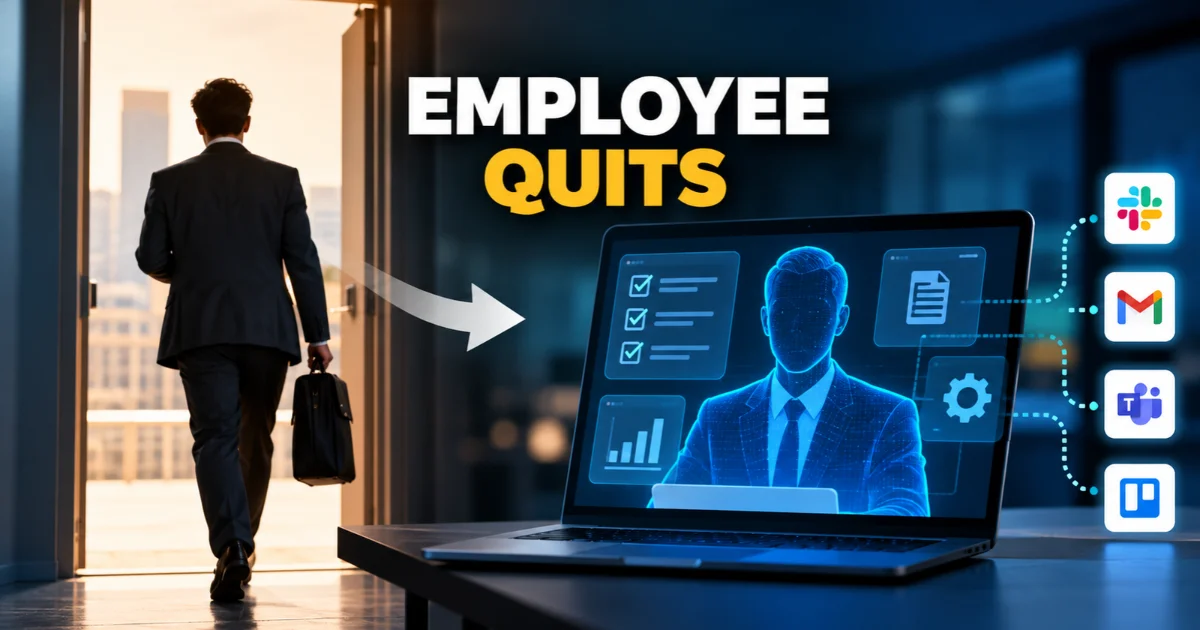

Turnover is a standard reality of running a business, but one company found a highly unconventional way to deal with an empty desk. A Chinese gaming firm made headlines after it successfully replaced a departing human resources employee with a fully functional artificial intelligence replica of that exact same person.
Rather than simply automating the vacant role with a generic software tool, the company fed the former employee’s institutional knowledge and behavioral quirks into an algorithm.
The result was a virtual agent that stayed behind to manage the workload long after the actual human had handed in his resignation.
The experiment triggered massive debates across social media platforms like Weibo, highlighting how AI employees are here and autonomous agents are replacing traditional roles while blurring the lines between workplace efficiency, intellectual property, and personal privacy.
The Mechanics of Digital Distillation
Creating a digital clone capable of executing specialized office tasks requires a technical process known in the machine learning community as distillation. Instead of relying on a massive, general-purpose language model to guess how a job should be done, developers compress specific, highly targeted behaviors into actionable units often referred to as skills.
In this scenario, the underlying architecture leveraged an open-source framework designed to preserve the institutional memory that usually vanishes when a worker leaves a company.
The engineering team achieved this by feeding the algorithm vast amounts of the former employee’s historical data.
They uploaded thousands of chat logs, weekly progress reports, slide presentations, and detailed workflow documents. By processing this localized dataset, the system learned to mimic not just the mechanical steps required to perform a job, but the distinct communication style of the departed worker.
According to a detailed breakdown published by Money control, the resulting avatar now successfully handles routine human resources tasks like answering staff inquiries, scheduling complex appointments, and formatting internal presentations.
The digital clone even operates a chat window where it greets current staff members, politely introducing itself as the digital avatar of their former colleague before offering its assistance.
By breaking down the employee’s daily routine into repeatable digital skills, the company essentially trapped his professional essence in code, allowing a machine to execute multi-step administrative processes without fatigue.
Privacy Concerns and the Corporate Boundary
While the technological achievement of bottling a worker’s expertise is impressive, it immediately sparked intense legal scrutiny regarding who actually owns a person’s professional habits.
Legal professionals in China have warned that extracting an employee’s personal work patterns for algorithmic training without explicit, documented permission heavily infringes on privacy rights.
The practice enters a massive legal gray area because it does not just copy a workflow template; it actively replicates a human being’s unique digital footprint, including their tone of voice and problem-solving methodology.
The viral reaction online largely centered around the ethics of corporate ownership over an individual’s likeness. Many observers questioned why any departing worker would agree to leave their virtual ghost behind, while others argued that former employees should be entitled to perpetual royalty fees if their digital clones continue generating value for a business.
This highlights a significant gap in current labor contracts, reinforcing the broader reality that AI won’t replace your team — but it will replace your workflow in ways organizations are still scrambling to regulate. When businesses look for ways to cut costs and retain institutional knowledge, the concept of the digital double forces a radical rethink of how we define labor.
The technology to replicate a worker is already here, leaving society to figure out the rules of engagement long after the virtual avatars have logged on for their first shift.