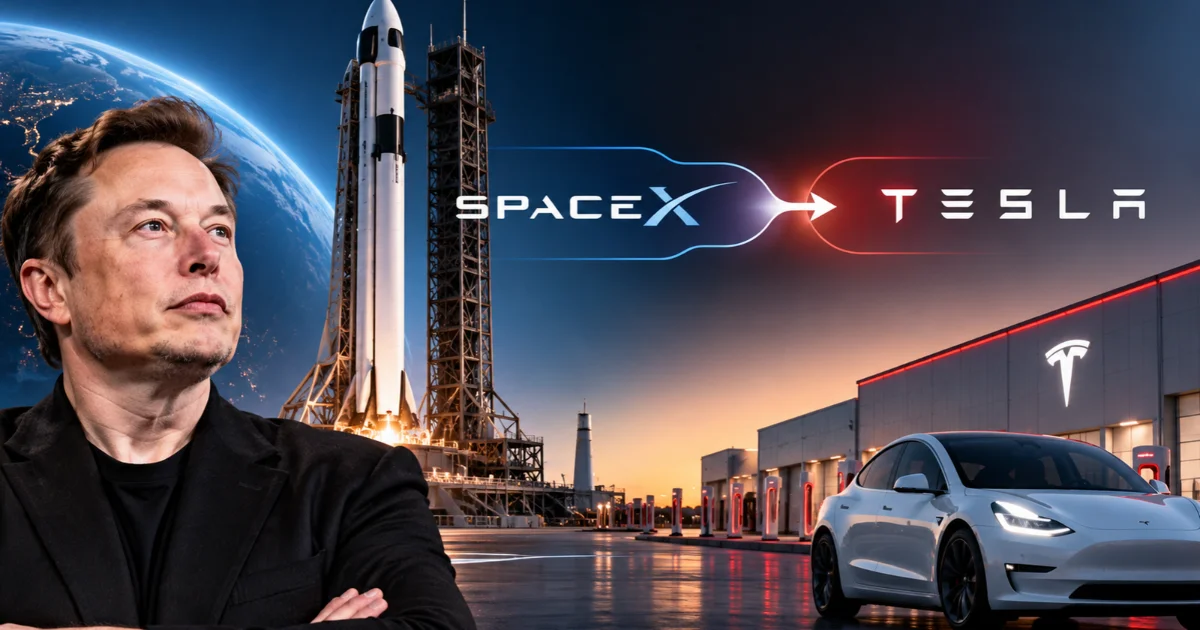

Corporate consolidations happen often. However, talks of a merger between SpaceX and Tesla mark a historic shift. For years, Elon Musk ran both firms as separate ventures. Even so, they shared key executives and engineering insights.
Now, leaders are actively evaluating a full combination. Both boards set up independent special committees to review the deal.
This proposal unites AI, robotics, chip production, satellites, and electric vehicles under one roof. If completed, the deal will create a massive corporate giant. It will connect Earth-based transportation with deep space exploration.
The Logic Behind a Trillion-Dollar Synergy
At first glance, building mass-market electric vehicles and launching reusable orbital rockets seem like entirely disparate missions.
However, a deeper look at the underlying technology reveals massive overlapping interests, particularly in the realms of artificial intelligence and advanced physical manufacturing.
Both organizations are already heavily invested in solving complex engineering bottlenecks that define the next generation of tech.
Tesla relies on bleeding-edge AI for its autonomous driving ambitions and the ongoing development of humanoid robots, while SpaceX continues to expand its own AI computing infrastructure to manage complex orbital logistics, rocketry telemetry, and the massive Starlink satellite network.
According to a recent report at outlook detailing how Elon Musk wants SpaceX and Tesla together, the two companies are already quietly collaborating on Terafab, a highly anticipated semiconductor manufacturing project.
Bringing these operations completely under one roof could dramatically streamline research and development, allowing top-tier engineering talent and capital to flow freely without the legal and administrative friction of inter-company agreements.
The financial scale of this proposed entity is staggering, with market estimates from financial analysts suggesting the combined business could be worth somewhere in the neighborhood of $3.5 trillion.
This valuation hinges on the premise that combining their technological moats makes them practically unassailable, creating a closed-loop ecosystem where silicon design, software engineering, and heavy manufacturing feed into each other seamlessly.
Governance and the Cost of Ambition
Despite the obvious technological synergies, executing a merger of this magnitude requires navigating a labyrinth of corporate governance and harsh financial realities. The fact that this deal might take the shape of SpaceX outright acquiring Tesla introduces intense scrutiny from the disparate shareholders of both entities.
Musk himself acknowledged the complexity of the situation during SpaceX’s third-quarter earnings call on October 20, noting that while he personally believes the merger is a solid strategy, the ultimate decision rests entirely with the special committees of both companies.
He explicitly stated that he is unable to participate in these critical deliberations because his dual leadership roles make him a conflicted party. This strict separation is absolutely crucial to avoid running afoul of regulatory bodies and to prevent aggressive investor lawsuits.
Beyond the boardroom politics, the operational reality of merging two capital-intensive beasts cannot be ignored.
Skeptics within the industry rightly question whether combining these businesses actually makes it easier to coordinate technology and capital investment, or if it merely lumps together two cash-hungry giants with wildly different commercial priorities and timelines.
Executing a unified AI strategy for businesses of this scale is precarious; funding the colonization of Mars and scaling affordable electric vehicles globally both require astronomical, sustained amounts of capital.
Tying their financial fates together means a severe misstep in one sector could potentially jeopardize the other. The success of this move will depend entirely on whether the shared technological backbone is strong enough to carry the immense weight of Musk’s dual ambitions.