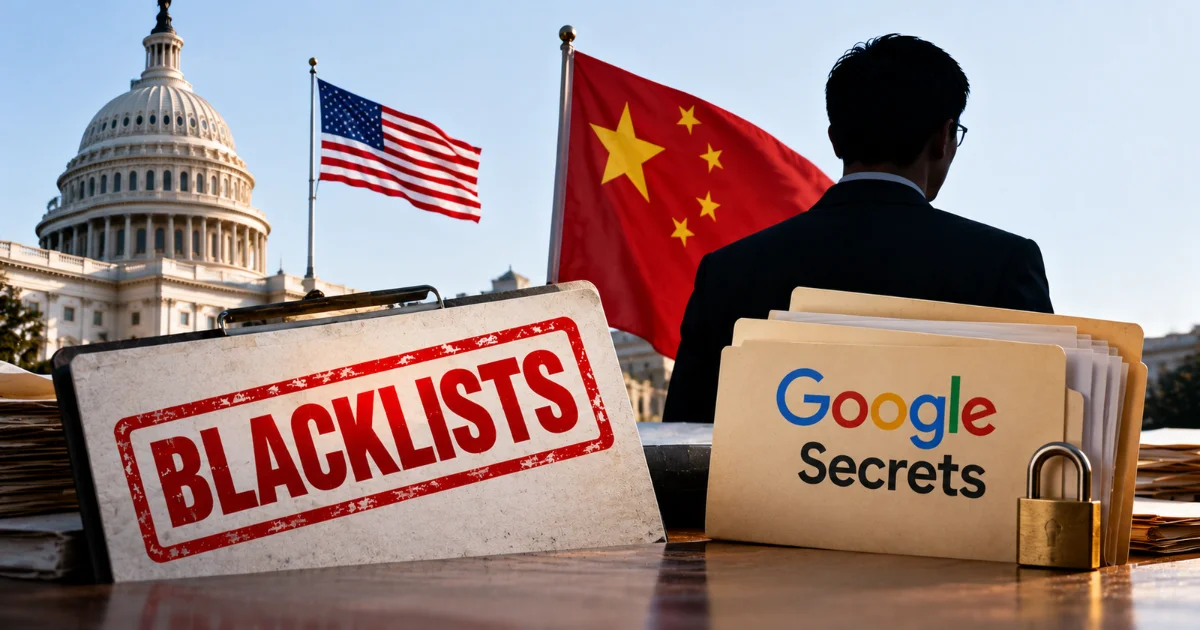

The geopolitical struggle over artificial intelligence dominance has officially reached venture capital boardrooms. The United States government recently took an aggressive regulatory stance. Specifically, it blacklisted MiraclePlus, a prominent Chinese investment firm founded by former Microsoft AI scientist Lu Qi.
This decisive sanction is directly tied to the high-profile conviction of Linwei Ding. Ding is a former Google software engineer who stole thousands of pages containing proprietary AI supercomputing documents.
By targeting an investment vehicle instead of just an individual engineer, Washington is signaling a fundamental shift in its enforcement playbook.
For years, officials focused mainly on restricting advanced semiconductor shipments. Now, the regulatory spotlight is targeting the financial pipelines that nurture rival ecosystems. As a result, any funding entity connected to stolen technology will face immediate economic isolation.
The Strategic Shift in Intellectual Property Defense
To understand this move, we must look at the tools the US State Department now uses. Officials levied these sanctions under the Protecting American Intellectual Property Act. This legislation gives the government sweeping power to cripple foreign entities involved in trade secret theft.
Consequently, placing MiraclePlus on this list triggers an immediate freeze of any US-based assets held by the firm. In addition, the penalty imposes strict international banking restrictions. These barriers effectively cut the firm off from the dollar-dominated global financial system.
According to a recent report detailing the technological implications of the sanctions on global markets at Times of India, MiraclePlus has been a high-profile backer of ambitious Chinese startups, including humanoid robotics company AgiBot and AI inference developer SiliconFlow.
The core of the issue traces back to Ding, who systematically transferred highly confidential internal files to his personal computer just weeks before tendering his formal resignation from Google in late 2023.
These vulnerabilities highlight how internal proprietary infrastructure is increasingly exposed to exfiltration, underscoring broader corporate concerns covered in AI Security Explained: Prompt Injection, Data Leaks & How to Prevent Them.
By penalizing the financial backers who stood to benefit from this illicit transfer of trade secrets, US authorities are establishing a precedent that the venture capital ecosystem cannot feign ignorance regarding the provenance of the technology it chooses to fund.
Ripples Across the Global Venture Capital Ecosystem
The broader implications of this blacklisting will force a massive recalibration of cross-border venture capital operations. Historically, early-stage technology investing has thrived on moving fast and capitalizing on the rapid migration of engineering talent between competing tech giants.
However, this regulatory maneuver fundamentally alters the risk calculus for institutional investors. Navigating these regulatory, compliance, and technological hurdles requires a much more disciplined AI Strategy for Businesses: How to Win While Competitors Waste Budget.
Furthermore, isolating an entity like MiraclePlus overnight sends a clear warning to other venture funds. Due diligence must now include rigorous forensic audits of every founder’s IP history.
In practice, these sanctions mean that any startup taking capital from a blacklisted fund becomes radioactive to Western partners and investors. This dynamic creates a containment zone around suspect capital.
As a result, foreign companies cannot easily commercialize stolen American research on the world stage.
In conclusion, US policy has weaponized the global banking system against trade secret theft. Catching the engineer who takes proprietary code is no longer enough.
The new strategy cuts off the capital needed to build a competing product. The tech race continues to accelerate, and financial networks are now just as critical to defense as hardware supply chains.