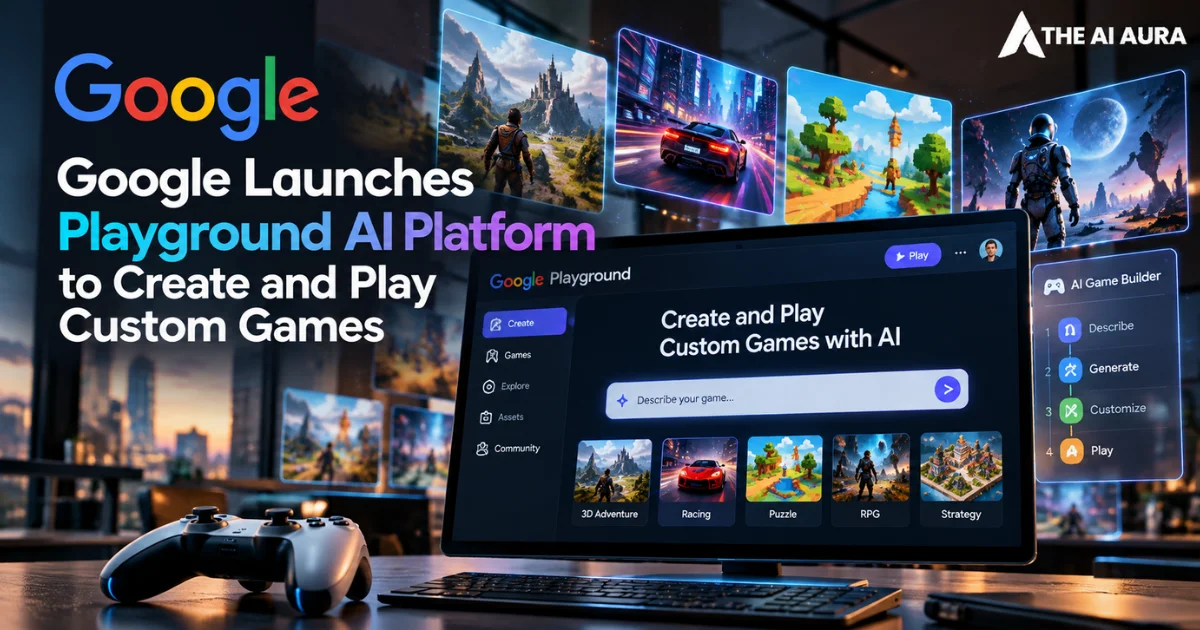

Game development once demanded a steep learning curve. Creators needed years of experience with complex engines, asset pipelines, and coding languages. Artificial intelligence is now breaking down that barrier.
It fundamentally reshapes how developers build interactive digital experiences. Google accelerates this shift with Playground, an experimental gaming platform. The tool transforms simple text prompts into fully playable games.
Creators no longer need to wrestle with code repositories or debug scripts. Instead, they can build, test, and share custom games through an intuitive conversational interface.
This strategic move signals a significant evolution in generative AI, aggressively pushing the technology past static image and text generation into the highly lucrative realm of dynamic, interactive media.
Lowering the Barrier to Game Development
Absolute accessibility and rapid iteration drive this new Google ecosystem. Playground lets anyone start from a blank canvas. Users can also remix starter prompts to quickly build a working prototype.
Creators can tweak game mechanics, adjust gravity, overhaul character designs, and rewrite physics rules. They simply type their requests directly into the engine. You maintain full creative control over the project. You can adjust variables in real time until the concept feels polished.
According to the detailed technical roadmap published on the official Google blog, the platform operates entirely within the web browser, meaning the games generated can be played seamlessly across laptops and mobile devices without requiring heavy client downloads.
The platform’s social architecture is equally robust. It centers on an expanding, searchable catalog of community-driven interactive content. Creators can keep projects private or generate direct links to challenge friends. They can also publish completed builds to the public Playground Explore gallery.
Google added multiplayer mechanics and live leaderboards for select genres to boost engagement. Players can claim custom handles through their Play Games profile and compete for top global rankings.
They can follow prompt engineers to discover new releases. Meanwhile, automated safety algorithms highlight top-rated community content.
The Bridge to Professional Engines with Unity Spark
While prompt-based generation is perfect for casual creators and rapid prototyping, Google clearly recognizes that highly successful concepts often outgrow their initial web-based limitations.
To address this technical ceiling, Playground will soon integrate directly with Unity Spark, providing a clear, uninterrupted pathway from amateur experimentation to professional-grade commercial development.
This upcoming architectural bridge will unlock high-fidelity 3D rendering capabilities, complex professional logic mechanics, and the raw performance flexibility of the underlying Unity runtime environment.
Developers can begin their creative journey with a basic text prompt in the Playground interface and seamlessly transition their successful project into a robust, immersive ecosystem backed by Unity’s world-class engine architecture.
This strategic hybrid approach ensures that the platform serves both as an accessible entry point for gamers and a legitimate, time-saving prototyping tool for serious game design studios.
Unity Spark is currently undergoing closed beta testing, paving the way for a broader rollout. For now, Playground is officially live as an early experiment for users aged eighteen and older in the United States.
Access to the tiered creation tools will be distributed based on users’ respective Google AI subscription levels, marking yet another step toward monetizing advanced generative capabilities. As the community begins pushing the boundaries of this platform, the traditional definition of a game developer is poised for a massive, irreversible expansion.