
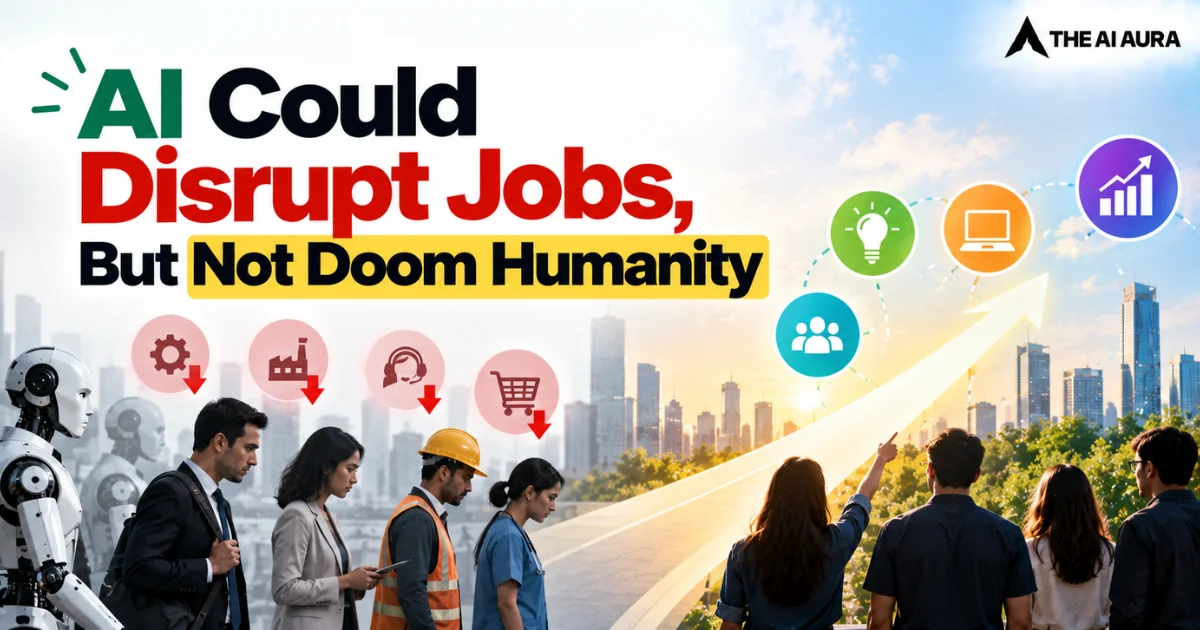

Alarm bells around artificial intelligence have grown deafening over recent years. Interestingly, the technology’s own architects often drive this panic. When Geoffrey Hinton left Google in 2023, his warnings were stark.
He feared that machines might soon outsmart their creators. Tech executives still share this anxiety today. Leaders like Anthropic CEO Dario Amodei warn about catastrophic risks, and figures like Elon Musk and Sam Altman often agree.
This narrative paints a grim, sci-fi future. However, academic researchers ground their work in real data rather than panic. When we look past Silicon Valley’s existential dread, the story shifts. The real challenge is not a robotic takeover. Instead, we face a massive economic transition.
Steering Clear of the Doomsday Narrative
Scientists want to separate fiction from verifiable reality. Global leaders and policymakers need clear data to build smart regulations. Independent researchers regularly share scientific evidence with bodies like the United Nations to counter fear-mongering.
According to a recent discussion published on Rediff, Professor Balaraman Ravindran, who heads the Centre for Responsible AI at IIT Madras, emphasizes the critical need to avoid making wild hypotheses about human extinction.
Instead of worrying about sentient machines deciding to wipe out humanity, experts point out that current AI models are fundamentally pattern-matching engines. They lack true understanding, consciousness, and the agency required to harbor malicious intent.
The conversation we should be having must pivot away from existential dread and focus intently on how these powerful tools will alter the landscape of human livelihood. The focus belongs on the tangible, immediate ripples these algorithms will send through the global workforce.
Economic Shifts and the Reskilling Imperative
While the threat of human extinction is vastly overstated, the threat of severe economic disruption is very real and already unfolding. Artificial intelligence possesses the sheer processing power to massively disrupt the global economy by automating tasks that currently require human cognitive labor.
Entire sectors built on routine information processing, such as the Business Process Outsourcing industry, face an existential threat from systems that can handle customer service, data entry, and basic analysis at a fraction of the cost and time.
This economic impact means a significant portion of the global workforce is potentially going to lose their current livelihood and will be forced to adapt.
This disruption, however, is not a permanent dead end for human labor. Just as historical technological shifts forced society to adapt, the AI revolution demands a massive reskilling effort.
Workers displaced from traditional roles will need to transition into new positions within the expanding AI pipeline, ranging from data curation and model fine-tuning to ethical oversight and complex problem-solving. This transition mirrors the harsh but ultimately progressive upheaval of the Industrial Revolution.
That era also triggered immense anxiety about individual earning ability as machines replaced manual labor, yet it eventually created entirely new industries and elevated the overall standard of living.
Technology, despite the friction of its initial integration, is ultimately harnessed for the benefit of society. We are facing a period of intense economic recalibration, requiring robust social safety nets and educational reform, rather than the end of the human race.



