
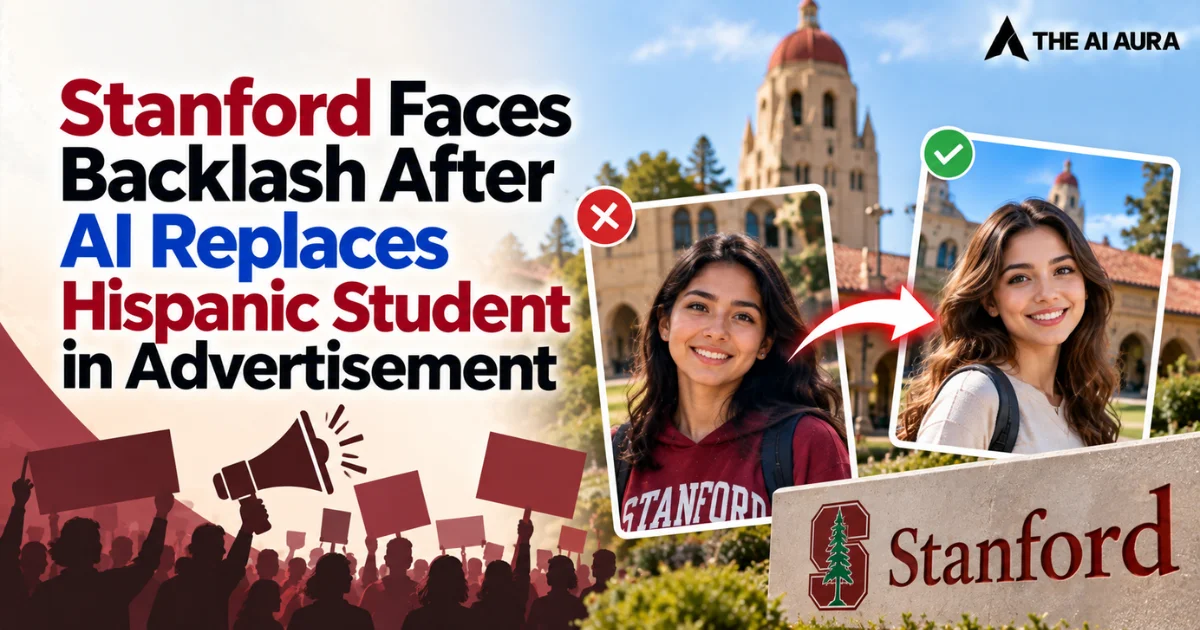

Stanford University is currently navigating a severe public relations crisis after a botched attempt to artificially manufacture diversity in its marketing materials sparked outrage across its campus.
The controversy centers around a promotional banner where the institution utilized generative AI tools to completely replace a Hispanic student with an AI-generated image of a Black woman, while simultaneously slimming down the physical appearances of two other students in the frame.
The original photograph was taken by a university photographer during a Lunar New Year celebration in 2024, capturing a genuine moment among peers. What was initially meant to be an authentic representation of campus life was instead quietly fed through an AI image generator to digitally alter the students’ fundamental identities, races, and body shapes to fit a predetermined marketing aesthetic.
The Reality of Digital Erasure
Billy Ramirez is a senior majoring in human biology. The university completely overwrote his identity in the photograph. Campus staff erected the modified promotional banners last week.
Students immediately reacted with sheer disbelief. Ramirez was driving back to school from his hometown. A friend sent him a side-by-side comparison. It showed the newly minted advertisement next to the original photo.
According to a recent report detailing the incident at NDTV, Ramirez found the situation to be a bizarre mix of dark comedy and genuine frustration.
He initially laughed at the sheer absurdity of a prestigious academic institution resorting to artificial intelligence to completely overwrite his race and gender for a dining hall advertisement.
However, that initial amusement quickly faded into valid disappointment. He expressed strong disagreement with the university. Administrators should not dictate how enrolled students visually appear.
The school effectively erased a real Hispanic student. They did this to project a fabricated campus image. This choice crossed a massive ethical line. It violated student consent and destroyed authentic representation.
Institutional Hypocrisy and the Diversity Dilemma
Backlash quickly intensified across the student body and social media platforms. This forced Stanford into full damage control. The administration issued a formal statement. They admitted to the digital manipulation. They acknowledged this stunt flagrantly violated established technological guidelines.
Stanford’s official AI policy is very clear. It explicitly prohibits using artificial intelligence to alter images. This applies to people, events, research, or facilities. The university stated the alteration was a clear breach of trust.
The lack of disclosure worsened the situation. They will now mandate additional training. The Residential and Dining Enterprises division must properly review future marketing materials.
This incident cuts much deeper than a simple administrative marketing blunder. It exposes a deeply troubling trend where higher education institutions are resorting to desperate, deceptive measures to artificially project an inclusive, highly curated image.
At a time when colleges across the United States are facing intense political pressure and national scrutiny regarding diversity initiatives, Stanford’s digital manipulation highlights the dangerous intersection of corporate marketing pressures and readily available AI image technology.
Universities are rushing to portray themselves as welcoming and accommodating but utilizing generative AI to fake that environment defeats the entire purpose of equity.
Instead of celebrating the actual diverse student body they already have, the university opted for a synthetic, algorithmic shortcut, ultimately alienating the very students they claim to value and severely damaging their institutional credibility in the process.