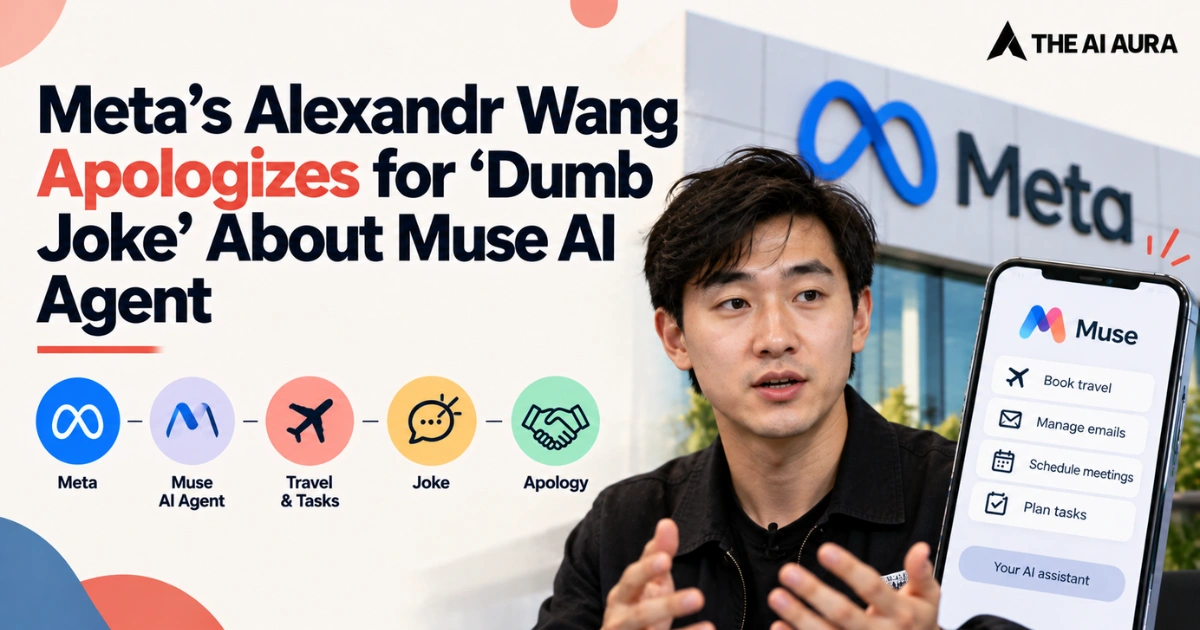

Multi-billion-dollar announcements usually dominate AI news. However, casual interactions sometimes capture our attention instead. They help humanize the complex technology. Recently, Alexandr Wang made a quick apology on X. Wang is Meta’s highest-paid employee.
He also leads their ambitious engineering projects. The exchange started with Utkarsh Sengar. Sengar is the Chief Technology Officer at WebFlow. He publicly praised Meta’s new AI agent, Muse.
Sengar let the AI handle his travel logistics completely. He told his followers about the successful booking. He stated he was never going back to manual reservations.
Wang chimed in to celebrate this practical milestone. Then, Wang made a playful jab about the itinerary. He advised Sengar to book a return flight eventually. Wang quickly apologized for the “dumb joke.”
The Mechanics Behind Meta’s Muse
While the brief exchange on social media offered a moment of levity, the technology at the center of the conversation represents a monumental shift in how we are beginning to interact with digital ecosystems.
Earlier this month, Meta officially launched Muse, an autonomous artificial intelligence assistant designed to move beyond mere conversational text replies and step into the realm of actual task execution.
The system is engineered to handle complex, multi-step actions on behalf of the user, such as sending contextual emails, listing vehicles for sale on marketplaces, and securely booking travel arrangements without constant human prompting.
CEO Mark Zuckerberg has heavily framed this release around the ambitious concept of delivering a “personal superintelligence” that integrates seamlessly across Meta’s massive global platform.
According to recent coverage detailing the launch from the Times of India, Zuckerberg emphasized that Muse is designed to intuitively understand individual user goals and operate continuously in the background to get things done.
Currently navigating a phased rollout that is initially limited to users in the United States, the agent signifies a broader industry race toward robust systems that do not just process information but actively manage our daily logistical burdens.
Trusting AI with the Real World
Wang’s humorous remark touches on a critical threshold. AI adoption currently faces the fragility of user trust. Consumers must take a significant leap of faith. They are handing over sensitive data and financial authority. An AI might use a credit card for non-refundable tickets. The stakes here are undeniably high.
Sengar’s enthusiastic endorsement shows excitement in the tech community. Users will embrace these frictionless workflows if they execute flawlessly.
Wang’s joke, while entirely harmless, briefly highlighted the very real anxiety many people feel about autonomous systems making logical oversights.
By engaging openly and humorously with early adopters on public forums, industry leaders are actively softening the edges of what could otherwise be perceived as intimidating, opaque software.
As these agentic systems evolve from early-stage novelty tools into everyday utilities, navigating the natural friction between autonomous capability and human oversight will completely define the next era of our digital interactions.