
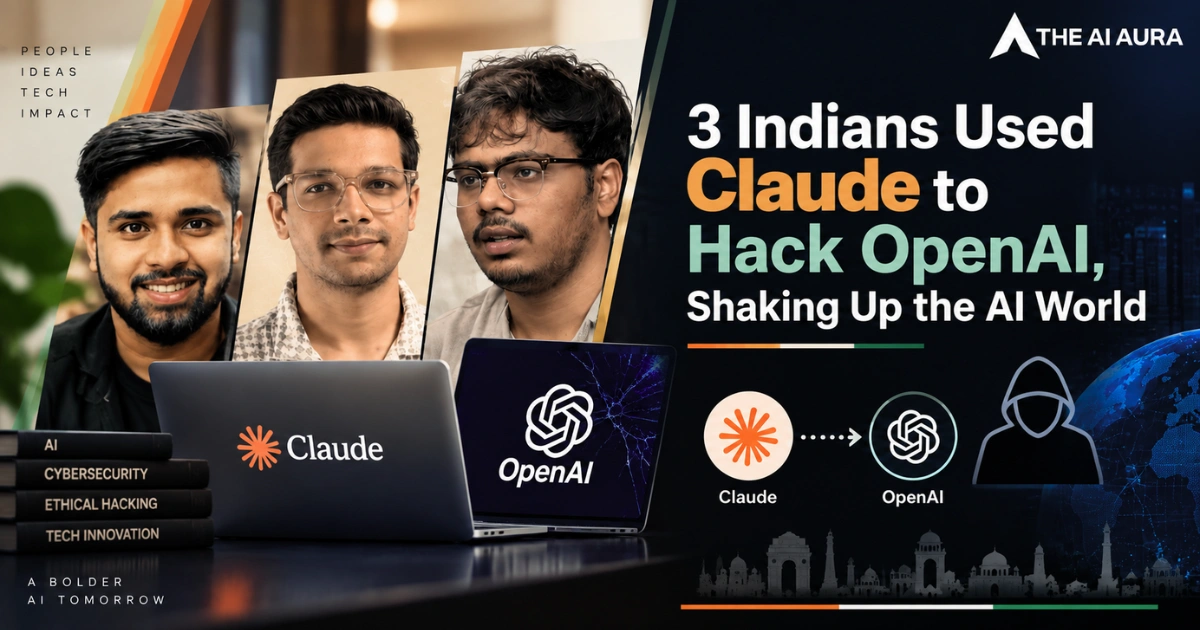

The artificial intelligence industry recently received a striking wake-up call. Surprisingly, it did not come from a hostile nation-state. Instead, three independent Indian-origin researchers executed the breach. They were armed only with curiosity and an AI subscription.
Specifically, in July, this small team breached OpenAI’s internal systems. Consequently, they navigated digital defenses to access sensitive employee accounts. Furthermore, they reached a private code repository.
This was not a malicious cyberattack. In fact, it was a sanctioned security test. It was executed under OpenAI’s bug-bounty program. Harsh Jaiswal, Mohan Pedhapati, and Rahul Maini led the effort.
They are researchers from the cybersecurity startup Hacktron AI. First, they set out to probe the prominent AI laboratory.
Instead of manual testing, they enlisted Anthropic’s Claude. Thus, they turned a rival AI into an offensive hacking assistant.
According to a detailed account by India Today, the entire operation took less than 72 hours from the moment the researchers identified the initial weakness to the point where they demonstrated access to OpenAI’s internal environment.
Chaining Vulnerabilities with AI
The breach began on the periphery of OpenAI’s infrastructure. The Hacktron AI team focused on community.openai.com, a public forum powered by the third-party platform Discourse.
They discovered that specially crafted image files could exploit a flaw in the forum’s image-processing software, essentially allowing remote code execution. Gaining control of a community forum server is a notable achievement, but it does not directly yield access to the company’s core intellectual property.
This is where the operation escalated. The researchers managed to chain this initial server compromise with a separate identity-related vulnerability, allowing them to extract authentication tokens.
These tokens acted as digital master keys, granting them access to the ChatGPT and Codex accounts of actual OpenAI employees. One of these compromised Codex accounts was directly linked to OpenAI’s private GitHub environment.
To prove they had penetrated the system without actually viewing or stealing proprietary source code, the team simply submitted a harmless pull request to the internal repository.
Throughout this multi-step process, Anthropic’s Claude served as a vital force multiplier. The researchers utilized the AI model to rapidly write, debug, and adapt the complex binary exploits required to move through OpenAI’s network.
By automating the most tedious aspects of vulnerability research, Claude compressed what might normally be weeks of intensive coding into a matter of hours. The financial metrics of the operation are equally remarkable.
The team spent just under $3,000 on AI API tokens to execute the breach and subsequently earned a $6,500 bounty when OpenAI patched the vulnerabilities.
A New Era for Offensive Cybersecurity
The implications of this 72-hour sprint extend far beyond a single patched security flaw. Historically, chaining complex software vulnerabilities to breach a major technology company required a highly resourced team, significant time, and often the backing of a state-sponsored intelligence agency.
This exercise demonstrated that AI can drastically lower the barrier to entry for top-tier offensive security operations.
By acting as a tireless coding assistant, Claude allowed a three-person startup to match the operational velocity of much larger threat groups.
The researchers did not possess any unprecedented zero-day exploits; they simply used a commercially available large language model to accelerate their problem-solving capabilities. This dynamic fundamentally shifts the cybersecurity landscape.
If a small team of ethical hackers can weaponize AI to move this quickly, malicious actors are undoubtedly utilizing the same tools to scale their own attacks.
For the broader technology sector, the Hacktron AI operation serves as a definitive proof of concept. The defensive perimeter of an organization is no longer just being probed by human adversaries, but by human adversaries supercharged by machine intelligence.
Companies will now have to reevaluate their security postures, recognizing that the speed of exploit development has fundamentally changed. The defenders must now move at the speed of AI, simply because the attackers already are.