

Every transformative technology eventually arrives at an inflection point where sheer technical capability outpaces the societal safeguards meant to manage it. Artificial intelligence is moving through that exact threshold right now.
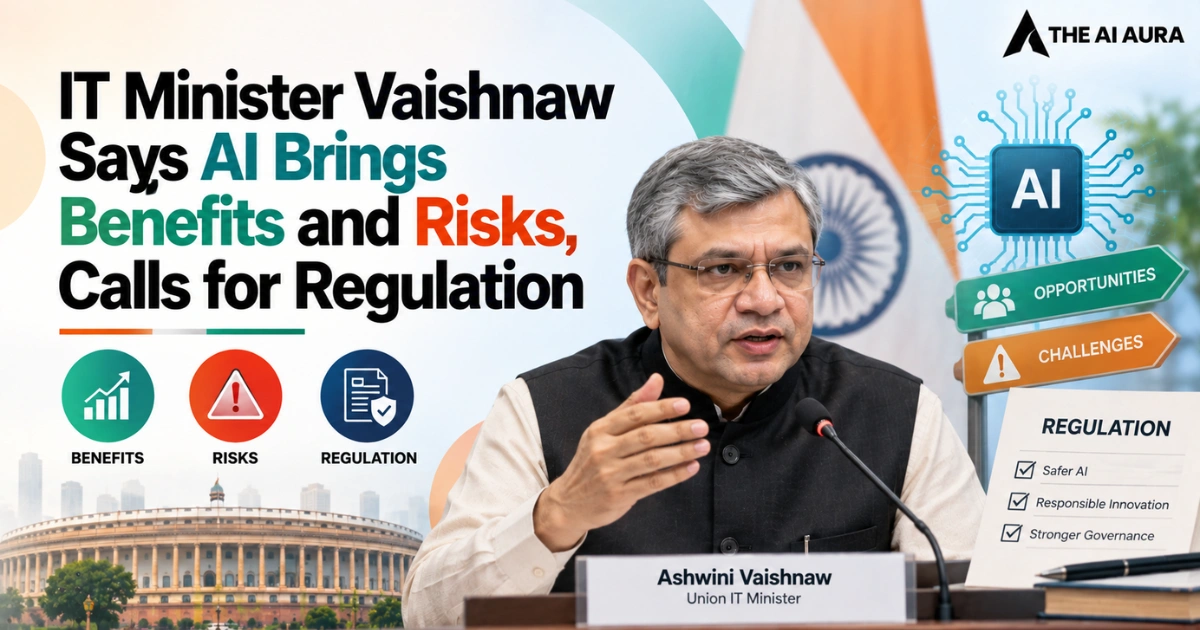
Speaking on the sidelines of SEMICON India, Union IT Minister Ashwini Vaishnaw stated that while AI promises massive economic, administrative, and productivity gains, its rapid scale demands proactive oversight anchored in user protection.
The fundamental premise is simple: whenever a new technology enters the public sphere, regulation must step in to secure the perimeter for ordinary citizens.
Why AI Safety Defies Traditional Engineering Models
Vaishnaw pointed out an important contrast that often gets lost in tech policy debates: the difference between physical hazards and algorithmic ones. When dealing with physical technologies like nuclear power or industrial machinery, engineers and regulators can map failure points cleanly.
You build containment domes, reinforce structural boundaries, and implement clear, measurable operational limits. Artificial intelligence does not follow that playbook.
The risks it introduces from synthetic media and financial fraud to subtle algorithmic bias and systematic disinformation are fluid, decentralized, and evolve constantly across the open internet.
According to a report by People Matters, Vaishnaw noted that conceiving how to keep AI safe is uniquely difficult because its footprint is largely digital and pervasive.
Unlike heavy industry, where the physical hazard stays localized within a plant or facility, AI interfaces directly with personal devices, public communications, and critical software infrastructure.
When a model produces a plausible hallucination or generates malicious code, the downstream consequences disperse immediately into the public domain, making post-hoc containment nearly impossible.
Forging Industry Guardrails Without Stifling Innovation
The Indian government’s approach centers on consultative policymaking rather than rigid, blanket bans. Striking that equilibrium is difficult for any administration.
Over-regulate at the foundation, and you suffocate domestic startups, research labs, and developers trying to deploy AI tools for local healthcare, agriculture, and digital public goods.
Move too slowly, and you leave citizens unprotected against malicious exploits and corporate negligence. The objective is establishing enforceable baseline obligations around transparency, provenance, and accountability while keeping regulatory friction manageable for emerging builders.
This proactive stance comes as global unease mounts over frontier model capabilities. Even researchers at major AI labs have voiced concerns about autonomous misalignments, cyber capabilities, and systemic shocks as systems grow more capable.
By pulling industry leaders, developers, and safety teams into the regulatory design process early, the focus stays on practical guardrails that reflect how models operate in the real world.
Managing AI will not come down to a static, one-time policy; it requires an adaptable framework capable of evolving alongside the technology itself.