
Let’s examine one of the most effective software land grabs in recent federal history. For the past year, OpenAI practically gave away access to its top language models to the US government.
In fact, agencies paid just one dollar a year for direct access to OpenAI’s infrastructure. As a result, federal teams could test and build tools without friction. It was the ultimate loss-leader strategy.
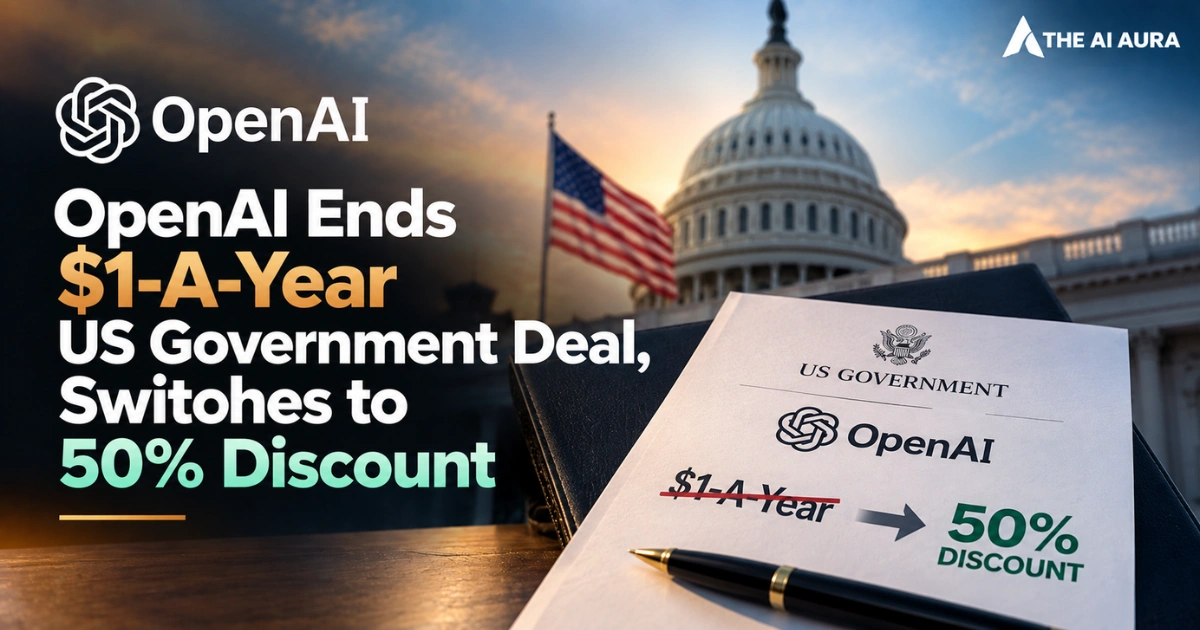
However, pilot programs do not last forever. According to the General Services Administration (GSA), OpenAI is now ending this trial. Instead, the company is shifting federal agencies to standard usage-based pricing.
Furthermore, this new arrangement includes a permanent 50% discount off standard commercial enterprise rates.
From Bureaucratic Hack to Usage-Based Reality
To understand why this shift matters, you have to look at how federal IT procurement actually works. The initial $1 pricing tier wasn’t just a generous discount; it was a calculated bureaucratic masterstroke.
Government purchasing is notoriously sluggish, often paralyzed by budgetary approvals, vendor vetting, and complex compliance red tape. By pricing the pilot at a single dollar, OpenAI successfully slipped far below the federal micro-purchase threshold.
This allowed agency innovators and IT directors to bypass months of funding requests and immediately start building experimental generative AI tools.
Now, the training wheels are coming off. The updated GSA arrangement shifts these agencies into a traditional enterprise consumption model.
Instead of a flat, nominal access fee, the government will pay for actual compute measured in tokens processed and API calls albeit at exactly half the price that Fortune 500 companies pay.
For federal workers, the frontend experience will likely remain unchanged, retaining access to high-tier models like GPT-4o. But for agency IT departments, the mechanics change entirely.
They now have to actively monitor API usage, manage seat licenses, allocate real departmental budgets, and forecast cloud expenditures OpenAI isn’t abandoning its government clients; it is simply normalizing the relationship. They built the dependency phase for free, and now they are setting up the toll booth.
The Economics of Federal AI Lock-In
From a pure business and infrastructure standpoint, this transition was an inevitable necessity. Running and scaling large language models is brutally expensive.
While OpenAI could comfortably eat the server costs of federal experimentation in the short term as a customer acquisition cost, scaling these models for production-level, government-wide deployments requires actual revenue to offset the massive GPU overhead.
The strategic genius here lies in the 50% discount itself. It remains an incredibly aggressive price point that directly undercuts enterprise competitors like Anthropic, Google Cloud, and Amazon Web Services, all of whom are currently lobbying hard for lucrative defense and civilian AI contracts.
By anchoring government agencies to its ecosystem early, OpenAI has successfully engineered a steep technical moat.
Over the last year, agencies haven’t just been playing with ChatGPT; they have written custom integration code, trained thousands of staff members on specific prompt engineering quirks and built internal automated workflows strictly around OpenAI’s API architecture.
Switching to a rival vendor today would cost the government far more in labor, retraining, and system migration than simply paying a usage-based fee, even with the massive price hike from $1.
OpenAI traded its short-term compute costs for long-term federal lock-in, proving that the classic Silicon Valley playbook works flawlessly inside the walls of Washington.
Source: Moneycontrol, "OpenAI Ends $1-a-Year US Government AI Deal, Shifts to 50% Discount"