
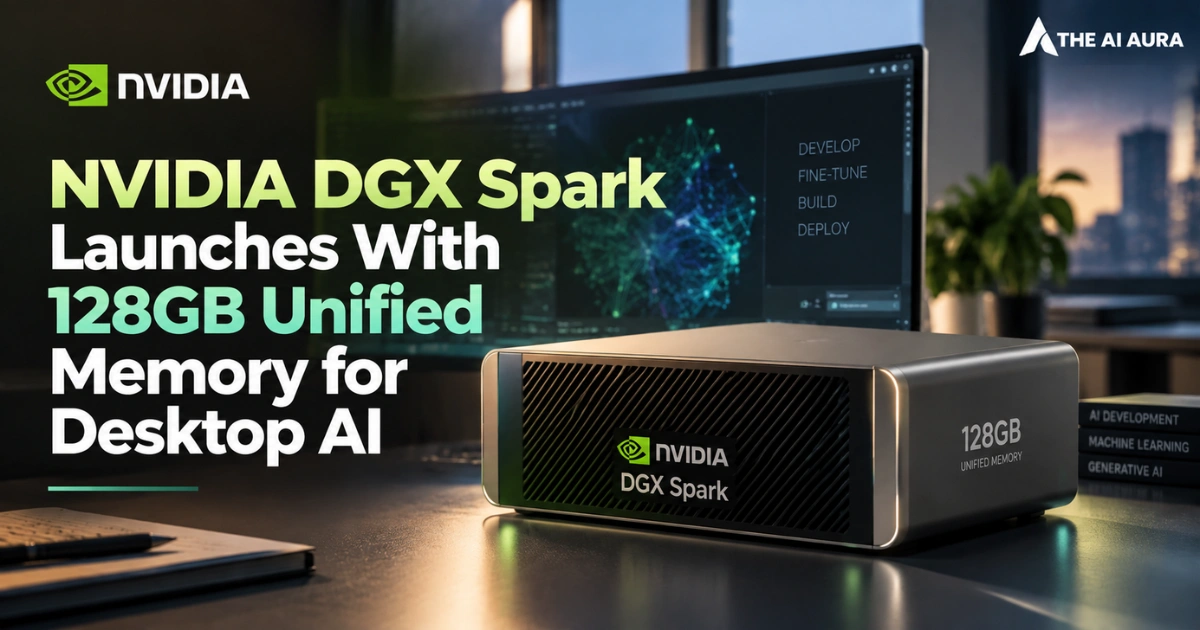

Running massive AI models locally has always created frustrating bottlenecks. Most of these limits stem directly from VRAM shortages. Cloud compute solves hardware shortages.
However, it introduces network latency, serious privacy risks, and unpredictable monthly bills. NVIDIA designed the DGX Spark to bridge this gap. This compact desktop workstation powers local-first AI development.
The system runs on the GB10 Grace Blackwell Superchip. This chip pairs a custom 20-core Arm processor with NVIDIA’s newest architecture. Yet, the silicon itself isn’t the most disruptive element of the launch.
The defining feature of the DGX Spark is its massive 128GB pool of coherent unified memory. It eliminates the barrier between standard system RAM and dedicated GPU VRAM. As a result, developers can run enterprise models right at their desks. NVIDIA brings true data-center power into a quiet desktop footprint.
How 128GB Unified Memory Transforms Local Workloads
A typical high-end PC relies on a discrete graphics card with its own isolated memory bank usually capping out at 24GB on top-tier consumer hardware. Constantly moving massive datasets between the system RAM and the GPU across a PCIe bus introduces a latency penalty that severely bottlenecks large model inference.
The DGX Spark bypasses this architectural flaw entirely. Because the Arm CPU and the Blackwell GPU share the exact same 128GB memory pool simultaneously, data never needs to be copied back and forth.
This shift completely rewrites what engineers can accomplish offline. The DGX Spark can natively run inference on models boasting up to 200 billion parameters.
More impressively, it can handle local fine-tuning for models up to 70 billion parameters a task that previously mandated expensive cloud instances. For research teams pushing beyond those limits, two independent DGX Spark units can be physically bridged over a ConnectX-7 interface.
This link pools their hardware resources together, scaling the capacity up to staggering 405-billion-parameter models while keeping proprietary training data completely air-gapped and off the internet.
Enterprise Server Architecture in a Desktop Form Factor
Look past the sleek chassis, and the DGX Spark is essentially a scaled-down enterprise server. It utilizes advanced 2.5D multi-die packaging and high-speed NVLink-C2C interconnects to maintain extreme bandwidth between components.
It runs on the DGX Base OS and natively supports NVIDIA’s complete professional software stack, including NVFP4, CUDA, TensorRT, and vLLM. This parity is crucial: developers can build, tweak, and test an application entirely on their desktop workstation, then deploy that exact same container to a massive cloud cluster without altering a single line of environment code.
The primary barrier to entry is the pricing reality. Launching at $4,699 directly from NVIDIA, the workstation is noticeably higher than its initially projected $3,999 price tag. NVIDIA attributes this premium to severe, ongoing global memory supply constraints.
At this tier, the system is locked in direct competition with custom RTX 4090 desktop builds and upcoming Ryzen AI Halo systems. However, for organizations handling sensitive health data, proprietary financial algorithms, or strict government contracts, the math changes.
When absolute privacy is legally mandatory and cloud computing costs are highly volatile, investing upfront in 128GB of local unified memory becomes a necessary infrastructure upgrade rather than a luxury purchase.
Source: Softonic, "NVIDIA DGX Spark Is Now Available: Desktop AI With 128GB Unified Memory"