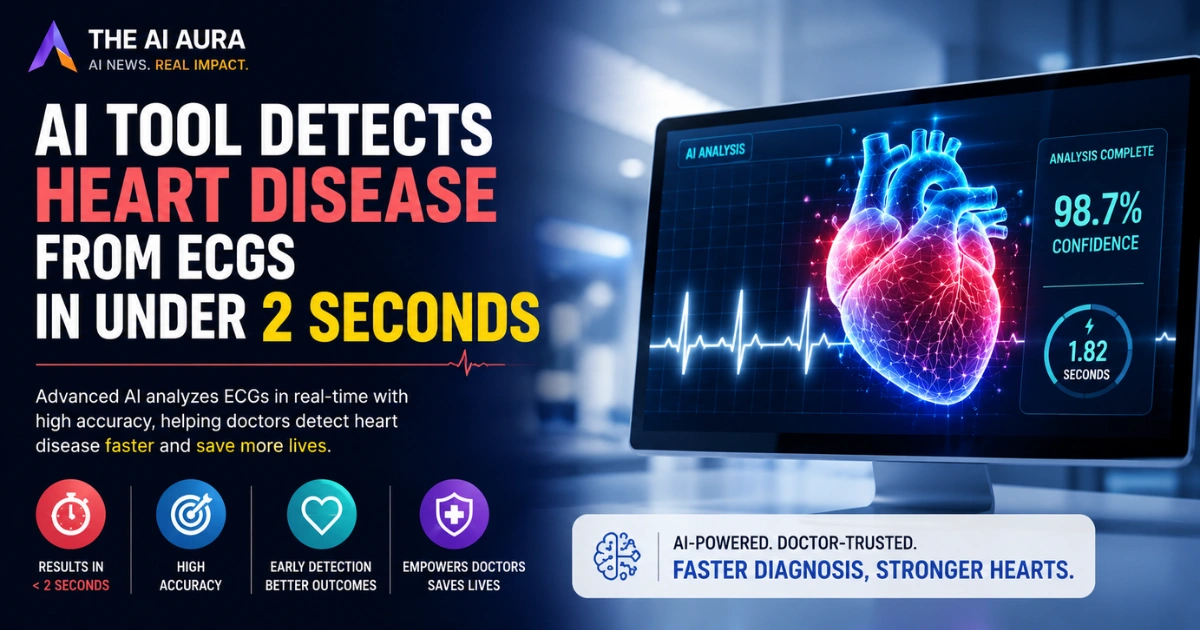

A new artificial intelligence model detects heart failure and valve disease in under two seconds. It reads standard electrocardiograms (ECGs) to spot hidden cardiac issues. The British Heart Foundation funded the research.
Researchers from Imperial College London presented the breakthrough at the European Society of Cardiology congress. The system bypasses traditional diagnostic bottlenecks by extracting structural disease markers directly from electrical rhythm tests.
How the Algorithm Sees What Cardiologists Cannot
For a century, doctors relied on standard ECGs to diagnose arrhythmias and heart attacks. However, standard ECGs cannot reveal structural damage like valve failure.
Clinicians normally require an echocardiogram to detect these structural defects. Unfortunately, patients often face months-long waiting lists for specialized cardiac ultrasounds.
This AI model bridges the diagnostic gap with superhuman precision. It analyzes electrical waveforms at a microscopic scale.
Researchers trained the algorithm on millions of historical patient records. As a result, the tool spots subtle electrical shifts that signal physical damage to the heart muscle.
During a recent clinical trial involving 67,000 patients in the United States, the tool demonstrated exceptional accuracy for an electrical-based screening method:
- Successfully identified up to 81% of patients suffering from heart failure.
- Successfully identified up to 90% of patients with undetected heart valve disease.
- Generated comprehensive diagnostic risk readouts in under two seconds.
While researchers at Imperial College London describe the system as “superhuman,” it is not designed to replace the echocardiogram. Instead, it acts as an ultra-fast triage mechanism to ensure critical patients get the imaging they need immediately, illustrating how AI won’t replace your team — but it will replace your workflow.
Transforming Hospital Triage and Opportunistic Screening
The tool immediately improves clinical workflow. Emergency teams run an ECG as soon as a patient arrives with chest pain.
If the algorithm flags structural disease, doctors can fast-track the patient for an urgent ultrasound. This prevents critical patients from waiting on standard queues while their condition worsens.
The technology also introduces a massive opportunity for opportunistic diagnosis. Because an estimated one billion ECGs are performed globally each year often for routine pre-operative checks, sports physicals, or unrelated symptoms the AI can run silently in the background of hospital IT networks.
It can scan every incoming ECG automatically, flagging high-risk individuals who are entirely asymptomatic and unaware they possess a deteriorating heart condition.
The engineering team is currently working to compress the system’s computational footprint.
The next immediate goal is integrating this predictive model directly into handheld ECG readers proving why bigger AI models don’t always mean better AI when point-of-care accessibility is required allowing primary care physicians and paramedics to detect complex structural heart diseases on the spot.
Source: The Guardian, "'Superhuman' AI Tool Spots Heart Disease in Less Than 2 Seconds"