

If there’s one demographic pushing the boundaries of generative AI, it’s students. Walk into almost any high school or college, and you’ll find teenagers using chatbots to decode complex physics concepts, brainstorm essays, or debug strings of code.
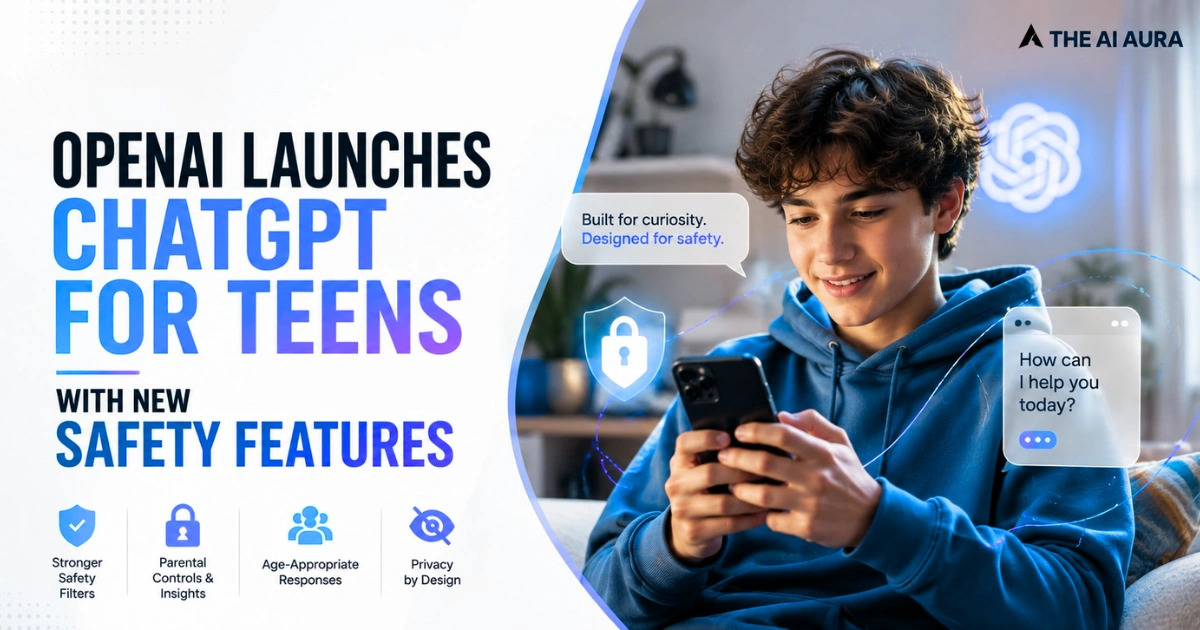
OpenAI has clearly been watching this trend. On Tuesday, the company officially launched a tailored “ChatGPT for Teens” experience, specifically designed for users aged 13 to 17.
Instead of relying purely on honor-system age gates, the platform now automatically activates this specialized environment if its internal systems estimate a user falls under the age of 18.
The shift isn’t just a simple interface update; it’s a fundamental change in how the AI interacts with younger minds, driven largely by the reality that teenagers are already among the most active power users of the technology.
How the New Safety Guardrails and Parental Controls Actually Work
The core of this new teen-centric ecosystem is a hardened set of safety guardrails. Pragya Misra, OpenAI’s head of strategy and global affairs in India, noted that internal consumer research made it obvious: students in schools and colleges dominate the platform’s usage.
The company’s goal was to preserve the full, unhindered AI experience while layering in active protections.
Functionally, this means strict, automated blocks on content depicting self-harm, violence, dangerous activities, or sexually explicit material. But the more significant shift for families is the introduction of a parent-loop.
Parents can now directly link their own OpenAI accounts to their teenager’s profile. This isn’t designed as a full surveillance tool, but rather for managed oversight.
Parents can enforce “Quiet Hours” to prevent late-night usage and will receive targeted safety notifications if the system flags specific, high-risk situations.
OpenAI is also addressing the digital fatigue inherent in modern tech consumption. The system now actively monitors session lengths, deploying frequent reminders for teenagers to step away and take a screen break during extended, continuous conversations with the chatbot.
Beyond the Blocks: Study Mode and the Push for AI Literacy
Restricting harmful content is only half the strategy; the other half is teaching teenagers how to use AI as a collaborative tool rather than a shortcut. This ties directly into the “study mode” OpenAI introduced last July, which forces the chatbot to act more like a Socratic tutor.
Instead of simply spitting out the final answer to a math problem, it actively guides the student through the methodology and underlying concepts.
This educational pivot is currently playing out on a massive scale. India, which ranks as one of the world’s most advanced markets for AI adoption in coding, data analysis, and complex reasoning, is serving as a major focal point.
Through the India-first OpenAI Learning Accelerator, the company recently distributed 500,000 free, six-month ChatGPT licenses to students and educators across government schools and technical institutes.
These initiatives aim to build genuine AI literacy and confidence from the ground up. Right now, there is a growing global debate and several legislative pushes to ban or severely limit technology access for children under 16. Misra points out that these reactionary policies usually stem from a fundamental lack of understanding of what AI actually is.
By building a secure, educational environment directly into the platform, OpenAI is making a clear counterargument: the safest way to protect teenagers from AI isn’t to ban them from using it, but to teach them how to master it safely.
Source: Official Rediff, "OpenAI Launches ChatGPT For Teens"