
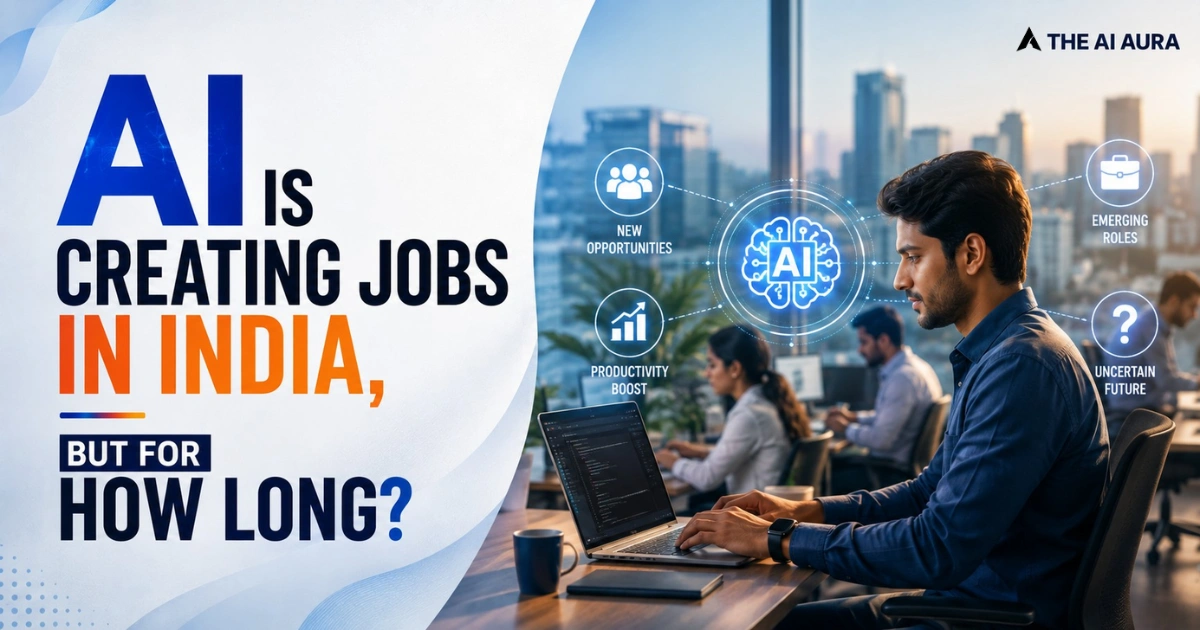

When we think of the artificial intelligence revolution, the imagery that typically comes to mind involves sleek server farms in Silicon Valley or heavily funded startup incubators in Bengaluru. However, the real foundation of modern AI is currently being built in much quieter corners of the world.
In Tier-2 and Tier-3 Indian cities like Karur, a massive workforce has quietly emerged to support the backbone of global machine learning.
Thousands of young professionals and graduates in these regional hubs are securing full-time employment not as software developers, but as data annotators.
Companies operating in these towns are tapping into a localized, educated talent pool to perform the heavy lifting required to make AI functional.
These workers spend their days attaching metadata to raw information drawing bounding boxes around vehicles for self-driving car algorithms, categorizing text sentiment for chatbots, and tagging audio files for voice recognition software.
The immediate economic impact is undeniable. These AI jobs are decentralizing tech wealth, moving it away from the saturated metros of Chennai and Hyderabad, and bringing steady paychecks to smaller towns. Yet, this localized economic boom carries an inherent paradox.
The entire purpose of this labor is to train algorithms to become smart enough to no longer need human intervention. This raises a critical question for the rural and semi-urban Indian tech workforce: is this a sustainable career path or a temporary bridge to full automation?
The Mechanics of India’s Data Annotation Boom
Artificial intelligence is notoriously data-hungry, but raw data is effectively useless without context. Algorithms do not inherently know what a pedestrian looks like or whether a customer service email is angry or polite.
They learn through a process called supervised learning, which heavily relies on a “human-in-the-loop” model.
In facilities across Karur, Coimbatore, and Durgapur, annotators work through specialized software interfaces to manually label image, video, text, and audio data.
If an autonomous driving startup in San Francisco needs its car to recognize a traffic light in heavy rain, human workers in India feed the model thousands of accurately labeled examples of exactly that scenario.
These Tier-2 cities have become strategic goldmines for AI data solutions due to their unique combination of affordable operational costs, high-speed internet penetration, and a motivated workforce capable of maintaining sharp focus on repetitive tasks.
By pushing operations into smaller towns, data service providers can offer global tech giants massive scalability while maintaining competitive pricing. For the employees, it offers an entry point into the tech ecosystem without the crippling cost of living associated with major IT corridors.
It is a mutually beneficial arrangement that is currently thriving, driven by the insatiable demand for highly accurate training datasets.
The Shrinking Shelf Life of Manual Labeling
Despite the current hiring spree, the foundational mechanics of AI suggest that basic data annotation is a self-obsoleting industry.
Every bounding box drawn and every audio file transcribed makes the underlying machine learning model incrementally better. Eventually, the software reaches a point where it can accurately label standard data on its own.
We are already seeing a shift toward self-supervised learning and the use of synthetic data where AI generates its own training sets which dramatically reduces the need for basic human input.
This does not mean data annotation will vanish overnight, but the nature of the job is going to evolve aggressively. As basic categorization becomes fully automated, the human workforce will be forced to handle only the “edge cases” highly complex, nuanced scenarios that confuse the AI.
Future roles will pivot toward quality assurance and Reinforcement Learning from Human Feedback (RLHF), where workers evaluate the logic, safety, and cultural accuracy of AI outputs rather than just labeling raw inputs.
For the workforce in Karur and similar hubs, the clock is ticking. The survival of this localized tech boom depends entirely on upskilling.
Workers who currently perform simple data entry must transition into subject matter experts capable of auditing AI logic. The jobs exist today in abundance, but the window to leverage them into long-term tech careers is narrowing.
Source: Official The New York Times, "AI Jobs, Data Annotation and India’s Karur"